

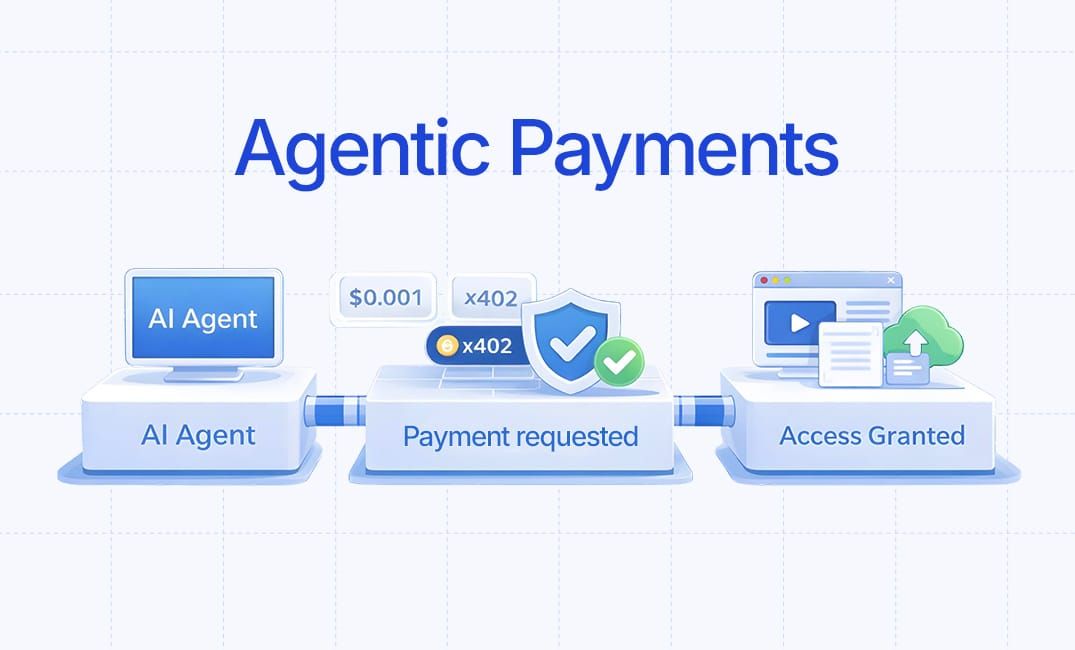
E-commerce is shifting from clicks to autonomous execution. As AI agents become capable of planning and taking actions across tools and websites, payments are becoming the key bottleneck and the biggest infrastructure opportunity.
This guide maps the agentic payments landscape (cards, fintech platforms, stablecoins, open protocols), explains the hard technical problems, and shows why HTTP-native standards like x402 are emerging as the pragmatic foundation for machine-to-machine commerce.
In a nutshell
- Agentic payments are transactions initiated, negotiated, and completed by AI agents under delegated policies, without a human approving every step.
- Legacy rails (cards/ACH) are strong for consumer trust and acceptance but struggle with micropayments, real-time agent negotiation, and frictionless machine identity.
- The market is splitting into proprietary agent payment stacks (networks/platforms) vs. open standards that work across agents and merchants.
- x402 is an open standard around“Payment Required” for the web: an API can respond with HTTP 402 + machine-readable payment terms, the agent pays via stablecoins, and the server fulfills the request.
- PayAI Network facilitates x402 adoption and tooling so developers can monetize APIs and build agent-native commerce flows.
What Are Agentic Payments?
Agentic payments are payments initiated and completed by autonomous AI agents on behalf of a human, a business, or another agent, based on predefined rules instead of manual, per-transaction approval.
Unlike “API-triggered payments” (where software simply calls a payments API after a human already chose what to buy), agentic payments require the agent to handle the full commercial loop:
- Discover and compare options (price, availability, shipping, SLAs)
- Authenticate and prove authorization (who am I, who do I represent, what am I allowed to do?)
- Negotiate or select terms in real time
- Settle instantly: often in tiny increments (per API call, per second, per token)
This shift is showing up in industry research as a move from manual authorization to policy-driven machine execution, where agents act under user-defined constraints and should be linked to verifiable identity credentials.
Agentic AI and the Shift from Clicks to Commands
Agentic AI refers to goal-oriented systems that can plan multi-step actions and use tools (browsers, APIs, wallets, databases) to complete tasks end-to-end.
That’s now common for research, coding, and scheduling. But commerce breaks down at the moment of payment:
- An agent can find the best product or flight.
- It can even fill in forms.
- But paying often triggers CAPTCHAs, 3DS flows, account creation, and identity checks that were designed for humans, not autonomous software.
OpenAI’s “computer-use” approach illustrates the state of the art: Operator can complete real web tasks, but reliability is still uneven: e.g., reported benchmark results include 38.1% on OSWorld, 58.1% on WebArena, and 87% on WebVoyager. Even when UI automation works, it’s not a stable foundation for machine commerce at scale.
Why Traditional Payment Rails Fail AI Agents
Cards and bank rails are excellent at what they were built for: consumer purchases, fraud management, and widespread merchant acceptance. But AI agents expose structural mismatches:
Human-first identity and sessions: traditional flows assume logins, account ownership, and interactive sessions—friction that conflicts with 24/7 autonomous agents.
Micropayment economics don’t work: card transactions commonly include fixed fees on the order of $0.10–$0.30 per transaction, plus percentage fees, which makes sub-dollar and sub-cent pricing impractical. Analyses of card economics often point to a fixed “around $0.30” expectation that breaks agent-style micro-transactions.
No native price discovery in HTTP: the web request/response cycle has no standard way for a server to say “pay X to continue,” and for a client to pay automatically without a bespoke integration.
The Agentic Payments Landscape: Who Is Building What
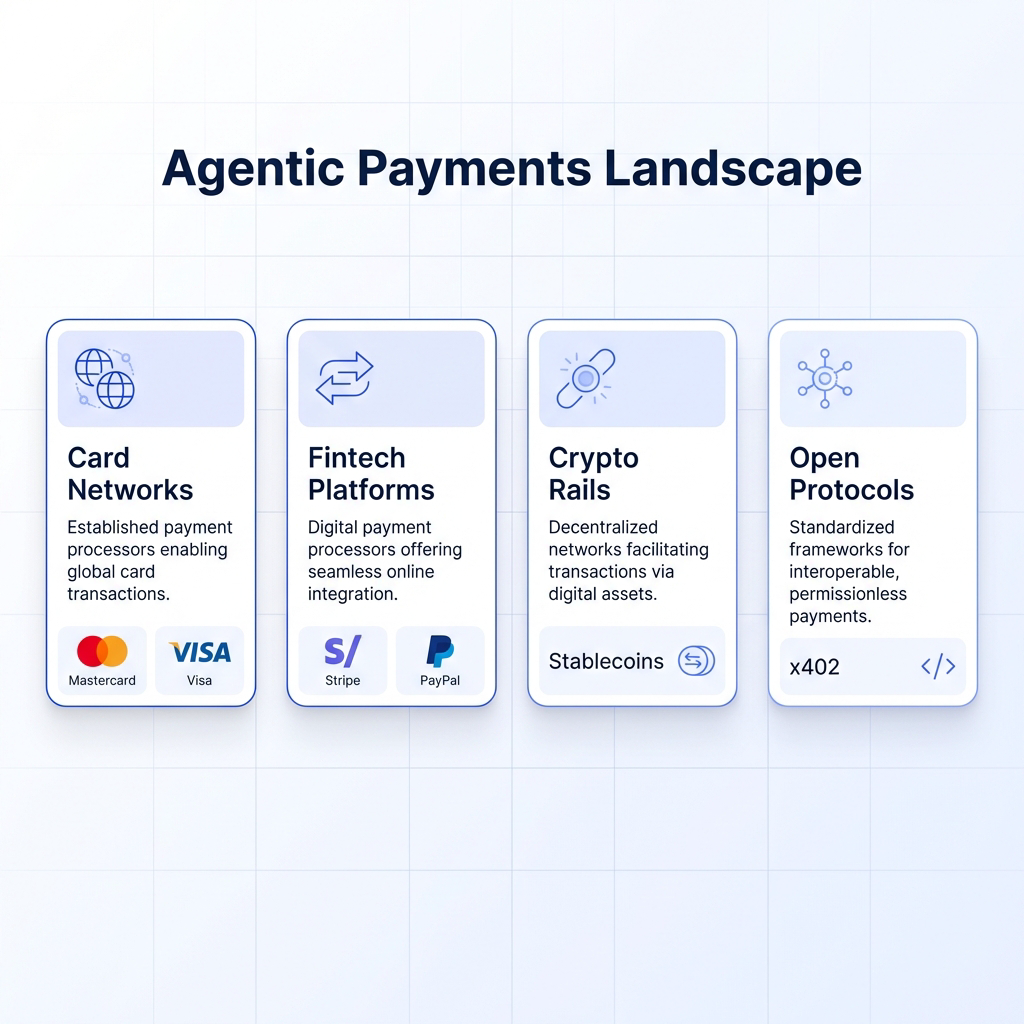
The ecosystem for agentic payments is evolving rapidly, with distinct approaches emerging across different payment rails:
- Card networks like Mastercard and Visa are focusing on creating "agent-ready" checkouts and tokenized credentials, leveraging existing card payment infrastructure.
- Fintech platforms such as Stripe and PayPal are developing agent integrations and developer tools built on their established account-based payment systems.
- LLM-native commerce uses assistants like ChatGPT, Claude, and Gemini to initiate purchases, often through embedded checkout or UI automation.
- Crypto rails (stablecoins + wallets) offer programmable settlement and favorable economics for micropayments.
- Open protocols (x402 and related efforts) are developing interoperable standards specifically designed for machine-to-machine payments.
Mastercard Agent Pay and Visa Intelligent Commerce
Mastercard Agent Pay (announced April 2025) positions the network as a secure bridge between AI agents and card acceptance — leveraging tokenization, trusted registration, and partnerships (including Microsoft and Samsung). Mastercard also reported a live, end-to-end AI-agent executed payment with Santander in a regulated banking environment (announced Jan 2026).
Visa Intelligent Commerce similarly emphasizes tokenized, AI-ready credentials and merchant experiences designed for agent-led shopping flows.
The current payment infrastructure boasts near-universal merchant acceptance and is underpinned by mature compliance and dispute resolution frameworks. This maturity has cultivated strong consumer trust in the system.
Despite its widespread adoption, this system has three main problems: High fees make it bad for very frequent, small payments (micropayments). It's built for people and traditional shopping, not for transactions between automated "agents." And it relies on merchants to adopt it, which slows down the launch of new services.
Stripe, PayPal, and Fintech Platform Approaches
Fintech platforms are pushing “agents as another client type”:
Reporting in 2026 described a Stripe “machine payments” preview integrating x402-style flows to bill agents in stablecoins (USDC), with settlement on Base.
PayPal announced Agentic Commerce Services and support for agent-ready merchant experiences through the “Agent Payments Protocol” they are developing with Google, expanding network-based enablement for agent checkout flows.
Developers already know these APIs, which allows for fast integration for existing merchants. Furthermore, the existing ecosystem benefits from strong global operations and risk tooling.
However, there are some limitations to this approach. It is typically account-based and platform-mediated. Micropayments are still awkward due to minimum fees and chargeback semantics. Finally, interoperability depends on each platform’s product decisions.
ChatGPT Payments, Claude Payments, and LLM-Native Commerce
This is where user demand is loudest: “Can my assistant just buy it?”
OpenAI announced Instant Checkout inside ChatGPT connected to a large Shopify merchant ecosystem, highlighting recognizable brands and emphasizing in-chat purchasing.
That same release described an “Agentic Commerce Protocol” co-developed with Stripe, designed to reduce backend changes for merchants already on Stripe.
These experiences are real and valuable, but most are still human-delegated:
- The assistant is acting with user credentials or a platform checkout wrapper.
- Payment logic is not a universal machine-payment primitive; it’s an application integration.
A key commercial detail: OpenAI disclosed a 4% transaction fee for Instant Checkout purchases (in addition to payment processing fees). That’s a signal of where value is being captured in agentic commerce: by whoever owns the integration layer.
Agentic Payments in Crypto: Stablecoins, AI Agent Wallets, and On-Chain Rails
Crypto rails are compelling for agents because they’re:
- Programmable
- Always-on (24/7)
- Globally reachable
- Friendly to sub-cent settlement
Stablecoins are also growing as a mainstream payment primitive: one report cited stablecoin transaction volumes rising from $450B (early 2024) to about $710B (early 2025), with 35M unique wallet addresses in 2025 (up 50% YoY). The same source cited stablecoin-linked card spending reaching $4.5B in 2025 (up 673% from 2024).
On agent wallet infrastructure:
Coinbase unveiled “agentic wallets” designed for autonomous spending with session spending caps and transaction size controls, with deployment “in under 2 minutes” via CLI.
Policy-based wallet standards are also emerging: e.g., MetaMask documented ERC-8004-style server wallets with guardrails like allowlists, frequency limits, and simulation checks.
And on chain performance, Solana is frequently cited for micropayment viability, with reported ~400ms finality and average fees around $0.00025 per transaction.
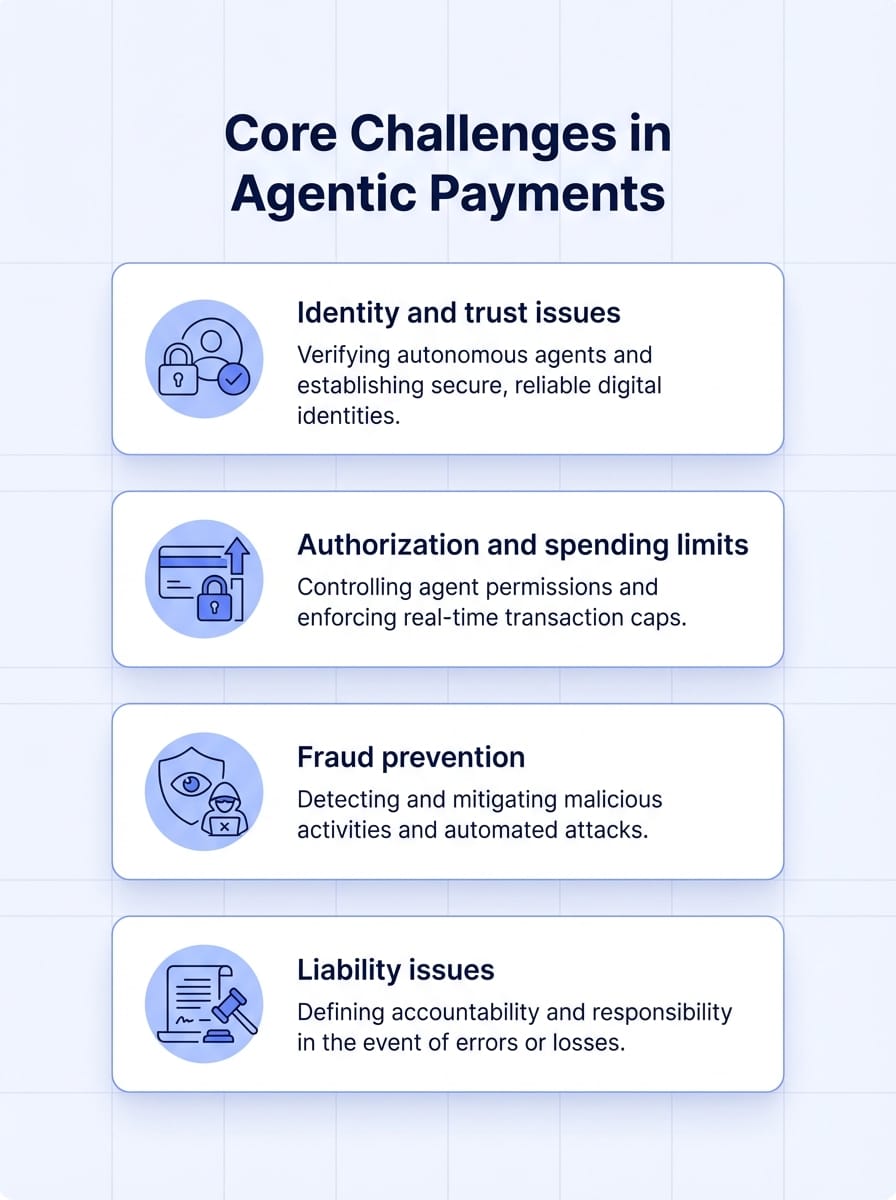
Core Challenges in Agentic Payments
Most “agentic payments” content stops at inspiration. We believe that builders need the hard parts spelled out, because these constraints determine whether a system will work in production.
Identity and KYA (Know Your Agent)
Agents aren’t people, but they act on behalf of people and organizations. That creates a new trust problem: how does a merchant or API know which agent is calling, and whether it is allowed to spend?
KYA (“Know Your Agent”) is emerging as a framework to verify agent provenance and integrity—extending identity checks to non-human actors.
In practice, teams are converging on verifiable credentials for agents, OAuth-like delegation tokens linking agent actions to an owner, and attestation and audit logs to prove what happened and why.
Authorization, Scope, and Spending Limits
Agentic commerce requires delegated authority. That’s fundamentally different from “click approve.”
Good systems enforce:
- Per-transaction caps
- Category/merchant allowlists
- Time-bound budgets and revocation
- Multi-agent hierarchies (manager agent + worker agents)
Industry summaries increasingly define delegated authority as rules like spending limits, approved categories, and revocation enforced at the infrastructure layer.
Fraud Prevention and Agent-to-Agent Trust
Agents introduce new security risks, such as manipulating purchases through prompt injection, impersonating merchants or agents, and tampering with data during tool communication.
Fraud analyses now emphasize that cryptographic settlement and verifiable logs can provide stronger auditability for autonomous actions than traditional opaque workflows.
Regulatory pressure on operational resilience is also increasing—for example, the EU’s Digital Operational Resilience Act (DORA) became applicable Jan 17, 2025, tightening ICT risk requirements and third-party oversight in AI-powered payments.
Liability: Who Pays When an Agent Makes a Mistake?
There’s no single global rule set yet. As of early 2026, no jurisdiction has enacted agent-specific liability regulation; liability may fall on the user, AI provider, merchant, or platform depending on facts and overlapping regimes.
Practically, builders should assume:
- You need strong audit trails
- You need reversible workflows where possible (refunds/voids)
- You need clear user policies about delegation and limits
Micropayments and Usage-Based Pricing at Scale
Agents create a new “unit of commerce”: the request.
Instead of “$49/month subscription,” agents want:
- Pay-per-request
- Pay-per-token
- Pay-per-data-row
- Pay-per-second of compute
Traditional fee structures make that painful: US interchange is often cited as 1.5–3.5% plus $0.10–$0.30 fixed, which quickly shuts out low-value payments.
Stablecoin rails on high-throughput chains are a direct response. Solana’s cited fee level of ~$0.00025 enables business models that would be impossible on cards. For more on why the economics matter, see our in-depth guide on micropayments.
How x402 Solves Agentic Payments at the Protocol Level
To make agentic commerce work on the open internet, you need a payment mechanism that is machine-readable, real-time, low-friction, and compatible with the web’s existing request/response model. That’s the design target for x402.
What Is x402? The HTTP-Native AI Payment Standard
HTTP status code 402 Payment Required has existed as a reserved idea since the early web, but wasn’t meaningfully standardized for internet payments until x402-style implementations.
The flow is simple:
- Client requests a resource (API, content, compute)
- Server replies 402 with the payment requirements (amount, asset, destination)
- Client pays (typically stablecoins)
- Server validates payment and returns the resource
This turns “payment” into a first-class part of the HTTP contract, rather than a separate checkout app.
If you want the deeper technical walkthrough, see x402 payment protocol and x402 Payment Required.
Why x402 Is Agent-Native by Design
x402 fits agents because it’s designed for what agents actually do: send requests.
Key properties of the x402 payment required flow are:
- Machine-readable payment terms: an agent can parse a 402 response and pay automatically, without UI scraping or simulating human interaction.
- Pay-per-request granularity: every call can be priced independently, aligning directly with agent workload patterns.
- Stablecoin settlement: global, practically instant settlement without negotiating banking integrations per region.
- Low transaction cost on Solana and other low-fee networks: Solana’s $0.00025 average fee supports genuine micropayment pricing.
PayAI Network’s role is to help developers adopt x402 with tooling and facilitation, and without turning the protocol into a walled garden.
Comparing x402 vs. Proprietary Agentic Payment Approaches
When picking a payment solution for agents interacting with services, you need to compare the options.
- x402 (open protocol): HTTP-native, agent-friendly micropayments, interoperable across frameworks.
- Card network approaches (Mastercard/Visa): excellent acceptance and consumer trust, but constrained by card economics and checkout patterns.
- Platform tools (Stripe/PayPal): fast time-to-market inside existing ecosystems, but platform-dependent.
- Custom crypto wallets without a protocol: programmable, but fragmented—every merchant/API reinvents price discovery and payment negotiation.
If you’re building for a world where agents buy from thousands of services, the strategic question is: do you want a single platform’s integration path, or an internet-native standard?
Real-World Agentic Payment Use Cases and Examples
Agentic payments are no longer hypothetical. What’s changing is where they live and how they’re implemented.
AI Agent API Marketplaces and Pay-Per-Call Services
The most immediate use case is agents paying other services on a transactional pay-per-call basis. Examples include:
Data enrichment: An agent pays a third-party service to append demographic or contact information to a list of customer leads.
Inference calls: An agent pays for an API call to a specialized large language model (LLM) to get a complex prediction or analysis that the agent's core model is not optimized for (e.g., highly accurate sentiment analysis on a niche topic).
Specialized transforms (translation, extraction, ranking): An agent pays a service to translate a high-volume batch of foreign-language customer reviews, or to accurately extract key financial figures from a set of unstructured annual reports, or to rank a list of search results based on a proprietary relevance algorithm.
This is where pay-per-request pricing is natural and where x402 has already seen significant activity. Solana’s x402 overview reported 120M+ transactions and $41M+ cumulative value across chains since launch.
For teams monetizing APIs, x402 effectively turns “billing” into “serve only after paid,” without forcing users into subscriptions or long-lived API keys.
Autonomous Shopping and Travel Booking Agents
Consumer agent shopping is happening now, but mostly through embedded checkout and platform orchestration:
ChatGPT’s Instant Checkout shows how assistants can compress the purchase journey and route orders through merchant networks.
AI-driven retail discovery is rising fast; one report cited AI traffic to US retail sites up 805% YoY on Black Friday 2025, and attributed 20% of holiday retail sales totaling $262B to AI-driven influence during the 2025 holiday season.
What’s still missing for fully autonomous travel and multi-merchant checkout:
- A standard way for agents to authenticate and pay across independent vendors
- Reliable dispute handling when an agent misbooks or misinterprets constraints
- “Mandates” and policy proofs that travel providers can verify
Agent-to-Agent Commerce and Autonomous Supply Chains
B2B is where “autonomy” delivers immediate ROI: procurement agents can anticipate shortages, place orders, negotiate discounts, and settle after delivery verification, reducing downtime and admin load.
Agent-to-agent commerce becomes viable when 1) pricing is machine-readable, 2) settlement is immediate and 3) audit trails are automatic
That combination is difficult with invoices and cards, and much easier with programmable rails plus protocol-level payment negotiation.
Content Monetization and the Creator Economy
A practical near-term opportunity: agents paying for content and data as they browse and synthesize.
This flips the monetization model from subscriptions and paywalls to per-article, per-snippet, per-dataset, per-inference.
And it’s aligned with rising AI-mediated discovery: one dataset cited 39% of consumers using AI for product discovery, with 23% of Americans buying something via AI in the past month.
Micropayments are the enabling layer here—see our article on micropayments for the business model implications.
Building for Agentic Payments: A Developer’s Guide
This section is about decisions you can make now, without betting your roadmap on one vendor’s walled garden.
Choosing Your Agentic Payment Infrastructure
Use these questions to choose a path:
- Do you need micropayments? If yes → card economics will fight you; stablecoins + low-fee chains tend to win (e.g., Solana’s cited $0.00025 average fee).
- Is your user experience consumer checkout? If yes → network and platform approaches (Visa/Mastercard/PayPal/Stripe) may accelerate adoption.
- Is it agent-to-agent or API-to-agent? If yes → prioritize machine-readable payment negotiation in-band with HTTP (x402-style flows).
- Do you need global reach from day one? → Stablecoins remove a lot of cross-border complexity, while bank rails vary by region.
Integrating x402 Into Your AI Agent or Service
At a high level, x402 integration is straightforward:
Server-side (merchant/API)
- Add middleware to protected endpoints.
- If unpaid, return HTTP 402 with structured payment requirements.
- When payment is confirmed, fulfill the request.
Client-side (agent)
- Equip the agent with an x402-capable wallet module.
- When it receives a 402 response, it pays automatically, then retries/continues.
Practical starting points:
- x402 quickstart
- Server examples: FastAPI x402 server, Next.js x402 server
- Client examples: TypeScript fetch client, Python requests client
Security, Compliance, and Best Practices
Agentic payments need guardrails by default:
- Budgeting and scope controls: session caps, transaction limits, allowlists. (Coinbase’s agent wallet approach highlights session spending caps and transaction size controls as core controls).
- Auditability: log every payment intent, quote, policy evaluation, and on-chain settlement reference.
- Operational resilience: expect stronger third-party and ICT risk requirements (e.g., DORA applicability from Jan 2025).
- Consumer transparency expectations: regulators have already signaled that “AI” doesn’t reduce disclosure obligations (e.g., CFPB guidance on explanations and transparency in AI-driven decisions).
If you’re deploying tokenized or on-chain payment features, ensure your team reviews legal and risk disclosures appropriate to your architecture..
The Future of Agentic Payments: What Comes Next
The direction is clear: commerce is becoming API-shaped, and payments are becoming protocol-shaped.
The Agentic Finance Platform Era
We’re seeing rapid merging of several key areas into a single, unified experience for agents:
- Payment Infrastructure: Integrating digital wallets, user identity, authorization/mandate management, and the coordination of these services.
- Customer Journey: Combining merchant finding, order fulfillment, and resolution of payment disputes.
- Underlying Technology: Abstracting the complexities of different settlement systems (like credit cards, Real-Time Payments, and stablecoins) so the agent only interacts with a single, simplified interface.
Market sizing projections are aggressive; Morgan Stanley projects $190B–$385B in US e-commerce spending via agents by 2030 and Bain estimates 15–25% of e-commerce could flow through agentic channels.
At the same time, platform consolidation pressure is real. Google announced a Universal Commerce Protocol co-developed with major retailers and ecosystem leaders, signaling that “agentic commerce” is moving toward standardized, platform-mediated rails.
Open standards like x402 matter here: they can keep agentic commerce from becoming a set of incompatible silos.
Regulation, Standards, and the Path to Mainstream Adoption
Expect two parallel tracks:
1) Regulation catches up to autonomy
- The EU’s agentic commerce compliance timeline is described as phased through Aug 2027, with milestones for foundation model transparency and high-risk financial AI compliance.
2) Standards formalize agent trust and mandates
- Google Cloud announced AP2 (Agent Payments Protocol) with cryptographically signed mandates and verifiable credentials as trust primitives.
- LangChain published an Agent Protocol to standardize agent interoperability in production environments.
The builders who succeed will prioritize compliance and interoperability as product requirements for the agentic economy.
The Bottom Line
Agentic payments are becoming a real category because agents are becoming real operators—buying, subscribing, querying, and negotiating across services. The hard part isn’t demos; it’s infrastructure: identity, authorization, fraud, liability, and micropayment economics.
Open, HTTP-native standards like x402 point to a practical path forward: payments that work at the speed and granularity of the internet itself, one request at a time.
Frequently Asked Questions
What are agentic payments?
Agentic payments are payments initiated and completed by autonomous AI agents under delegated rules. The agent doesn’t just “click pay”—it can discover options, choose and negotiate terms, and settle the transaction without a human approving every individual purchase.
How do AI agents pay for things?
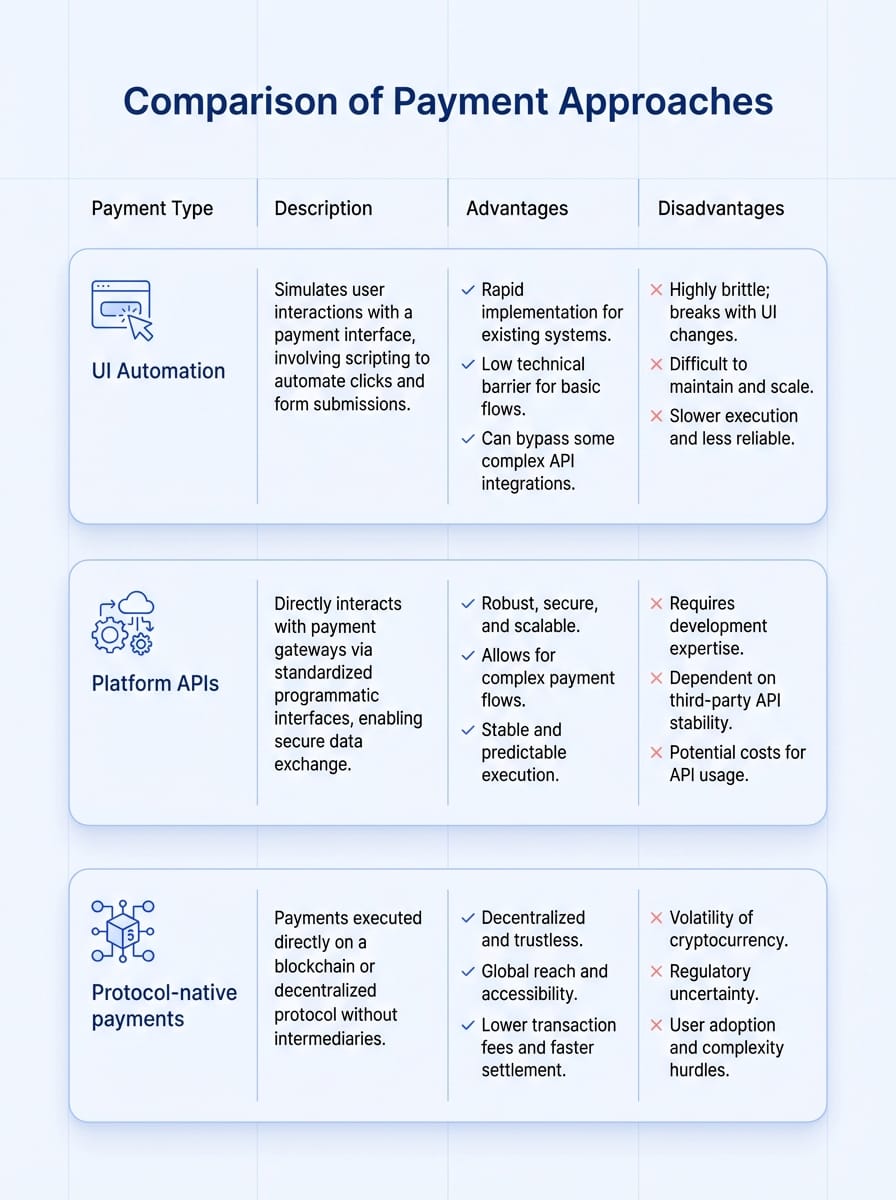
Today there are three main approaches:
- UI automation: agents use a browser like a human (fill forms, click checkout). This is flexible but brittle and hard to secure at scale.
- Platform APIs: agents call a platform’s payment APIs (Stripe/PayPal-style). This is robust inside that ecosystem but typically account-based and platform-dependent.
- Protocol-native payments (x402): payment is negotiated in-band via HTTP (402 + machine-readable terms), settled in stablecoins, then the resource is delivered.
What is x402 and how does it enable agentic payments?
x402 is an open, HTTP-native payment pattern that uses HTTP 402 Payment Required to express “pay X to access this endpoint.” The agent receives machine-readable payment requirements, pays via stablecoins, and the server fulfills the request—without account creation, API keys, or interactive sessions.
Find our deep dives here: x402 payment protocol, x402 Payment Required
Can ChatGPT or Claude make payments?
ChatGPT can support purchasing through integrated experiences such as Instant Checkout with merchant ecosystems (including Shopify-connected merchants). Claude and other assistants can also complete checkout via tool use or computer use—often by operating web UIs. The gap is that these are typically delegated, app-specific flows, not a universal payment protocol for machine-to-machine commerce.
What is the difference between agentic payments and traditional digital payments?
Three practical differences:
- Initiator: software autonomy vs. a human clicking “Pay”
- Negotiation: agents need machine-readable price discovery and authorization policies
- Economics: agents generate high-frequency, low-value payments that don’t fit card fee minimums.
Which companies are building agentic payment solutions?
Notable efforts include:
- Mastercard claims secure, scalable and trusted AI payments via Agent Pay
- Visa introduced Intelligent Commerce
- Stripe is building the Agentic Commerce Protocol with OpenAI
- PayPal is currently developing the Agent Payments Protocol with Google
- Coinbase introduced x402 to enable instant, automatic stablecoin payments directly over HTTP agent wallet infrastructure
- PayAI Network facilitates x402 adoption and tooling on Solana, Avalanche, Base, Polygon, SKALE, Sei, X Layer and other low-fee networks.
Are agentic payments safe? Who is liable if an AI agent makes a wrong payment?
Safety is achievable, but it requires infrastructure-level controls (limits, allowlists, audit logs) and clear delegation policies. Liability is still evolving and there is legal ambiguity across jurisdictions. In practice, responsibility generally falls on the person or organization deploying the agent, unless contracts and regulations specify otherwise.
Why are stablecoins and blockchain important for agentic payments?
Agents often need micropayments at high volume. Traditional rails have fixed fees that dominate small transactions. Stablecoins enable programmable, global settlement, and low-fee chains make sub-cent payments viable (e.g., Solana’s cited $0.00025 fees.
The agentic payments era is here. Whether you’re building AI agents or monetizing APIs, PayAI Network gives you open infrastructure to get paid, one HTTP request at a time.