

The world's largest asset manager has published a whitepaper arguing that AI agents could become one of the biggest new sources of demand for digital assets. In the section on how agents will pay for things, it names one protocol before any other: x402.
The paper is The Machine-Native Economy. Its authors are Robert Mitchnick (Head of Digital Assets), Will Su (Head of Digital Assets Research), Jay Jacobs and William Helm. Its core idea fits in one line:
"AI represents machine-native intelligence, while digital assets represent machine-native money."
Most of the coverage stopped at the headline. The details are more interesting.
What BlackRock actually said about x402
The description is precise:
"x402, an open payment protocol developed by Coinbase, uses the HTTP 402 'Payment Required' status code to facilitate machine-initiated payments."
The paper also sets out what that makes possible: 24/7, near-real-time, verifiable settlement. A provider can release data or a service as soon as payment is confirmed, without carrying the risk of not getting paid. It goes further on pricing:
"x402 could support on-demand settlement on a per-use, per-model-token, or per-job basis."
Per model token. That's BlackRock describing a world where every chunk of inference can be its own payment event. You can't do that with a card, and x402 was built for it.
Why the old rails don't work for agents
BlackRock is blunt about it:
"Many existing payment rails are less well suited to high-volume, low-denomination agentic transactions."
It gives four reasons:
- Account setup. Opening a merchant account assumes a human with an ID. Agents don't have one.
- Fees. A $0.30 minimum fee can't carry a $0.002 API call.
- Settlement delays. Waiting days to settle doesn't work when a machine needs its answer in milliseconds.
- Scale. The volume doesn't fit. One agent can make thousands of requests in an hour.
BlackRock's conclusion is that crypto-native rails are "particularly well suited to high-frequency, sub-cent, machine-to-machine (M2M) transactions that take place around-the-clock," such as API calls, on-demand data and compute billed by use.
x402 works exactly that way. A server replies with 402 Payment Required, the agent pays in stablecoins over HTTP, the payment settles and the resource is released. No account, no checkout page and no human in the loop.
Why AI adoption turns into demand for digital assets
This is the part of the paper that should get more attention. BlackRock describes broad AI adoption as potentially "an underappreciated source of demand" for digital assets. The reasoning is simple.
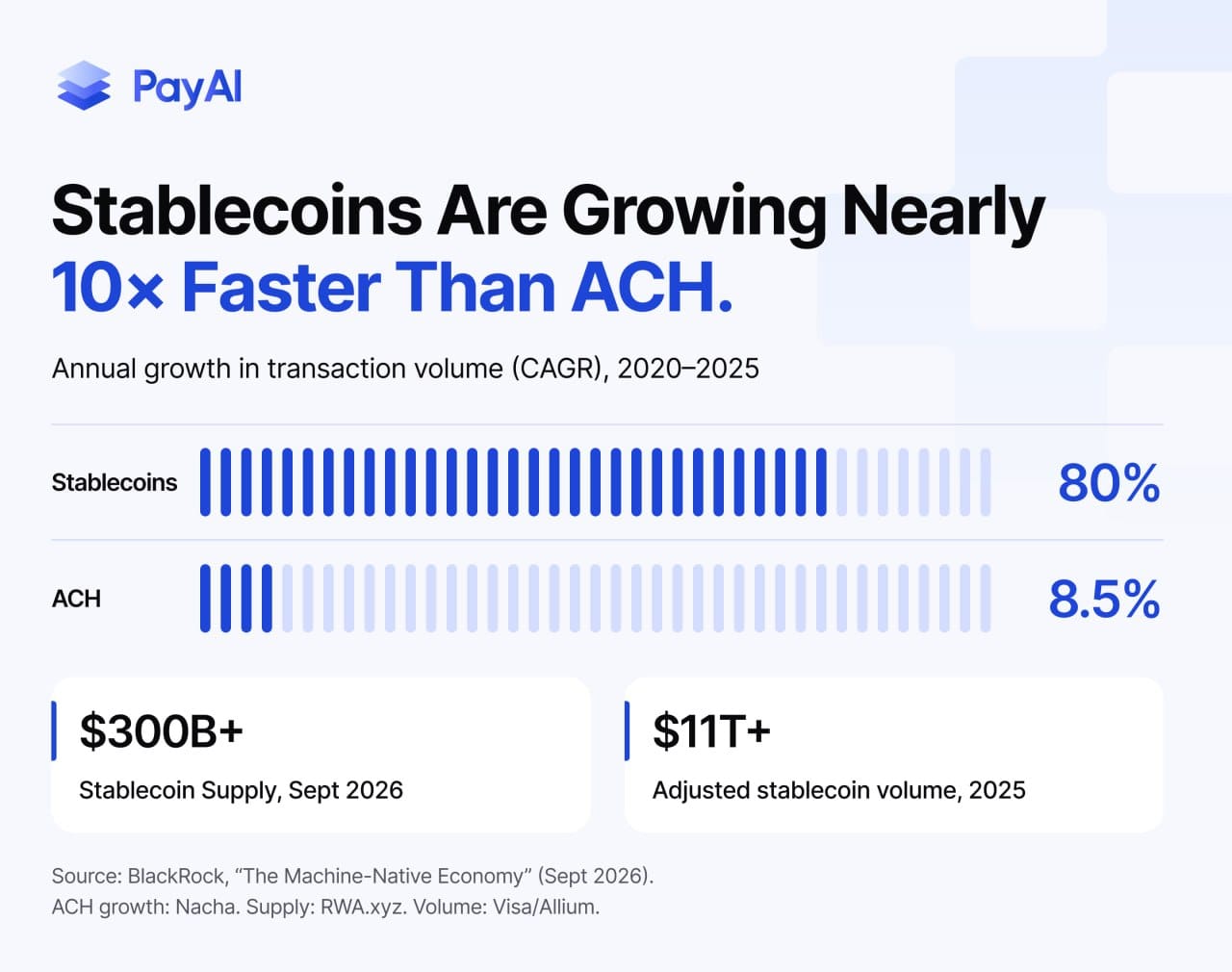
Stablecoins are already large enough. The paper puts circulating supply above $300 billion (as of September 2026, citing RWA.xyz) and adjusted transaction volume above $11 trillion in 2025 (Visa/Allium). It says stablecoin volume grew at about 80% a year from 2020 to 2025, against roughly 8.5% for ACH. It also expects stablecoins "to lead transactional use."
Compute is the next thing agents will buy. BlackRock cites consensus estimates that AWS, Microsoft's Intelligent Cloud segment and Google Cloud will reach about $1.1 trillion in combined revenue by 2030, and Goldman Sachs estimates of more than $5 trillion in cumulative AI capital spending from 2025 to 2030. It expects inference to be the largest AI workload by 2030. It also points to Stripe's August 2026 agreement to acquire OpenRouter as an early sign that model routing is becoming financial infrastructure.
Put those together. Every inference call, data request and tool call an agent makes is a transaction that could settle onchain. As AI usage grows, the number of payment events grows with it. BlackRock's own phrasing is that agentic AI and machine-to-machine payments "will likely increase demand for blockchains and other programmable payment infrastructure."
That's the demand loop. More useful agents lead to more machine-to-machine transactions, which lead to more stablecoin settlement.
The honest part: it's early
BlackRock says so itself: "The ecosystem remains nascent, with agentic payment activity and compute-market liquidity still limited."
The onchain data supports that. TRM Labs recently analyzed $52.7 million in x402 settlements across Base, Solana and Polygon since May 2025. After filtering out noise, it estimated that only 0.6% to 7.5% of commerce by value looked agent-driven. TRM also noted that its method may understate agent activity, because a single-purpose agent that pays one service repeatedly looks like a script.
That doesn't weaken the thesis. It's the normal order for infrastructure: the rails get built first and the traffic follows. When BlackRock's research team writes a protocol into its thesis while traffic is still in single digits, that tells you how seriously it takes the direction.
The layer the whitepaper doesn't cover
BlackRock describes the x402 flow in terms of what the resource provider gets: payment confirmed, resource released. Something has to sit between "payment sent" and "payment confirmed." It has to verify the payment, settle it onchain and tell the server it's safe to respond.
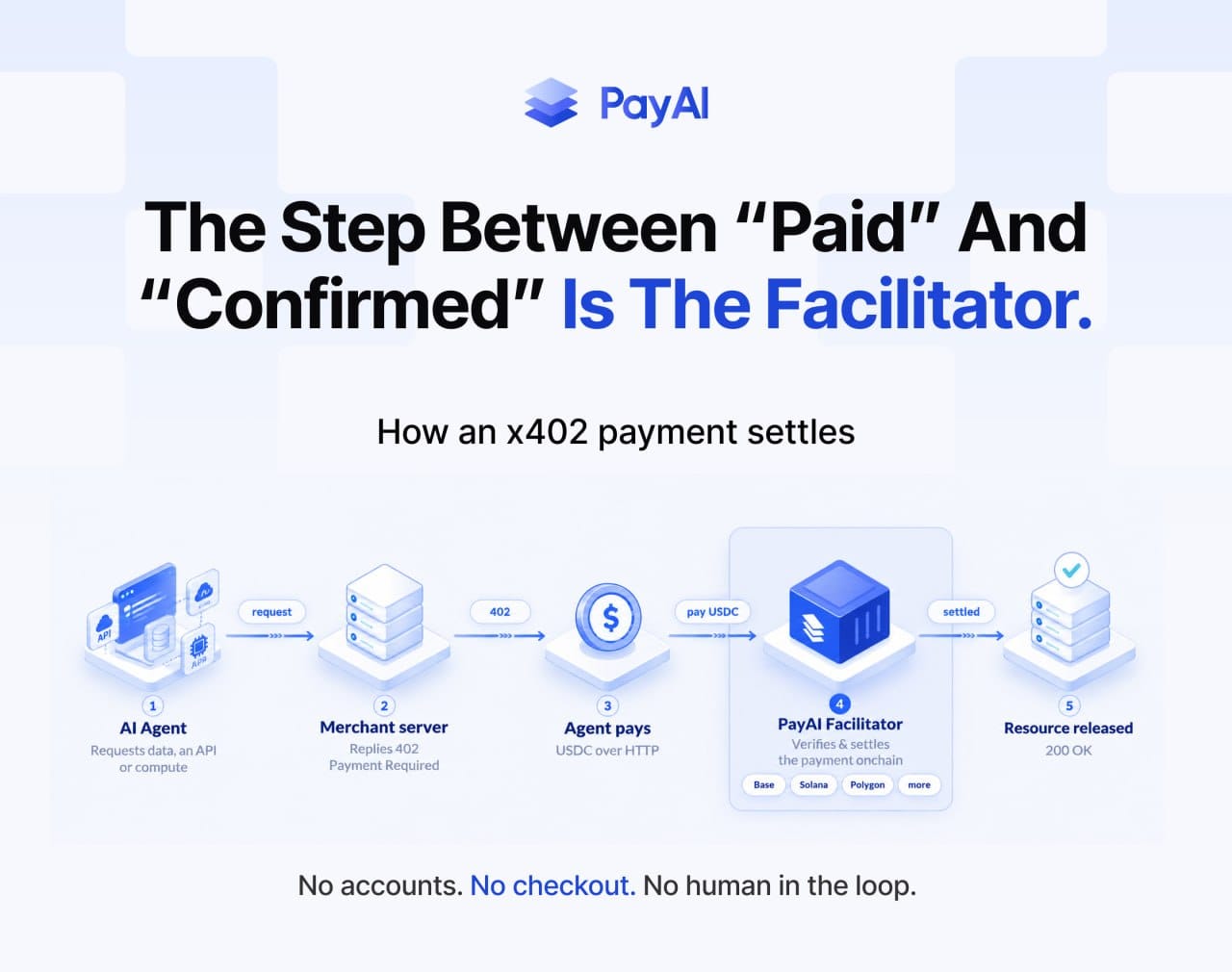
That's a facilitator. PayAI is a multi-network x402 facilitator that enables merchants to accept stablecoin payments via HTTP 402. The PayAI Facilitator handles the verify-and-settle step, so a merchant can put an x402 paywall on an API without running settlement infrastructure itself.
Networks matter here too. The only chains BlackRock names are Ethereum and Circle's Arc. x402 volume today also runs across Base, where Coinbase built much of the foundation, and Solana and Polygon. The thesis doesn't pick a chain, and the settlement layer shouldn't either. Agents will pay wherever the resource lives. Infrastructure that settles across networks is what lets that work at scale.
The takeaway
For years the argument for crypto payments was about people: cheaper remittances, faster cross-border transfers, banking the unbanked. BlackRock's paper sets out a different buyer, software that transacts on its own at machine speed and machine volume.
Once the largest asset manager in the world writes your protocol into its thesis, the question is no longer whether agents will pay onchain. It's who settles the payments.
Build on it: read the x402 docs, go live with the quickstart, or see the full flow in the live demo.
Sources: BlackRock, "The Machine-Native Economy" (September 2026); TRM Labs x402 analysis via Decrypt.