

Key takeaways
- Arc is a USDC-gas, EVM-compatible Layer 1 built with AI agents in mind, and its agent tooling runs on x402.
- For USDC, the change is structural: dollars pay for the network itself.
- For Solana, Arc looks more like a complement than a rival, since USDC moves between them via CCTP.
- For x402 builders, another chain to settle on makes multi-network infrastructure matter more, not less.
For years, Circle issued the dollar that crypto runs on. On September 16, it launched a chain to run it on.
Arc went to public mainnet as an open Layer 1 purpose-built for financial markets, real-time money movement, and agentic economic activity. At PayAI Network, we run a multi-network x402 facilitator, so the question we care about is simple: what does an issuer-built, agent-focused chain mean for x402, for USDC usage, and for Solana?
What Arc is, in plain terms
Three design choices matter most here. Fees are paid in USDC, so no volatile native token is required. Finality is deterministic and sub-second. The chain is fully EVM-compatible, so existing Solidity contracts and tools work from day one.
It is also a very institutional chain. Arc runs a permissioned Proof-of-Authority model at launch, with eleven institutions joining Circle as validators, including BlackRock, DTCC, Visa, Mastercard and ICE. Circle says the rollout from that validator cohort is phased, and that it is exploring a move to Proof of Stake in 2027. That is a different design point from an open, permissionless network, and it's worth being clear-eyed about.
Circle also minted the full 10 billion ARC token supply, but says that is a technical milestone rather than a commitment to launch the token publicly. Network fees stay payable in USDC.
Why Arc is an x402 story
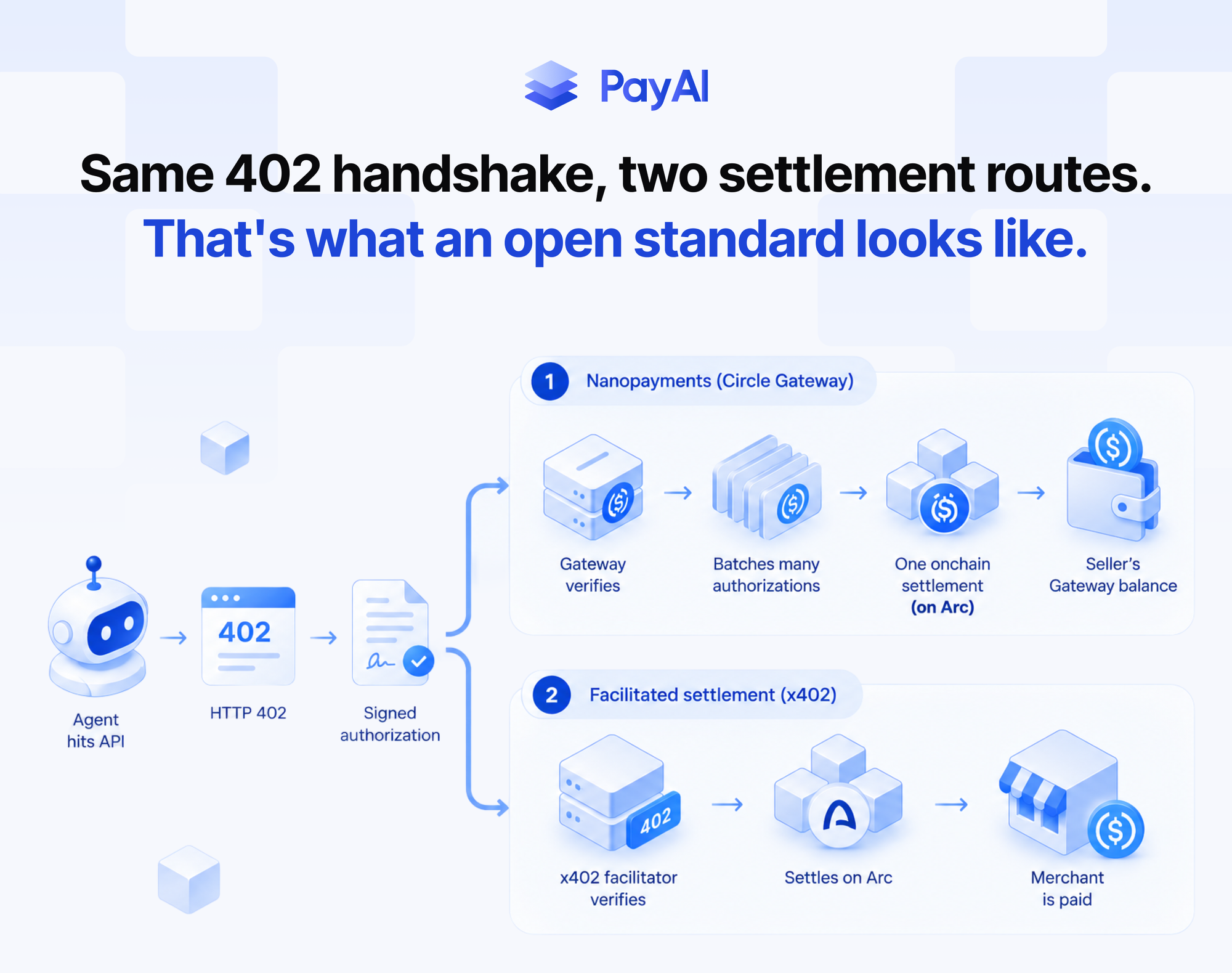
Circle Agent Stack, which launched in May 2026, bundles policy-controlled agent wallets, Nanopayments powered by Circle Gateway, and an emerging Agent Marketplace. Nanopayments runs on the same HTTP 402 Payment Required flow x402 is built on: a seller answers with a 402, and the agent retries with a signed payment authorization.
Circle's addition is batching. Gateway groups many signed offchain authorizations into a single onchain settlement, which is what makes sub-cent payments economically viable. Circle's own docs describe the payer side as gasless, with test prices as small as a millionth of a dollar.
Circle also reports that USDC accounts for 98.8% of agent-driven transaction volume, and that most x402 agent-to-agent payments since May have settled in USDC. That's Circle's figure, so treat it as a claim to watch rather than an audited fact.
The signal is still real. The largest regulated stablecoin issuer is building agent commerce on x402, which confirms HTTP 402 as a payment primitive and not one ecosystem's experiment.
There is one nuance. Open standards mean multiple routes. On Arc, Circle's Gateway is the first-party path, and independent options are already appearing: Arcus describes itself as an independent x402 facilitator for Arc, unaffiliated with Circle. That is the model working as designed. Any x402 facilitator can compete on reliability and coverage, and builders can switch by changing a URL.
What Arc means for USDC usage
The change is structural. Transacting on Arc depends on being able to obtain and use USDC for gas. Every user, app and agent on the network holds USDC first, not a volatile token they have to acquire separately.
For agents, that means budgeting in dollars. For pay-per-request payments priced in fractions of a cent, predictable cost matters almost as much as low cost.
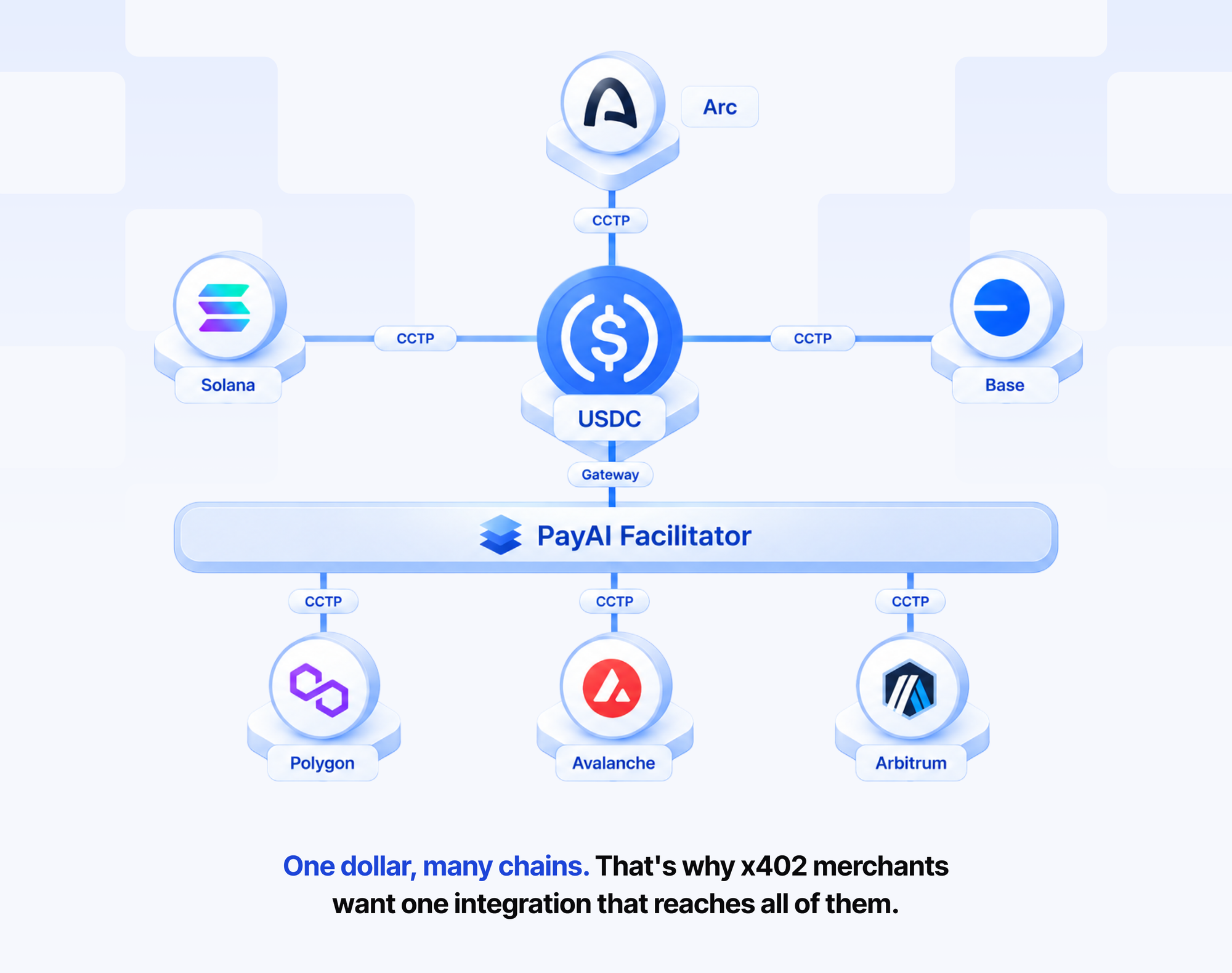
Arc is also not a walled garden. CCTP burns USDC on the source chain and mints native USDC on the destination, with no wrapped IOU. Circle's docs include a guide for moving USDC from Solana to Arc. Expect USDC in more places, moving between them with less friction. We won't put a number on that until there's onchain data to back it.
Is Arc good for Solana?
We think mostly yes, and it isn't zero-sum. Arc is built for institutional settlement, with permissioned validators and USDC-denominated fees. Solana is open, high-throughput and already home to real x402 activity. These are different design points serving different jobs.
Three reasons the picture is constructive:
- Solana is a peer in Circle's design. USDC on Solana routes to Arc through CCTP, so Solana is part of the network, not outside it.
- The audiences overlap. Phantom and Pump.fun are both named among the builders in Arc's launch cohort. Users and liquidity can flow in both directions.
- Unified balances turn chain choice into a routing decision. A bigger USDC agent economy gives agents more reasons to settle wherever is cheapest and fastest for the job.
The thing to watch is defaults. If Circle's agent tooling steers builders to Arc first, mindshare and some volume will follow. That's healthy competition, and it keeps every network shipping.
What it means for PayAI
PayAI is a multi-network x402 facilitator. It is Solana-first and settles USDC micropayments across Solana, Base, Polygon, Avalanche, Arbitrum, Sei, X Layer and SKALE, with availability varying by scheme and network. The bet is that merchants shouldn't rebuild their stack for every chain, and agents shouldn't have to care which chain a merchant prefers. Every new network x402 settles on strengthens that case.
Arc isn't on PayAI's supported network list today, and we'd rather say so plainly than imply otherwise. Here is what we're watching:
- How many x402 services adopt Arc.
- Whether agent payments concentrate on Gateway's batched flow or on standard facilitated settlement.
- How the validator and Proof of Stake roadmap shapes the network's openness.
The pattern is already visible: BlockRun, a builder our ecosystem knows well, is among the agentic builders named in Arc's launch cohort. x402 services are going multi-chain.
What to watch next
- Openness: a permissioned validator set at launch, with Proof of Stake on the 2027 roadmap.
- The ARC token: minted, but no public launch committed.
- Real agent volume: mainnet is days old, and Circle's headline numbers are Circle's.
- Default routes: which x402 settlement path becomes the norm on Arc.
The bottom line
Arc doesn't change what x402 is. It changes how many places x402 can settle, and it puts the biggest USDC name behind agent payments. That's good for USDC, good for the standard, and a reason for merchants to want one integration that reaches many networks.
Ready to accept x402 payments? Start with the PayAI Facilitator quickstart, see a live payment at x402.payai.network, or browse the code on PayAINetwork's GitHub.
Sources: Circle's Arc mainnet announcement · Circle Nanopayments build guide · Circle CCTP Solana-to-Arc docs