
Solana is a growing player within the x402 ecosystem, accounting for around 1.5M transactions within the first three months of 2026. Within that ecosystem, PayAI Network is the largest facilitator of all real x402 transactions on the network, making it the first and one of only two major facilitators powering micropayments on the fastest-growing chain for internet-native commerce.
In a nutshell
- PayAI Network was the first x402 payment facilitator to launch on Solana.
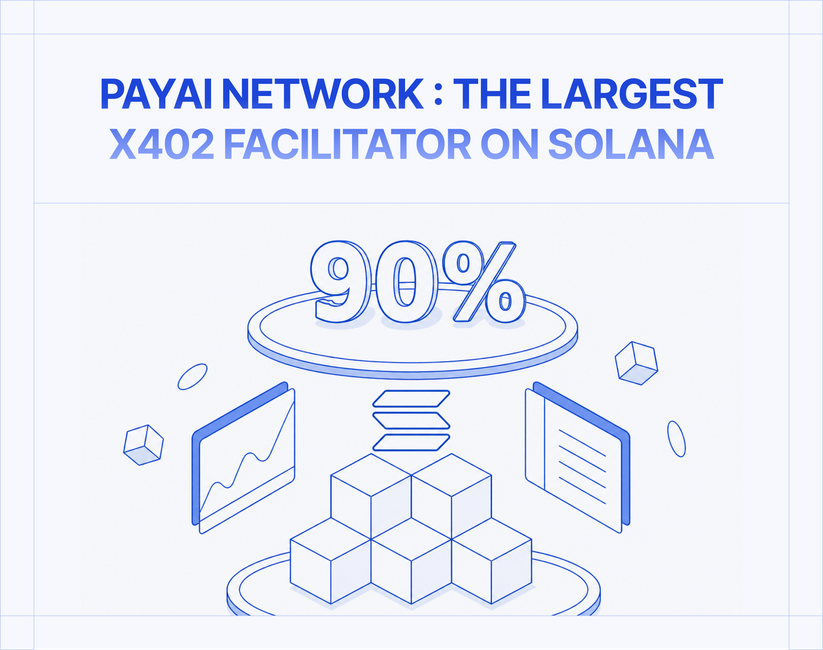
- It currently handles approximately more than 90% of all real x402 transactions on Solana, with peak weekly volume exceeding 3 million transactions.
- Solana has grown from a secondary chain to commanding 49% of all x402 market share, and even reached 88% briefly in early 2026.
- The facilitator layer is a critical piece of x402 infrastructure. It handles transaction verification and submission so that service providers don't have to.
- As x402 matures beyond its early growth phase, facilitator reliability, cost efficiency, and developer experience will determine which platforms capture long-term demand.
What is a facilitator, and why does it matter?
The x402 protocol enables direct, programmable payments at the internet protocol level. When a client makes a request to a paid API endpoint, the server responds with a 402 status code and a price. The client signs a payment, and the request is fulfilled.
But between the client's signed payment and the server's response, something has to verify the transaction and submit it to the blockchain. That's the facilitator's job.
A facilitator sits between the seller and the settlement network. It verifies that the payment is valid, ensures the funds are available, submits the transaction to the network, and confirms settlement. Without facilitators, every service provider would need to build and maintain its own payment verification and blockchain submission infrastructure. That's a non-trivial engineering burden — especially at scale.
Think of it this way: the x402 protocol defines the language. The facilitator makes sure the conversation actually happens. It's the layer that turns a signed payment intent into settled funds in the service provider's wallet.
This is why facilitator market share matters. The facilitator you use determines the speed, reliability, and cost of every transaction your platform processes.
PayAI Network's position on Solana
PayAI Network accounts for roughly 90% of all real x402 transactions on Solana. At its peak, PayAI processed over 3 million transactions in a single week during early December 2025.
The key distinction for PayAI Network is its focus on handling transactions for real-world applications. In contrast, most other facilitators primarily process "gamed" transactions: this is simulated activity designed to inflate volume without involving genuine market participants.
Why Solana became the chain for x402
When x402 first launched, Base held the early lead. It accumulated over 70 million cumulative transactions and roughly $21.5 million in total volume. But Solana closed the gap fast.
By the week of December 8, 2025, Solana had overtaken Base in weekly transaction count: 5.8 million versus 5.3 million. By early February 2026, Solana briefly accounted for more than 88% of all x402 transactions across every supported network.
The reasons are structural:
Low fees make micropayments viable. The entire point of x402 is to enable payments small enough to attach to individual API requests. If the transaction fee is $0.01 but the payment is $0.001, the economics don't work. Solana's transaction fees, which are typically fractions of a cent, make sub-cent payments practical.
High throughput matches API traffic patterns. APIs can generate thousands of requests per second. The underlying blockchain needs to handle that volume without congestion or latency spikes. Solana's throughput capacity, processing thousands of transactions per second, aligns with the burst patterns of real API usage far better than chains with lower capacity.
Fast finality keeps the user experience clean. When a developer makes an API call that costs $0.002, they don't want to wait 12 seconds for block confirmation. Solana's sub-second finality means the payment and the API response feel instantaneous. For agentic payments, where autonomous systems are making hundreds of requests per minute, is a requirement.
Developer ecosystem alignment. Solana has cultivated a developer community that skews toward high-performance, consumer-facing applications. These are exactly the kinds of projects that benefit from per-request monetization. A Solana developer building an AI agent, a real-time data feed, or a gaming backend is a natural fit for x402.
The growth trajectory for x402 payments
The numbers tell a story of rapid early growth followed by a necessary correction.
At its peak during the week of December 22, 2025, Solana recorded over 6.8 million x402 transactions. By the week of February 9, 2026, that number had fallen to fewer than 510,000, a decline of more than 90%.
So what happened? Data from Artemis suggests that a substantial portion of early activity was non-organic. During the week of November 24, when transaction counts peaked across all networks, more than 78% of transactions were classified as non-organic. Over 98% of recorded transaction volume during that same period was estimated to fall into the same category.
This pattern is common in early-stage network deployments. Automated testing, incentivized activity, and infrastructure validation all generate transactions that inflate headline numbers. It happened with early DeFi protocols. It happened with NFT marketplaces. And it's happening now with x402 facilitators across every chain.
The important question isn't whether early numbers were inflated. They almost always are. The important question is what the organic baseline looks like, and whether it's growing.
What the organic signals show
Several indicators suggest that real demand is forming beneath the noise.
Buyer wallet participation is holding steady. During the week of February 9, approximately 4,900 wallets remained active on Solana's x402 network. Of those, around 3,700 were buyers. This is a meaningful shift from the early days, when seller wallets (service providers) dominated participation. A growing buyer-to-seller ratio suggests that real consumers, both human and autonomous, are finding and using x402-powered services.
The long tail is emerging. More than 25,000 unique wallets have acted as service providers since October 2025. More than 18,000 wallets have participated as buyers. These aren't numbers driven by a handful of large players. They represent a broad base of participants experimenting with the protocol.
Facilitator infrastructure is maturing. The consolidation around two primary facilitators, Dexter and PayAI, mirrors what happens in every successful infrastructure layer. Early fragmentation gives way to a few reliable providers who compete on performance, uptime, and developer experience. PayAI's consistent 90%+ transaction share through both the growth spike and the correction suggests stable, returning usage rather than one-time testing.
What PayAI brings to the facilitator layer
Being first to market on Solana gave PayAI Network an early advantage, but market position in infrastructure isn't maintained by timing alone. It's maintained by reliability, developer experience, and cost.
Verification speed. Every x402 transaction requires payment verification before the API response can be delivered. Facilitator latency directly impacts the end-user experience. A slow facilitator means a slow API. PayAI's infrastructure is optimized for Solana's sub-second finality, ensuring that verification doesn't become a bottleneck.
Developer integration. PayAI provides server-side middleware for the frameworks developers actually use — Express, Next.js, Hono, FastAPI, Flask, and Gin. On the client side, it supports fetch, Axios, httpx, and requests. This breadth matters. A facilitator that only supports one language or framework limits its addressable market.
Transparent pricing. Facilitator fees are a direct input to the cost of every API transaction. PayAI's facilitator pricing is published openly, so service providers can calculate their unit economics before they deploy. There are no hidden fees and no surprises at scale.
Authentication and security. Every facilitator handles real money. The security of the verification and settlement process is non-negotiable. PayAI's authentication model is documented and auditable.
Getting started with PayAI as your facilitator takes minutes, not days. The quickstart guide walks through the full integration from the first line of code to a live, paid API endpoint.
The competitive landscape
The facilitator market on Solana is currently a two-player race. Dexter leads on both transaction count and volume. PayAI holds a strong second position with a distinct profile.
But the market is far from settled. Several dynamics could reshape the landscape:
New chains are entering the race. Polygon's recent surge, which pushed Solana's weekly share from 88% down to 49.7%, shows that chain-level competition is intensifying. Facilitators that operate across multiple chains will have an advantage as service providers look for multi-chain support. PayAI's supported networks are expanding to meet this demand.
Agent-driven demand is growing. As AI agents become more capable and autonomous, the volume of programmatic API payments will grow significantly. Agents don't care about brand loyalty. They care about latency, reliability, and cost. The facilitator that offers the best combination of these factors will capture agent-driven traffic regardless of current market share.
Dynamic pricing creates new facilitator requirements. As service providers adopt dynamic pricing, adjusting API prices based on demand, time, or resource load, facilitators need to handle variable payment amounts efficiently. This adds complexity to the verification layer and favors facilitators with more sophisticated infrastructure.
Developer experience becomes the differentiator. In infrastructure markets, the product that's easiest to integrate wins over time. AWS didn't win because it was the cheapest. It won because the developer experience was better than the alternatives. The same dynamic will play out in the facilitator market. Comprehensive SDKs, clear documentation, and responsive support will matter more than raw throughput numbers.
What comes next
The x402 ecosystem is still early. Total transactions across all chains have surpassed 120 million, but organic activity is still establishing its baseline. Weekly volumes have pulled back from peak levels. The market is sorting signal from noise.
For PayAI Network, the path forward is clear: deepen Solana integration, expand multi-chain coverage, and invest in the developer experience that turns first-time integrators into long-term users. As the space becomes more complex, our goal is to abstract away the complexities of all of the networks and "standards" so that all a merchant needs is one SDK and then they can accept payments anywhere.
The facilitator layer is where the economics of open API monetization actually happen. It's the infrastructure that makes per-request payments fast, reliable, and invisible to end users. As x402 moves from early experimentation to production workloads, the facilitators that earned trust during the building phase will be the ones processing the next wave of demand.
PayAI was the first x402 facilitator on Solana. It currently handles nearly a third of all transactions on the network. And as the market matures beyond inflated early metrics toward sustained organic activity, that foundation matters.
To explore how PayAI's facilitator works under the hood, start with the facilitator introduction. To integrate it into your own project, follow the quickstart guide. To see a real-world example of x402 in production, read the Holoworld case study or explore the ecosystem of projects that use PayAI to power their microtransactions.