

Micropayments are transforming how businesses monetize digital content, services, and APIs by enabling transactions so small that traditional payment systems can't keep up.
As subscription fatigue grows and consumers demand more flexible pricing, understanding micropayments has become essential for digital business owners, developers, and content creators looking to unlock new revenue streams.
Micropayments in a nutshell
- Micropayments are digital transactions that typically range from fractions of a cent to as much as $10 per transaction, enabling pay-per-use business models that are unviable with traditional payment processors.
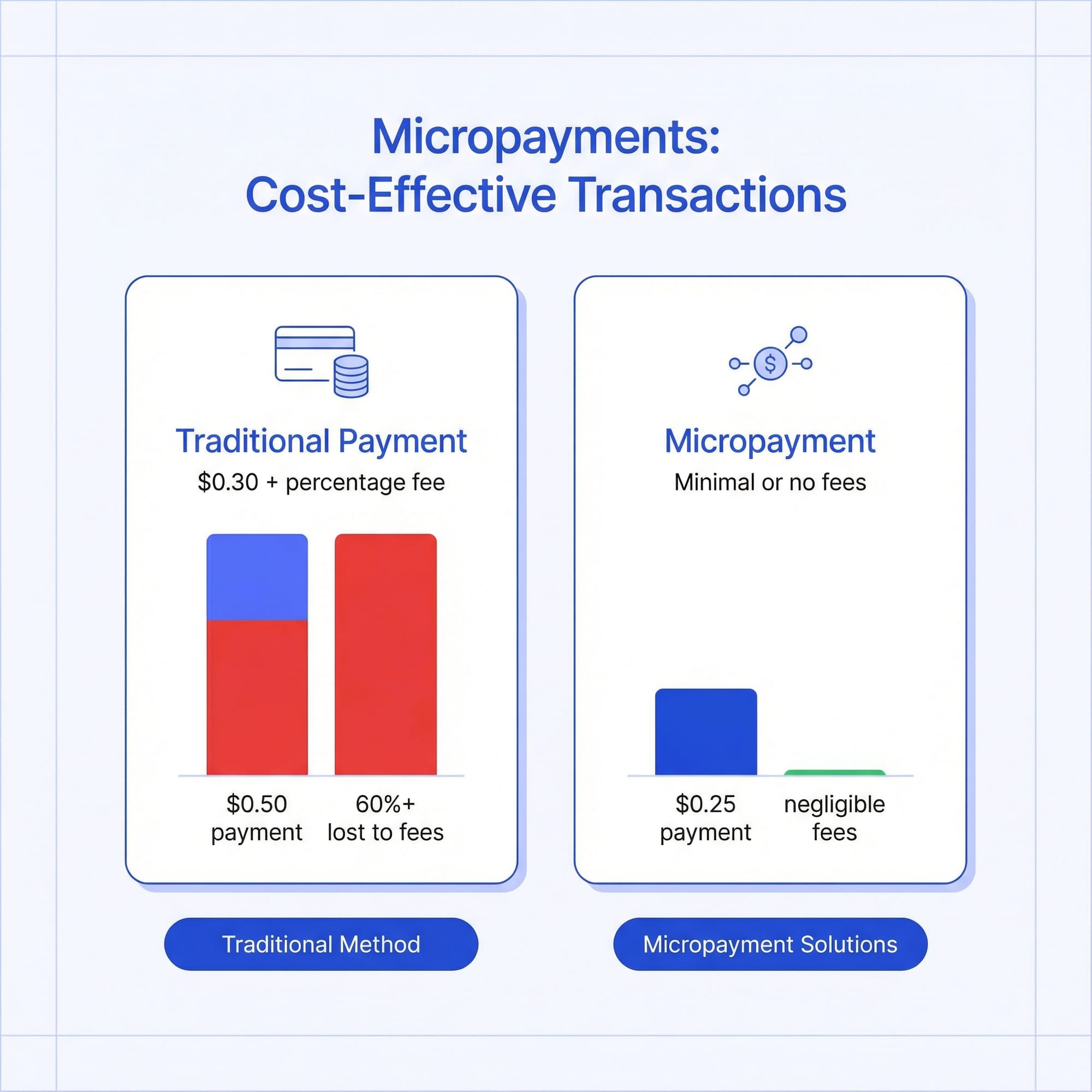
- Traditional payment fees (often $0.30 + percentage) make small transactions uneconomical; for example, a $0.50 payment loses 60%+ to fees alone.
- Modern internet micropayment systems such as the x402 protocol solve the fee problem through batch processing, cryptocurrency rails, and protocol-level innovations.
- Common use cases span digital journalism, gaming (valued at $120B+ in 2023), API monetization, and IoT device transactions.
- PayAI Network serves as a leading x402 payment facilitator, offering simple SDK integration without complex API development, getting merchants live in minutes, not months.
What are micropayments?
Micropayments are often described as “small payments,” but that definition misses what actually makes them powerful.
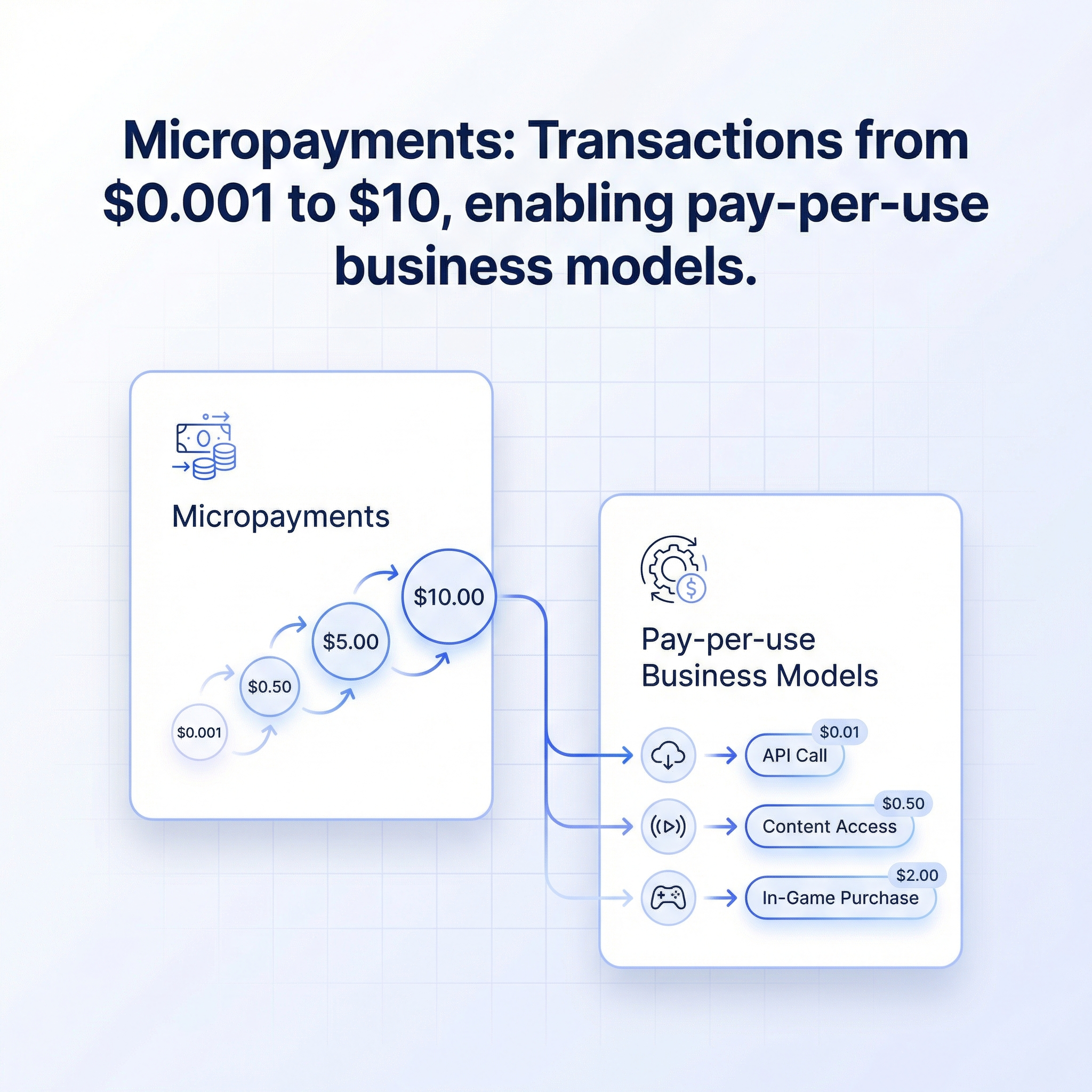
Micropayments are small-value digital transactions typically ranging from fractions of a cent to between $10 and $12, designed to monetize digital goods and services that would be impractical to sell through traditional payment channels. Unlike conventional digital payments where minimum thresholds exist, micropayments enable granular pricing - think paying $0.10 to read a single news article or $0.001 per API call.
When online payments are processed this way, we can exchange value at the same resolution at which software operates. Clients submit their requests, and the service immediately declares the price, which the client can then accept and submit or cancel. When payments occur per request, per action, or per result, entirely new economic models become possible.
Why micropayments matter now more than ever
Modern software looks nothing like the web of the early 2000s. APIs serve millions of requests per day. AI agents make decisions autonomously. Data, compute, and services are consumed dynamically, often by machines rather than humans.
In this environment, coarse pricing models struggle. Flat-rate plans encourage overconsumption. Free tiers invite abuse and distort incentives.
Micropayments allow cost to track value in real time. When each request carries a clear price, systems can make economically rational decisions without human oversight. Software can evaluate whether a call is worth making, whether an alternative is cheaper, or whether demand should be deferred.
This kind of pricing isn’t just convenient but is, in fact, necessary for autonomous systems. As such, micropayments solve a fundamental problem in digital commerce: the inability to charge for value at the granular level it's actually delivered. When a reader wants one article - not a $15 monthly subscription - micropayments make that transaction possible.
The strategic importance extends beyond convenience. Internet micropayment systems enable entirely new business models that create fairer value exchange between creators and consumers while reducing the friction that causes lost revenue.
Consider the economics: publishers estimate that they lose 40% of potential revenue from users unwilling to subscribe for occasional content. Micropayments capture this "casual consumer" segment that currently either bounces or uses ad blockers.
Solving the digital content monetization problem with micropayments
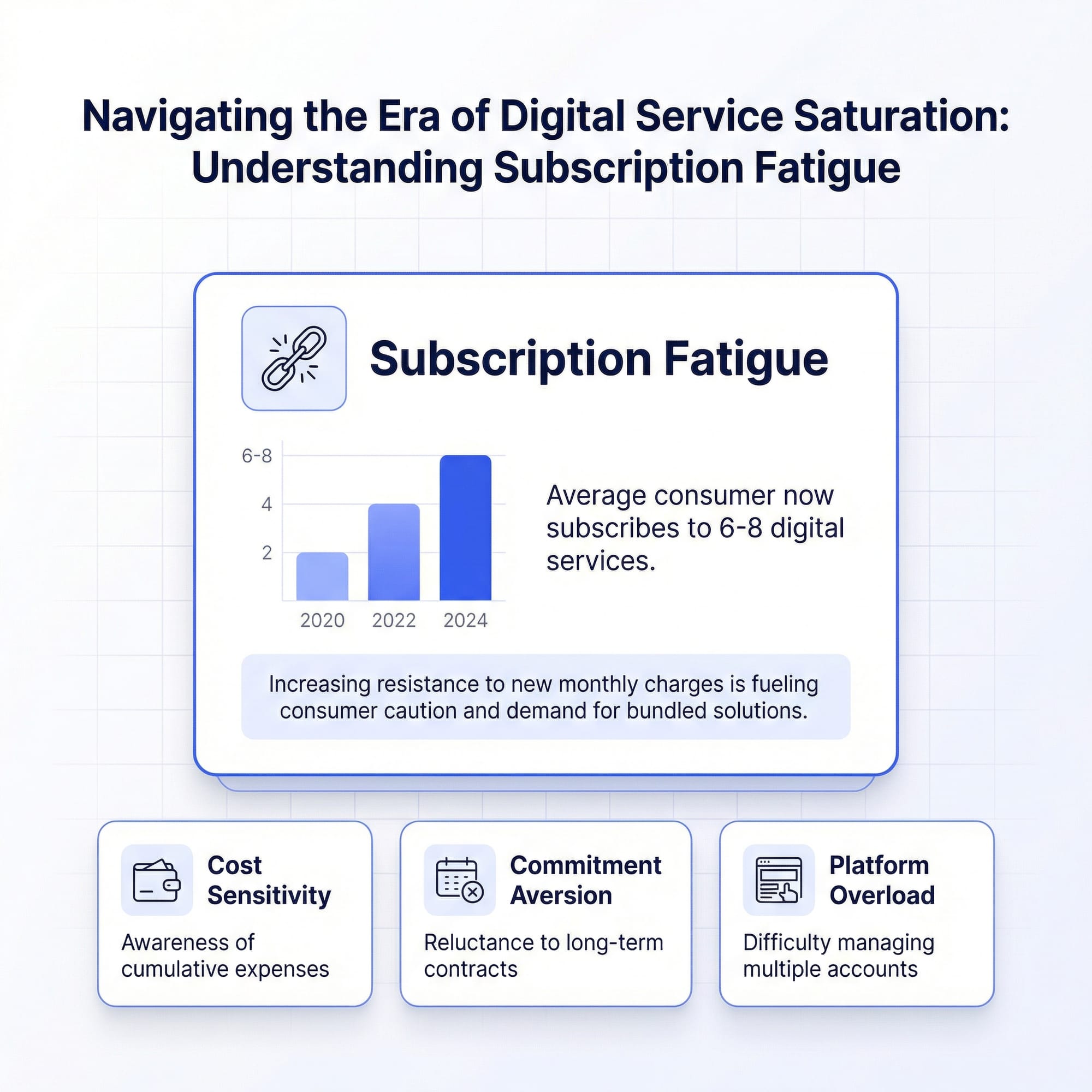
The average consumer now subscribes to 6-8 digital services, creating widespread subscription fatigue. Users increasingly resist adding another monthly charge for content they'll access occasionally.
Micropayments offer a paywall alternative through pay-per-article models:
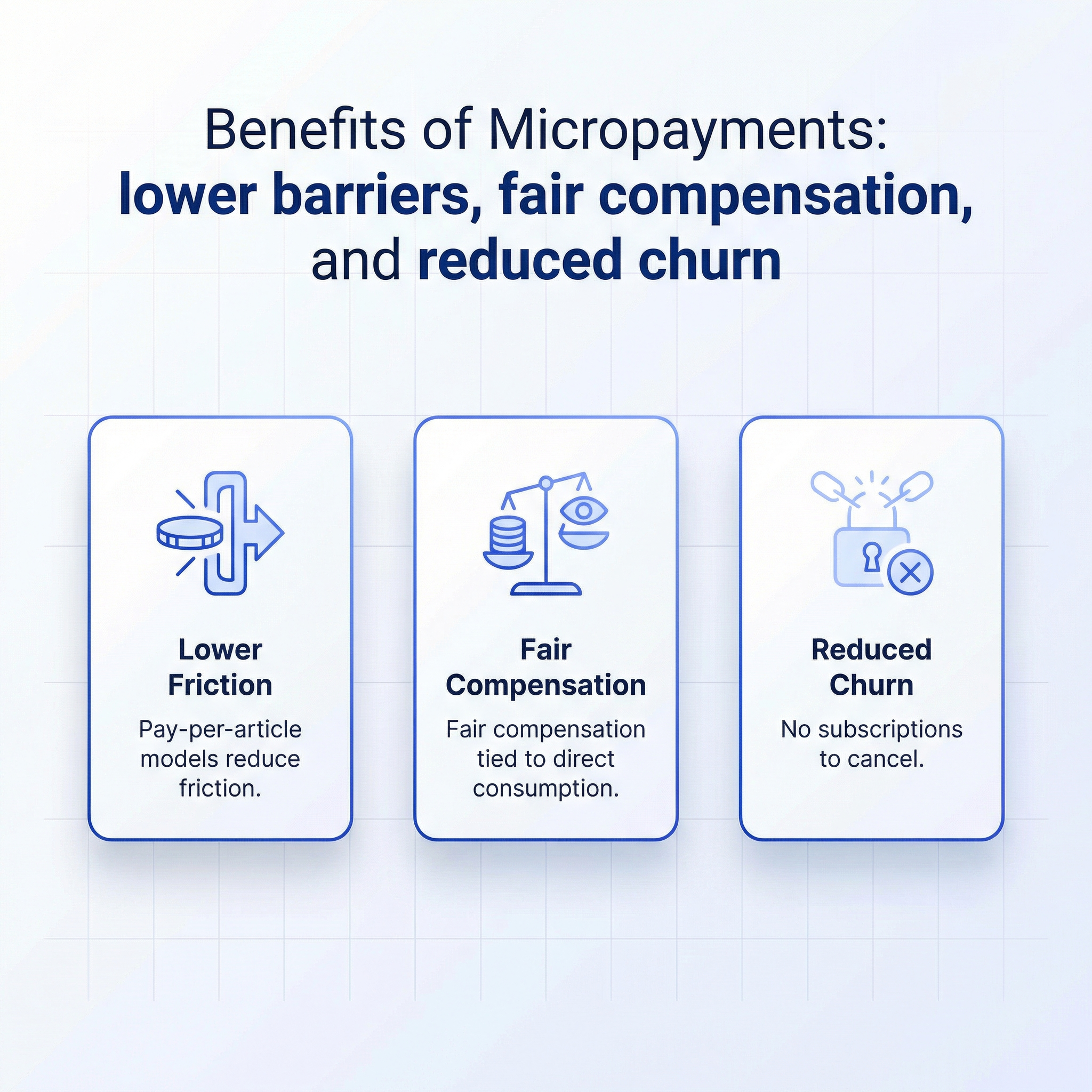
- À la carte consumption: Readers pay only for what they read.
- Lower barrier to entry: $0.25 feels different than $10/month commitment.
- Fair creator compensation: Revenue tied directly to consumption.
- Reduced churn: No subscriptions to cancel.
Platforms like Blendle pioneered this approach in journalism, demonstrating that users will pay for individual articles when the friction is low enough. Studies show micropayment-enabled content can increase engagement by 25-30% compared to hard paywalls.
Micropayments are enabling new digital business models
Beyond content, micropayments unlock business models that simply couldn't exist before. This is because micropayments differ from standard digital payments in three key ways:
- Fee structure optimization: Built to minimize or eliminate fixed per-transaction costs.
- Instant or near-instant settlement: Designed for high-volume, low-friction transactions.
- Aggregate handling: Often batch multiple small transactions before settlement.
As a result, we see innovative micropayment payment strategies (and adoption) across many new industries, as outlined below.
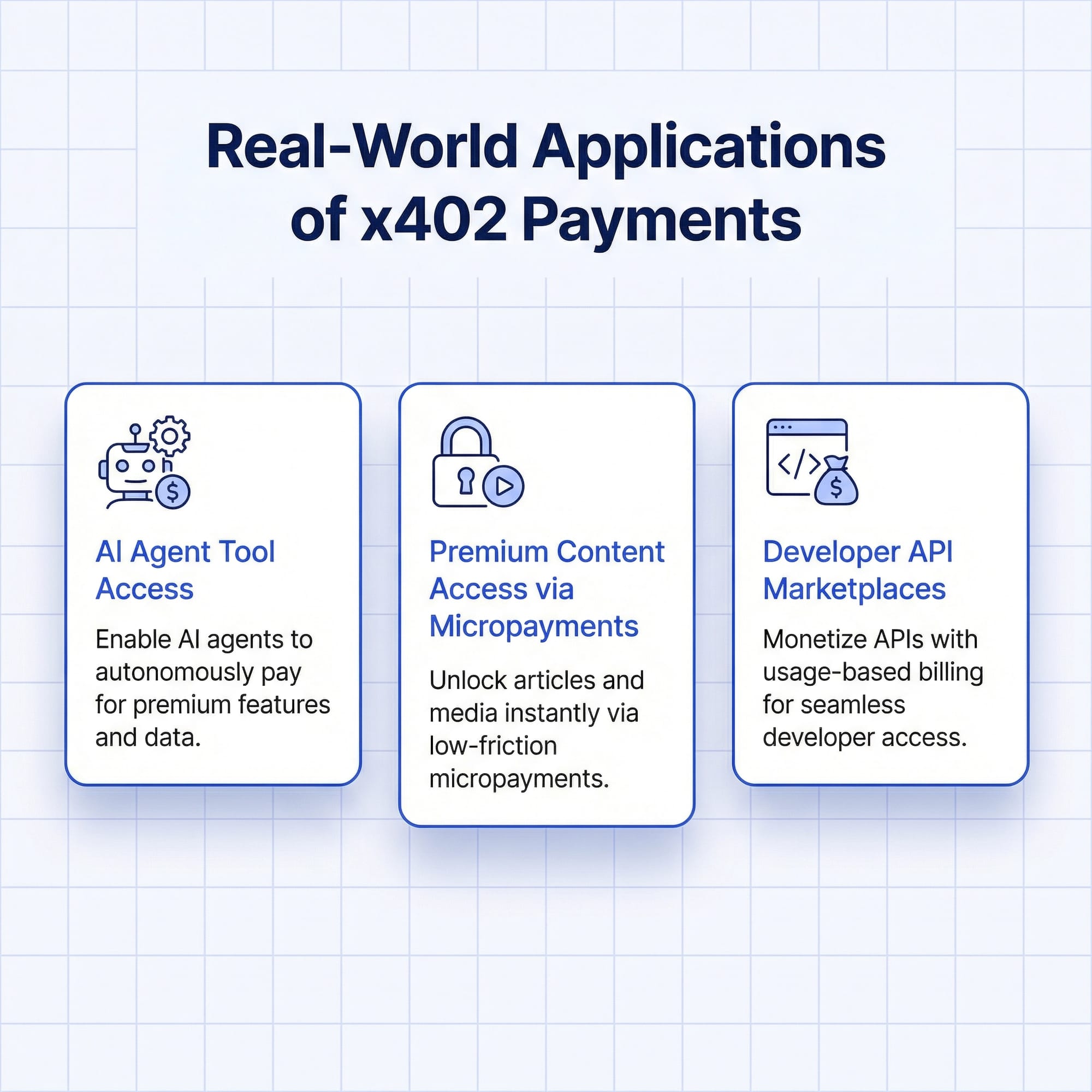
API-as-a-Service pricing
Instead of monthly API tiers with arbitrary limits, developers can charge per-call. A machine learning inference API might charge $0.002 per request, allowing customers to pay exactly for usage.
IoT device transactions
Smart devices can autonomously purchase services - an EV paying for charging by the kilowatt-second, or a sensor network purchasing bandwidth in real-time.
AI and machine learning services
As AI agents become more autonomous, they need the ability to purchase resources, data, and services on behalf of users. Micropayments enable machine-to-machine commerce.
Gaming microtransactions
The gaming industry has proven micropayments at scale, with in-app purchases exceeding $120 billion in 2023 alone.
Can traditional billing systems still work?
Most online billing systems are designed for relationships, not requests. They assume recurring customers, predictable usage, and delayed settlement. Even usage-based pricing is often enforced after-the-fact through metering pipelines and monthly invoices. This model works for human-driven software but breaks down when software interacts with software.
For an API or an AI agent, delayed pricing is nearly as problematic as opaque pricing. If cost information arrives after usage, systems cannot optimize behavior in real time. They either overuse resources or rely on arbitrary limits imposed by the provider.
Simply put, micropayments only work when payment is part of the interaction itself. This is why x402 is so central to changing how we approach online payments.
Micropayments become viable with x402
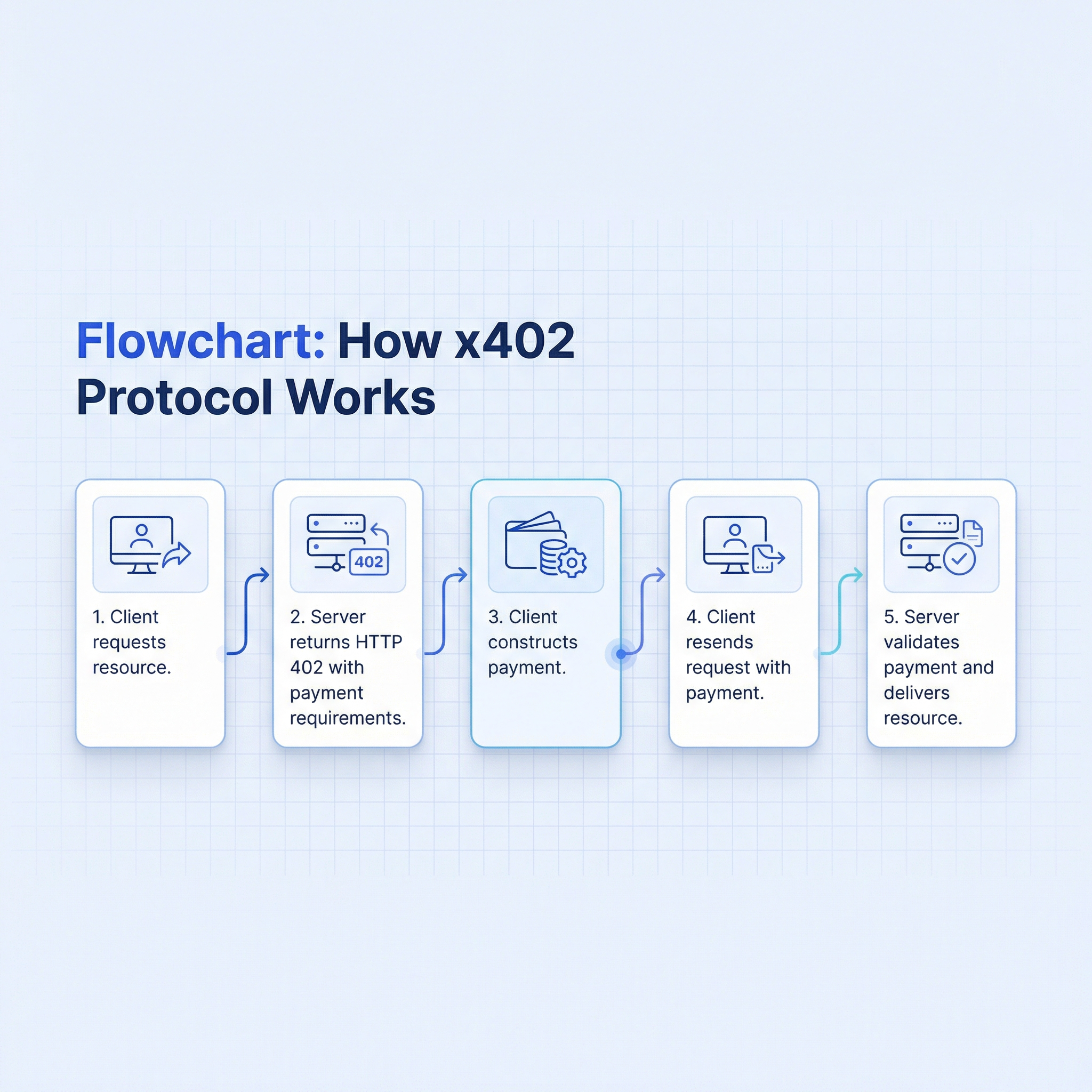
By embedding payments directly into the request–response cycle, x402 removes the historical bottlenecks that made micropayments impractical. A service can declare the price of a request as soon as it is made, and the client can choose whether to pay and retry. Settlement happens immediately, without accounts, subscriptions, or invoices.
Because payment is programmatic and inline, the cost of charging a cent or a fraction of one drops dramatically. Micropayments stop being a special case and become a default option. This enables pricing models that were previously too complex or fragile to maintain, including true pay-per-request APIs, granular data access, and autonomous agent-to-agent transactions.
Micropayments as infrastructure, not a feature
The most successful micropayment systems are not bolted on as monetization features. They are designed into the infrastructure from the beginning. This mirrors earlier financial breakthroughs.
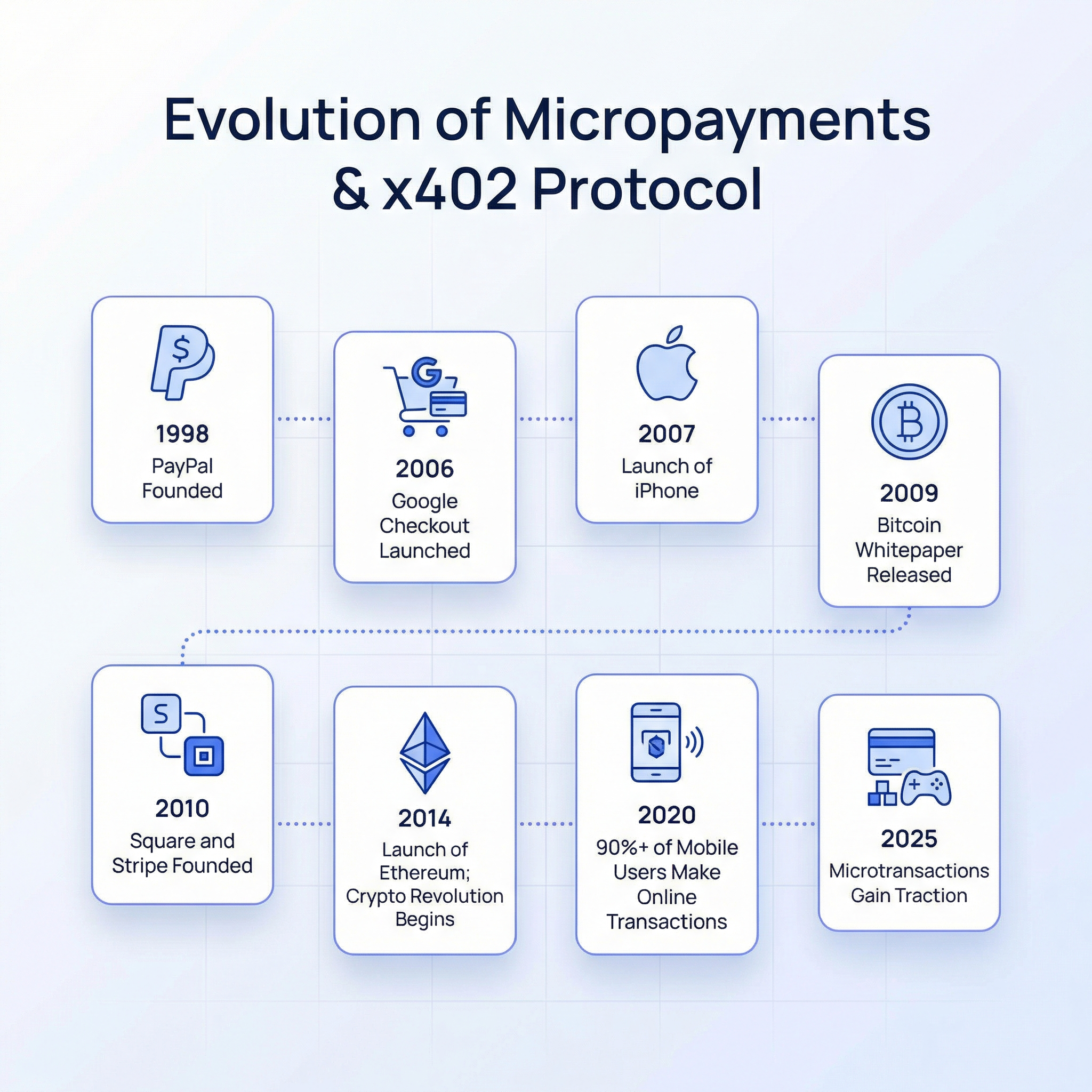
Microloans – a different kind of innovation that changed the financial world in the 1970s – worked not because the loans were small, but because the system was designed to support them. The same can be said of credit cards and now certain cryptocurrency and value-exchange platforms. Trust, incentives, and enforcement are embedded into the structure itself.
Micropayments follow the same rule. When systems are designed around granular value exchange, behavior changes. Developers experiment more freely. Platforms gain clearer demand signals. Markets price themselves more efficiently.
When value moves at software speed
When value can move as freely as data, the internet changes. APIs no longer need free tiers to attract users. AI agents can reason about cost the same way they reason about latency or accuracy. Platforms can open access without sacrificing sustainability. Entirely new markets become possible at the margins.
Micropayments are not a niche idea or pricing gimmick. They are what happens when payments finally operate at the same speed, scale, and granularity as modern software.
The internet has always been good at moving information. Micropayments, and the infrastructure that supports them, are how it learns to move value just as well.
Frequently Asked Questions
What is an example of a micropayment?
A micropayment is any small-value digital transaction, usually under $10. Common examples include:
- Paying $0.25 to read a single news article instead of subscribing to the entire publication.
- Spending $0.99 on a mobile game power-up or cosmetic item.
- $0.001 per API call when using machine learning services like image recognition or text analysis.
- $0.10 to skip ads on a video or audio stream.
- Tipping a content creator $0.50 for a helpful tutorial.
The pay-per-use model is the defining characteristic since you pay only for exactly what you consume.
How much is considered a micropayment?
Micropayments typically range from fractions of a cent to approximately $10-12, though definitions vary by context.
- Ultra-micropayments: Under $0.01 (API calls, IoT transactions)
- Standard micropayments: $0.01-$1.00 (digital content, tipping)
- Upper micropayments: $1.00-$10.00 (premium content, virtual goods)
The $10-12 threshold represents the point where traditional payment processor fees become proportionally acceptable. Below this level, the fixed-fee components of standard payment processing consume too much of the transaction value.
Why don't traditional payment processors support micropayments?
Traditional payment processors charge fees with fixed components (typically $0.20-$0.30 per transaction) that assume larger purchase amounts.
The math doesn't work for small transactions:
- A $10 purchase loses about 6% to fees (acceptable)
- A $1 purchase loses about 33% to fees (painful)
- A $0.50 purchase loses 62%+ to fees (unworkable)
These fees exist because credit card infrastructure involves multiple intermediaries (banks, networks, processors), each taking a cut. The fraud prevention, dispute resolution, and settlement systems have baseline operational costs regardless of transaction size.
Modern internet micropayment systems and x402 payment facilitator solutions solve this through batching, cryptocurrency rails, and protocol-level innovations that eliminate intermediaries.
What is the x402 protocol for micropayments?
The x402 protocol is a modern standard for web-native micropayments that builds on HTTP's 402 “Payment Required” status code, which was defined in the original HTTP specification but never widely implemented.
How it works:
1. A client requests a paid resource (webpage, API endpoint, file).
2. The server returns HTTP 402 with payment requirements in headers.
3. The client's wallet constructs a cryptographically signed payment.
4. The client re-sends the request with the signed payment in a header.
5. The server validates payment and delivers the resource.
This happens seamlessly, often in under a second.
PayAI Network serves as a leading multi-network x402 payment facilitator, handling the complexity of payment validation, multi-chain support, and settlement so merchants can implement x402 with a simple SDK rather than building infrastructure.
How can I accept micropayments on my website?
You have several options, ranging from complex to simple:
Complex approach: Integrate cryptocurrency wallets, run blockchain nodes, build payment verification logic, handle multi-currency, and create payment UX components. Timeline: 3-6 months.
Moderate approach: Use traditional payment APIs with aggregation workarounds and stored value accounts. Timeline: 1-2 months.
Simple approach: Use x402 with an SDK integration and a facilitator like PayAI Network. Simply add a few lines of code to your existing server middleware:
import express from "express";
import { paymentMiddleware, x402ResourceServer } from "@x402/express";
import { ExactSvmScheme } from "@x402/svm/exact/server";
import { HTTPFacilitatorClient } from "@x402/core/server";

const app = express();

app.use(
  paymentMiddleware(
    {
      "GET /weather": {
        accepts: { scheme: "exact", price: "$0.001", network: "solana:EtWTRABZaYq6iMfeYKouRu166VU2xqa1", payTo: svmAddress },
        description: "Weather data",
        mimeType: "application/json",
      },
    },
    new x402ResourceServer(new HTTPFacilitatorClient({ url: "https://facilitator.payai.network" }))
      .register("solana:EtWTRABZaYq6iMfeYKouRu166VU2xqa1", new ExactSvmScheme()),
  ),
);

app.get("/weather", (req, res) => res.json({ weather: "sunny", temperature: 70 }));
PayAI Network lets you integrate x402 payments without API complexity—the simple SDK handles wallet interactions, payment validation, and settlement across multiple networks.
Are micropayments secure?
Yes. Modern internet micropayment systems incorporate multiple security layers:
Cryptographic security:
- Payments are cryptographically signed, making them tamper-proof.
- Payments can only be generated by the wallet holder.
- Transaction data is unforgeable.
Protocol-level protection:
- x402 payments validate at the protocol level before resources are delivered.
- Payment requirements are enforced server-side, preventing bypass.
- Replay attacks are prevented through unique transaction identifiers and blockchain mechanisms.
Economic security:
- Low transaction values limit fraud incentives.
- Pre-funded wallets eliminate credit risk.
PayAI Network security:
- Real-time transaction monitoring.
- Compliance with payment security standards.
- Screening against OFAC-sanctioned entities.
The cryptographic foundation of modern micropayment systems often provides stronger security guarantees than traditional payment methods, which rely heavily on trust relationships rather than mathematical proofs.
Key Takeaways
Micropayments represent a fundamental shift in digital commerce: from bundled subscriptions to granular, fair-value transactions. The technology has finally caught up with the vision, making it practical for businesses of all sizes to implement micropayment monetization.
What you've learned:
- Micropayments enable transactions too small for traditional payment processors.
- The x402 protocol provides a web-native standard for internet micropayment systems.
- Use cases span content, gaming, APIs, and emerging AI/IoT applications.
- Modern solutions like PayAI Network eliminate historical implementation complexity.
Next steps:
1. Evaluate whether micropayments fit your business model using the criteria above.
2. Identify atomic units of value you could price with micropayments.
3. Consider starting with micropayments as a subscription complement.
4. Explore PayAI Network's SDK for simple x402 payment facilitator integration.
The $18.5 billion micropayment market is growing, and the businesses implementing it now will capture the opportunity as consumer and machine payment habits shift toward pay-per-use models.
This guide was written to provide comprehensive understanding of micropayments for digital business owners, developers, and entrepreneurs. For implementation support, consult PayAI Network's documentation and getting started guides at https://docs.payai.network.