

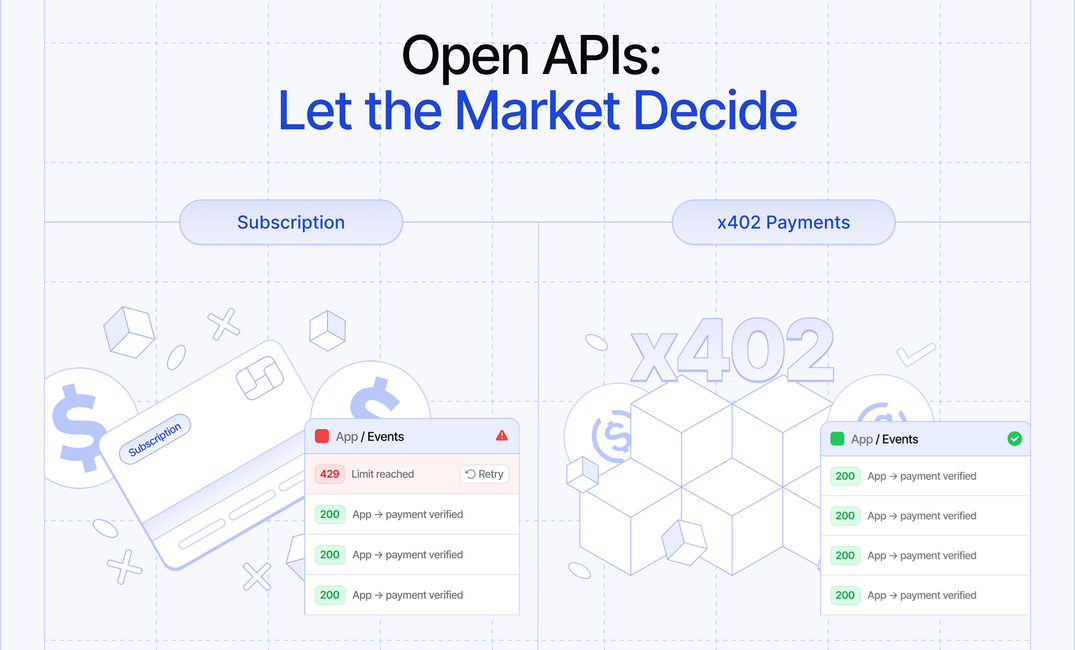
Tiered pricing and rate limits invariably lead to the abuse of freely available resources. As it functions now, the internet does not have an effective way to charge for usage without relying on the messy network of API keys, user credentials, billing systems, and unclear market signals. The x402 protocol solves this longstanding problem and introduces a seamless, economically efficient, and easily deployable solution that works as a service primitive, not a clunky add-on.
In a nutshell
- Open APIs have always faced a tradeoff: openness drives adoption, but free access invites abuse. Open access doesn’t have to mean unpaid access, and with x402, it no longer does.
- Rate limits, API keys, and free tiers attempt to manage this tension, but they distort incentives, punish legitimate users, and require constant manual tuning.
- x402 replaces limits with pricing. Instead of blocking usage, every request carries a transparent cost, making demand economically explicit.
- This shifts abuse from a technical problem to an economic one, where behavior naturally self-regulates based on willingness to pay.
- By letting the market, not quotas, determine access, x402 enables APIs that are open by default, abuse-resistant by design, and far simpler to operate.
The API tradeoff
Open APIs face a fundamental tradeoff.
While open access to resources and services invites experimentation, adoption, and innovation, it also invites abuse. Historically, platforms have addressed this tension with free tiers, rate limits, and API keys. While these tools reduce damage, they also distort incentives.
x402 offers a different approach: replace limits with transparent and immediately-available pricing.
Why Rate Limits Are the Wrong Tool
Rate limits inherently assume that abuse is inevitable and that blocking is better than pricing. They also treat legitimate demand and abuse as the same because in these systems, they do look the same.
In practice, rate limits end up punishing high-value users and they encourage burst abuse at tier boundaries. They require constant tuning in trial-and-error fashion and try to answer the questions of who is using a specific service and how much of it they want instead of asking whether they are willing to pay for what they want.
Abuse Is an Economic Problem
Most abuse isn’t malicious. It often only happens because it is cheap. If requests are free, then scraping, probing, and overuse all become free. As soon as requests have a cost, however, user and system behaviors change immediately. What the x402 protocol does is make every request economically explicit.
Pricing as the Control Surface
With x402, access remains open but cost scales with usage. Demand for services reveals the value of the service.
In practice, instead of a user receiving a notice such as: “You’ve hit your limit,” the system says: “This request costs $0.002.”
This is a fundamentally different way to approach online payments. It allows developers to self-select based on willingness to pay. Even if bad actors choose to burn money, this approach ensures that good actors continue to enjoy uninterrupted access.
Market Signals Beat Guesswork
Free tiers and quotas require guessing. Exactly how much is too much, and who are your real vs. abusive or malicious users? Which use cases matter and will drive value generation, and which ones are empty experimentation or testing?
With x402, the market answers those questions in real time, providing platform teams with cleaner demand signals, fewer false positives, and simpler enforcement logic in place of guesswork, complex pricing tiers, billing issues, and poor customer satisfaction.
Open by Default, Sustainable by Design
With x402, we can finally have APIs that are open without registration, global by default, and abuse-resistant by economics. This is especially powerful for data APIs, AI tools, and public infrastructure, all of which are the very usage verticals that we see the most substantial and sustained growth in.
Open access doesn’t have to mean unpaid access. It’s time for the internet to move from ineffective online payments to seamless native payments for all possible use-cases using x402. Visit PayAI.Network to learn how.