

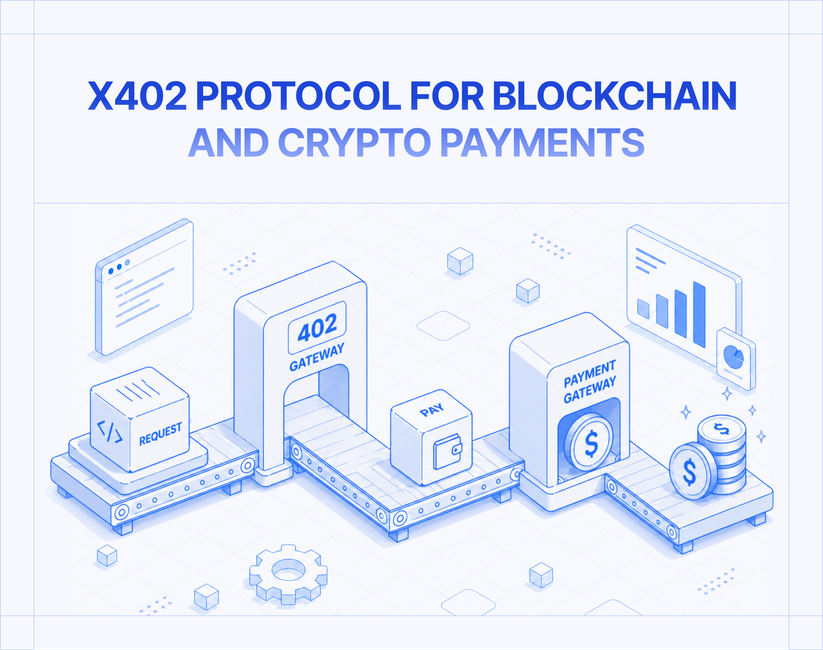
The web was always supposed to have a native payment layer, but for nearly three decades, that vision sat dormant inside a single reserved HTTP status code. Now, blockchain settlement, stablecoins, and the rise of autonomous AI agents have converged to finally activate HTTP 402, and an open protocol called x402 is leading the charge. This guide is a comprehensive resource available on what HTTP 402 means for crypto payments, how x402 works at the protocol level, and how to implement it today.
In a nutshell
- HTTP 402 Payment Required was reserved in the original HTTP specification in 1999 but never implemented because no viable digital payment infrastructure existed at the time.
- The x402 protocol activates HTTP 402 by embedding stablecoin payments (primarily USDC on Solana) directly into the web's native request–response cycle. No accounts, API keys, or subscriptions required.
- AI agents and agentic payments are the breakout use case: x402 lets autonomous software discover prices, pay on-chain, and access resources programmatically without any human intervention.
- x402 has reached $600 million in annualized payment volume as of early 2026, with Solana commanding roughly half of all transaction activity.
- PayAI Network operates as a Solana-first, multi-network x402 facilitator with open-source SDKs in Python, TypeScript, and Go, enabling developers to add internet-native payments to any API in minutes.
What Is HTTP 402 and Why Does It Matter for Crypto Payments?
Every time you encounter a "404 Not Found" error, you're interacting with the HTTP status code system, a standardized language that web servers use to communicate with clients. Buried in that same system is a code most people have never seen: 402 Payment Required. It was reserved nearly thirty years ago for a future where the internet could handle money as natively as it handles data.
That future has arrived. Blockchain networks and stablecoins now provide the programmable, instant settlement layer that HTTP 402 was always waiting for. And with AI agents increasingly operating as autonomous economic actors, the need for a frictionless, machine-readable payment standard is here.
The History of HTTP 402: A Status Code Ahead of Its Time
The HTTP 402 "Payment Required" status code was reserved by the Internet Engineering Task Force in 1999 with [RFC 2616] and maintained in [RFC 7231] (2014) for a digital payment protocol that did not yet exist.
Early digital cash attempts, like DigiCash, failed by 1998 due to uneconomical credit card processing fees for micropayments, leading the web to adopt models like advertising and subscriptions instead of the payment layer the 402 code anticipated.
For a deeper exploration of how HTTP 402 Payment Required evolved from a reserved code to an active protocol, PayAI's blog traces the full arc.
Why Blockchain Unlocks HTTP 402's Original Promise
Blockchain technology resolves every constraint that kept HTTP 402 dormant until recently. The alignment is almost uncanny:
- Programmable money. Stablecoins like USDC settle in seconds on-chain, matching the response times that HTTP clients expect. Circle issued 750 million USDC on Solana in February 2026 alone, signaling deep liquidity and issuer commitment.
- Permissionless access. No bank accounts, merchant IDs, or payment processor approvals are needed. Any client with a wallet can pay any server with an address.
- Global by default. A developer in Lagos and a server in Singapore can transact instantly without intermediaries, currency conversion, or correspondent banking delays.
- Composability. Smart contracts enable escrow, refunds, conditional payments, and multi-party splits natively. These are capabilities that traditional payment rails require entire platforms to replicate.
Solana, in particular, has emerged as the settlement layer most aligned with HTTP-level payment requirements. With sub-second finality and average transaction fees of $0.00025, it's the first blockchain where paying fractions of a cent per API request is economically rational. In December 2024, Solana processed 66.9 million transactions in a single day, exceeding the combined volume of all other major blockchains.
The convergence of AI agents, micropayments, and decentralized finance makes HTTP 402 crypto payments not just viable but essential for the current and future internet economy.
The x402 Protocol Explained: How Internet-Native Crypto Payments Work
x402 is an open, neutral standard that does something deceptively simple: it embeds payment into HTTP's native request–response cycle. A client asks for a resource, learns the price, pays on-chain, and gets access, all within the flow of a standard HTTP interaction.
The protocol specifies a PaymentRequirements schema that includes the payment scheme, network, maximum amount required, and resource metadata. Clients respond with cryptographically signed payment payloads in PAYMENT-SIGNATURE headers. Facilitators expose /verify and /settle endpoints for transaction validation. The entire system is implemented as open-source middleware across all major web frameworks, requiring minimal code to activate.
For a technical deep dive into the protocol's architecture, see the x402 payment protocol overview on PayAI's blog.
The Role of Facilitators in x402
x402 Payment Facilitators are the coordination layer that makes x402 practical at scale. They sit between resource servers and the blockchain, handling the operational complexity that most API providers don't want to manage directly.
A facilitator's responsibilities include:
- Transaction validation: Verifying payment payload signatures, amounts, nonces, and replay prevention.
- Settlement confirmation: Submitting transactions to blockchain networks and monitoring finality.
- Error handling: Returning structured error responses for failed or insufficient payments.
- Infrastructure management: Maintaining RPC connections, wallet infrastructure, rate limiting, and alerting.
PayAI Network operates as a Solana-first, multi-network x402 facilitator, enabling resource servers to accept crypto payments without running blockchain nodes or managing wallets directly. The facilitator exposes three core endpoints — /verify, /settle, and /list — that handle the entire on-chain interaction.
Critically, the x402 ecosystem supports multiple competing facilitators. As of December 2025, x402 had recorded $600 million in annualized payment volume, with Coinbase, PayAI, Dexter, and other facilitators processing transactions. This competitive dynamic prevents vendor lock-in: developers can switch facilitators by changing a single URL, with no application code changes required.
Supported Networks, Tokens, and Client/Server Libraries
PayAI's facilitator currently supports 12+ blockchain networks including Solana, Base, Skale, Polygon, Avalanche, IoTeX, Peaq, Sei, and their respective testnets. Servers can specify multiple networks per endpoint in an accepts array, letting clients choose their preferred chain based on wallet configuration.
On the developer tooling side, x402 SDKs are available across all major ecosystems:
- Python: requests and httpx client libraries
- TypeScript: fetch and axios integrations
- Go: net/http wrapper
Server middleware is available for FastAPI, Flask, Express, Hono, and Next.js. All SDKs provide a single function call that returns a signed payment payload — no manual transaction construction, signing, or retry logic required.
HTTP 402 and Agentic Commerce: Why AI Agents Need Crypto Payments
The most transformative use case for x402 isn't human-to-machine payments, it's machine-to-machine commerce - also known as Agentic Commerce. AI agents are increasingly performing tasks that require purchasing data, compute, APIs, and services autonomously. And traditional payment methods are fundamentally incompatible with how agents operate.
Credit cards require human identity and PCI compliance. OAuth flows require browser-based consent. API keys require account creation and manual provisioning. None of these work for an autonomous agent that needs to discover a new data source, evaluate its price, pay for access, and consume the result, all within a single task execution loop.
x402 crypto payments are agent-native by design. Agents can discover prices from structured HTTP headers, sign transactions with their own wallet keys, and receive access programmatically. No pre-registration. No human in the loop. McKinsey projects that agentic commerce could represent up to $1T for the U.S. alone and $3–5T globally by 2030, and x402 is the payment rail purpose-built for this economy.
How AI Agents Discover and Execute x402 Payments
The mechanism is elegant in its simplicity. An AI agent interacts with an x402-enabled endpoint using the same HTTP client libraries it already uses for any web request:
- The agent sends a standard HTTP request to a resource URL.
- It receives an HTTP 402 response containing structured payment metadata: amount, accepted networks, facilitator URL, and token type.
- The agent parses these requirements programmatically, no human interpretation needed.
- In an example where the agents hold a Solana keypair with a USDC balance, the agent constructs a transfer instruction using the x402 Payment Payload schema, signs it with its private key, and retries the request with the payment proof attached.
- Access is granted instantly.
This flow works identically whether the client is a human using a browser extension or a headless Python script running on a server. The client SDK documentation covers implementation details for every supported language.
Notably, industry standards are converging around this model. Google's Agent Payments Protocol (AP2) establishes cryptographic intent mapping and delegated authorization designed to interoperate with on-chain payment rails, positioning x402 as the natural settlement layer for autonomous agent transactions.
Use Cases: Agentic Commerce Powered by x402
The breadth of applications is already visible in early adoption patterns:
- Financial data agents purchasing real-time market data from APIs on a pay-per-request basis, paying $0.001 per price quote instead of $500/month for a data subscription they use sporadically.
- Research agents paying for premium content, academic papers, or proprietary datasets as they encounter them during autonomous research workflows.
- Multi-agent orchestration where agents pay each other for subtask completion: an analysis agent paying a data-cleaning agent, which in turn pays a scraping agent.
- E-commerce bots comparing prices across vendors and purchasing products on behalf of users with pre-authorized budgets.
- IoT devices paying for cloud compute or bandwidth in real time, settling costs at the granularity of actual usage.
The transaction data supports this trajectory. Weekly x402 transactions on Solana peaked at 6.8 million during the week of December 22, 2025, with over 25,000 unique seller wallets and 18,000 unique buyer wallets participating since October 2025. The protocol shows sustained, decentralized economic activity, and an increasing number of big tech players are adding developer support for the protocol.
x402 vs. Traditional Payment Rails for Agent Economies
The comparison is stark when you evaluate payment methods through the lens of agent compatibility:
- Credit cards: Require human identity verification, PCI compliance infrastructure, 2–3% processing fees, and multi-day settlement. An agent cannot obtain a credit card.
- API keys + subscriptions: Require account creation, key management, and committing to a pricing tier. Agents overpay for unused capacity or hit rate limits during peak usage.
- x402 with stablecoins on Solana: No identity required. Transaction costs of $0.00025 per transaction. Sub-second settlement. Pure pay-per-use. For a high-frequency agent executing 1,000 requests per hour, total transaction costs approximate $0.25.
The economics are unambiguous. For any use case involving high-frequency, low-value, or autonomous transactions, x402 on Solana is orders of magnitude more efficient than legacy payment rails.
Building AI agents that need to pay for data, compute, or services? Explore PayAI's client SDKs for Python, TypeScript, and Go →
The Economics of x402: Micropayments, Stablecoins, and Usage-Based Pricing
x402 doesn't just change how payments are processed; it changes what's economically possible to sell. When transaction costs drop below a fraction of a cent, entirely new monetization models emerge.
Stablecoins eliminate the volatility concern that has historically limited crypto payments for commerce. USDC maintains a 1:1 peg backed by U.S. Treasuries, and its deep liquidity on Solana, evidenced by Circle's $750 million USDC issuance on Solana in February 2026, makes it a reliable settlement asset for both buyers and sellers.
Crucially, x402 itself has no built-in protocol fees. It's an open standard, not a rent-seeking intermediary. Facilitators set their own pricing and the competitive facilitator market keeps costs aligned with value. PayAI offers a free tier of 1,000 settlements per month with no API key setup required.
Why Solana Is the Ideal Network for x402 Crypto Payments
PayAI's Solana-first strategy is grounded in technical and economic reality:
- Sub-second finality matches HTTP response time expectations. Users and agents don't wait. Payment confirmation happens in approximately 500 milliseconds.
- Transaction fees consistently below $0.01: typically $0.001 per transaction, make true micropayments viable. A $0.001 API call with a $0.001 transaction fee is economically rational. The same call with a $0.30 credit card fee is not.
- High throughput (4,000+ TPS capacity) supports the scale demands of machine-to-machine commerce, where a single agent might execute thousands of paid requests per hour.
- Deep USDC liquidity and ecosystem support, including Visa's stablecoin settlement launch over Solana in December 2025, signal enterprise-grade maturity.
That said, x402 is explicitly multi-network. PayAI supports 12+ chains, and the protocol is designed so that Solana leadership doesn't mean chain lock-in.
From Subscriptions to Pay-Per-Request: A New Monetization Paradigm
The subscription model has dominated internet monetization for two decades, but it creates persistent misalignment. Users overpay for services they use lightly. Power users strain capacity without proportional compensation. Long-tail usage, such as an occasional API call, a single article read, the one-time data query, goes unmonetized entirely because the friction of account creation exceeds the value of the transaction.
x402 enables a fundamental shift to consumption-based pricing. McKinsey research confirms that stablecoin-powered payment infrastructure is driving this transition from subscription to transaction-based models.
Consider the implications for different stakeholders:
- API providers can monetize long-tail usage that subscriptions leave on the table, charging $0.001 per request to anonymous agents that would never create an account.
- Content creators can charge per article, per query, or per data point, capturing value from readers who want one piece, not a monthly subscription.
- Data providers can offer granular, real-time pricing that reflects the actual value of each data point rather than bundling everything into flat-rate tiers.
The economics work because x402 eliminates the per-transaction fee floor that made micropayment pricing irrational for decades. When the cost of processing a payment drops to $0.00025, charging $0.001 for an API call becomes a viable business model.
Regulatory Landscape for HTTP 402 Blockchain Payments in 2026
Builders deploying x402 in production need to understand the regulatory environment, not as a barrier, but as a framework that's rapidly maturing in their favor. The key development: stablecoin regulation is moving from ambiguity to clarity, and that clarity accelerates adoption.
Stablecoin Regulation: GENIUS Act, MiCA, and Global Frameworks
Two landmark regulatory frameworks are shaping the stablecoin landscape for x402 payments:
In the United States, the Guiding and Establishing National Innovation for U.S. Stablecoins (GENIUS Act) establishes a federal framework for payment stablecoins. It allows insured depository institutions and qualified nonbank issuers to issue payment stablecoins, requires 1:1 reserve backing with U.S. currency or similarly liquid assets, and mandates monthly reserve disclosures. The impact is significant: EY-Parthenon research shows 54% of institutions not yet using stablecoins expect adoption within 6–12 months post-GENIUS Act.
In the European Union, the Markets in Crypto-Assets Regulation (MiCA) became fully applicable on December 30, 2024, establishing harmonized rules for stablecoin issuers and crypto-asset service providers across all EU member states.
For x402, these frameworks mean that USDC, the primary settlement token, operates under increasingly clear legal guardrails. Regulatory clarity doesn't slow adoption; it accelerates it by reducing institutional risk.
x402 in the Broader Payments Ecosystem: 2026 Outlook
x402 isn't emerging in isolation. It's part of a broader convergence of embedded finance, programmable money, and autonomous AI, and its trajectory suggests it's moving from early adoption to mainstream infrastructure.
x402 Adoption and Market Traction
The numbers tell a compelling story. As of early 2026, x402 has reached $600 million in annualized payment volume with cumulative transaction volume exceeding 120 million transactions and over $41 million in cumulative value transferred.
On Solana specifically, the ecosystem is diversifying. 25,000+ unique seller wallets and 18,000+ buyer wallets have participated since October 2025, with multiple facilitators competing for market share. Solana commands approximately 49% of x402 transaction volume, with Polygon and other chains growing rapidly.
PayAI Network's role in this ecosystem is significant. On Solana, PayAI is the largest facilitator by number of real transactions and transaction volume, handling more than $300,000 in Q1 of 2026.. The shift from speculative volume to sustained organic demand — driven by real machine-to-machine payment use cases — signals that x402 is crossing from experiment to infrastructure.
How x402 Fits with CBDCs, Tokenized Deposits, and Programmable Money
x402 is designed to be future-proof. At the protocol level, it's token-agnostic — the scheme and network parameters can accommodate any on-chain asset, not just USDC.
This means:
- CBDCs could become an x402 settlement option if central banks design them with programmable transfer capabilities. The Federal Reserve and other central banks are actively exploring programmable money architectures that would be compatible with x402's settlement model.
- Tokenized bank deposits offer another bridge between traditional finance and x402, allowing banks to participate in internet-native payment flows without requiring end users to hold crypto.
- Programmable payments, such as conditional transfers, time-locked escrows, multi-party splits, are natively supported by blockchain settlement. Research from the European Data Protection Supervisor distinguishes between programmable money (where rules restrict usage) and programmable payments (automatic conditional transfers), both of which x402 can leverage.
The broader narrative shift is significant: x402 is moving the conversation from "crypto payments", which carries speculative connotations, to "internet-native payments," which describes a fundamental infrastructure upgrade. This reframing matters for enterprise adoption and regulatory perception alike.
Why use PayAI Network for x402 Blockchain and Crypto Payments
PayAI Network is purpose-built for the x402 economy. Here's what differentiates it:
- Solana-first, multi-network architecture. Optimized for the speed and cost characteristics that make micropayments viable, while supporting 12+ blockchain networks to avoid chain lock-in.
- Open-source SDKs for every major language and framework. Python, TypeScript, Go. FastAPI, Flask, Express, Hono, Next.js, Gin. The barrier to adoption is measured in minutes, not weeks.
- Purpose-built facilitator infrastructure. Payment verification, settlement confirmation, and observability, all managed so developers can focus on their products, not blockchain operations.
- AI agents as first-class citizens. PayAI's tooling is designed from the ground up for autonomous agents, not retrofitted from human-centric payment flows. The client SDKs handle 402 interception, transaction construction, and retry logic automatically.
- Mission-aligned with an open internet. x402 is an open standard. PayAI is one of multiple competing facilitators. Developers can switch providers by changing a single URL. There's no vendor lock-in, no walled garden, and no proprietary protocol.
For developers exploring the open API marketplace opportunity, x402 via PayAI represents the most direct path from idea to monetized endpoint.
Frequently Asked Questions
What is HTTP 402 Payment Required?
HTTP 402 is a status code that was reserved in the original HTTP/1.1 specification (RFC 2616, 1999) for digital payments. For nearly three decades it went unused because no viable internet-native payment protocol existed. The x402 protocol now activates HTTP 402 by pairing it with blockchain settlement and stablecoin payments, enabling any HTTP endpoint to require and verify payment programmatically.
How does x402 work for crypto payments?
When a client requests a resource from an x402-enabled server, the server responds with HTTP 402 and structured payment metadata (price, accepted tokens, network, facilitator URL). The client constructs and signs a stablecoin transaction on-chain, then re-sends the request with payment proof attached. The facilitator validates the transaction, and the server delivers the resource. The entire flow completes in a single HTTP round-trip, typically under one second on Solana.
What is the difference between x402 and traditional API payment methods?
Traditional methods require account creation, API key provisioning, subscription selection, and billing setup before a single request can be made. x402 requires none of this. It's a zero-account, pay-per-request model where any client with a wallet can pay any server with an address. There are no subscriptions to manage, no keys to rotate, and no unused capacity to overpay for.
Can AI agents use x402 to make payments autonomously?
Yes, x402 is agent-native by design. An AI agent holding a Solana keypair with USDC balance can discover prices from HTTP 402 response headers, sign transactions autonomously, and gain instant access to paid resources. No human intervention, pre-registration, or OAuth flows are required. PayAI's client SDKs handle the entire payment flow automatically.
What stablecoins and blockchains does x402 support?
USDC on Solana is the primary settlement option via PayAI Network, optimized for sub-cent transaction costs and sub-second finality. PayAI's facilitator supports 12+ networks including Base, Polygon, Avalanche, Sei, and others. At the protocol level, x402 is token- and chain-agnostic. Any on-chain asset can serve as a payment method.
Is x402 compliant with payment regulations?
The regulatory landscape is maturing rapidly. The U.S. GENIUS Act and EU MiCA provide increasingly clear frameworks for stablecoin payments. Compliance obligations vary by role: facilitators may have MSB obligations, while resource servers accepting payment for their own services generally do not. Builders should design for compliance from day one and consult legal counsel for jurisdiction-specific requirements.
How do I add x402 payments to my API or website?
Install PayAI Network's server middleware for your framework (Express, FastAPI, Flask, etc.), configure pricing per endpoint and your wallet address, and deploy. The middleware handles 402 response formatting and payment verification automatically. The quickstart guide walks through the full setup in minutes.
What are the transaction fees for x402 crypto payments on Solana?
Solana transaction fees average $0.001 per transaction, making true micropayments economically viable. x402 itself has no built-in protocol fees - it's an open standard. Facilitator pricing varies; PayAI offers a free tier of 1,000 settlements per month with paid tiers for higher throughput.