

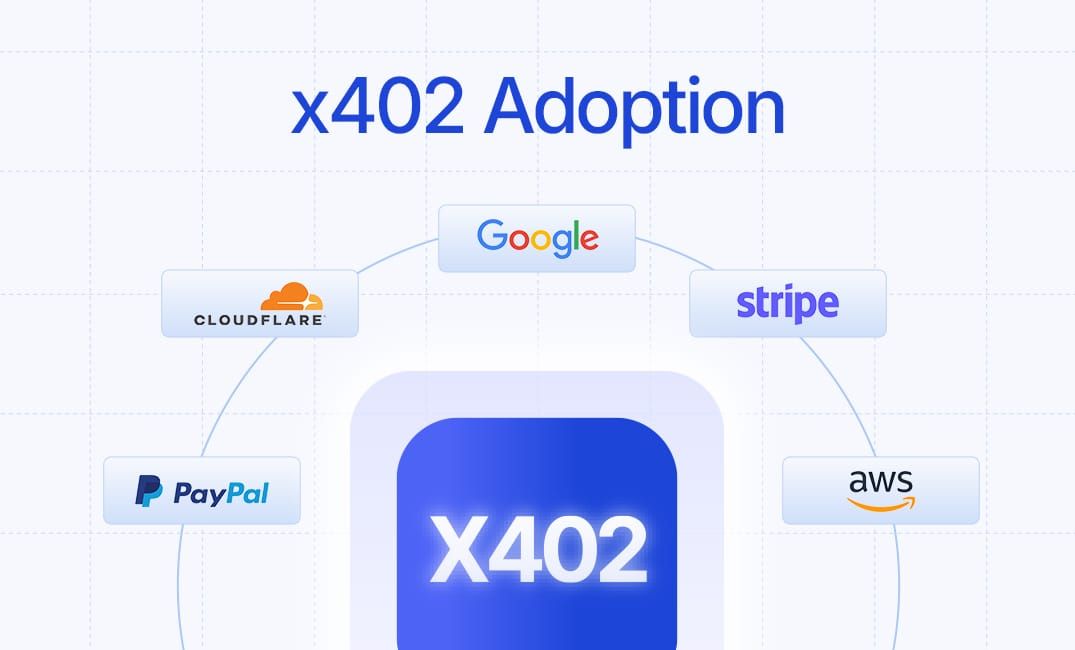
The x402 protocol has gone from an open-source experiment to a standard backed by some of the biggest names in tech and payments in barely over a year. Here's a clear-eyed look at who's building with x402, why adoption is accelerating now, and what it means for developers and builders positioning themselves for the agentic economy.
In a nutshell
- x402 has major backers. Google, Cloudflare, Stripe, Visa, AWS, and Circle have all moved to support or integrate the x402 protocol, signaling it's no longer experimental.
- A formal foundation exists. Cloudflare and Coinbase co-founded the x402 Foundation in September 2025 with founding members spanning cloud, payments, and infrastructure.
- AI is the catalyst. The agentic AI market is projected to grow from $7.3 billion in 2025 to as much as $324 billion by 2034, creating massive demand for machine-native payment rails.
- Solana leads settlement: Sub-cent fees and 400ms finality make Solana the dominant chain for high-frequency x402 micropayments.
- You can build today. Open-source SDKs and facilitator infrastructure, including PayAI Network's Solana-first tooling, let developers start monetizing APIs and AI services right now.
x402 Adoption Is Accelerating: Who's Building With It
When Coinbase publicly released the x402 protocol specification in May 2025, it revived the long-dormant HTTP 402 status code for stablecoin-based payments embedded directly into web requests. Within months, adoption moved far beyond the crypto-native crowd.
By September 2025, Cloudflare and Coinbase co-founded the x402 Foundation, with Google, Visa, AWS, and Circle joining as founding members. Agentic payments are no longer a concept of the future. It is now a cross-industry coalition spanning cloud computing, global payments, and internet infrastructure.
What makes this moment different from previous crypto payment attempts is the convergence: infrastructure providers, payment processors, and AI platforms are all moving toward x402 simultaneously. The internet's payment layer is being rebuilt for the agentic era, and the biggest players are choosing to build it together.
Google and x402: Search Giant Enters Internet-Native Payments
Google's involvement with x402 goes well beyond a logo on a foundation page. The company developed the Agent Payments Protocol (AP2) in collaboration with Cloudflare and partners including Accenture, PayPal and MetaMask. AP2 positions x402 as the underlying settlement mechanism for agent-initiated purchases and machine-to-machine transactions running on Google Cloud infrastructure.
This matters for several reasons. Google Cloud is one of the largest platforms for deploying AI workloads, and Gemini-powered agents are increasingly autonomous. Those agents need a way to pay for external services — data, compute, API calls — without human intervention. x402 gives them exactly that: a payment handshake that happens within a standard HTTP request.
Google's membership in the x402 Foundation alongside Visa, AWS, and Circle also sends an unmistakable signal to enterprise buyers: the agentic commerce system is not a crypto-only play. These companies plan to provide production-grade infrastructure that collectively serves billions of users.
Cloudflare and x402: Payments at the Edge
Cloudflare's adoption of x402 may be the most architecturally significant move in the ecosystem. The company launched a pay-per-crawl feature that lets website owners charge AI bots and crawlers for content access using stablecoin micropayments, turning a security headache into a revenue stream.
Because Cloudflare sits in front of millions of websites as a reverse proxy, embedding x402 payment support at the network edge means any site on Cloudflare can potentially monetize traffic without changing application code. For developers building on Workers or Pages, this removes enormous friction.
Cloudflare CEO Matthew Prince has publicly stated that x402 has the potential to become a foundational internet protocol for machine-to-machine payments, comparing its trajectory to HTTP and HTTPS. When a non-crypto-native infrastructure company with that reach treats a payment primitive as a first-class feature, it's a paradigm shift.
Stripe and x402: Legacy Payments Meets the New Standard
Stripe's move toward x402 is arguably the strongest validation signal for mainstream adoption. The company launched machine payments with x402 integration in preview, enabling AI agents to pay for API calls and digital services using USDC, with payments settling into merchants' Stripe balances as fiat currency.
This bridge is critical. Stripe processed over $1 trillion in payment volume in 2024 and serves as the payment backbone for millions of internet businesses. Its x402 support means existing merchants can tap into stablecoin-based micropayments without rebuilding their payment stack or learning crypto infrastructure.
For the millions of SaaS platforms, marketplaces, and API providers already on Stripe, this is a practical on-ramp. They can accept payments from AI agents using x402 while continuing to manage revenue through the same Stripe dashboard they already use. That's how protocol adoption scales: by meeting businesses where they are.
AWS Deepens Commitment to Agentic Payments with x402 Integration into its services
Not to be outdone by its cloud rivals, Amazon Web Services (AWS) has significantly expanded its commitment to the agentic economy by integrating x402 support into its Lambda and API Gateway services.
In a recent article, the company announced that developers can now natively configure API Gateway to return a 402 Payment Required response for non-authenticated or non-paid requests, using AWS Lambda to handle the x402 payment negotiation and settlement via the PayAI Network Facilitator.
This move dramatically lowers the friction for the millions of developers on AWS to monetize their serverless functions and data streams, positioning x402 as a first-class feature for consumption-based cloud services.
AWS, already a founding member of the x402 Foundation, is now providing production-grade tooling to ensure that agents running on platforms like Amazon Bedrock can seamlessly pay for resources across the cloud ecosystem.
Beyond the Big Four: The Growing x402 Ecosystem
Adoption extends well beyond Google, Cloudflare, Stripe and AWS. The open-source x402 ecosystem now includes SDKs in TypeScript, Python, Rust, and Go, with framework-specific integrations for Next.js, Cloudflare Workers, and more, all available through the x402 GitHub repository. Developers can explore x402 server integrations and client libraries across multiple stacks.
Solana has emerged as the dominant settlement layer for x402 transactions. With transaction costs of approximately $0.001 and block times of 400 milliseconds, it's the economically and latency-optimal chain for high-frequency micropayments. This is a key reason for why Solana captures a dominant share of x402 settlement volume.
The network effect is real: each new adopter, whether a cloud provider, a SaaS platform, or a developer deploying an API, makes x402 more valuable for every other participant. More endpoints accepting x402 means more incentive for agents to support it, and vice versa.
AI Agent Platforms and Agentic Commerce
AI agent platforms are where x402 adoption has the most transformative potential. The agentic AI market is projected to grow from $7.3 billion in 2025 to between $139 billion and $324 billion by 2034, and that growth creates urgent demand for payment infrastructure that agents can use natively.
Major AI frameworks are already moving. Google's Agent-to-Agent (A2A) protocol uses AP2 with x402 settlement. Anthropic's Model Context Protocol (MCP) enables tool integrations where agents can discover, negotiate, and pay for services within a single HTTP round-trip. No accounts, no API keys, no human in the loop.
The use cases are concrete: autonomous purchasing, pay-per-request API access, machine-to-machine coordination, and real-time resource allocation. x402 is emerging as the default payment rail for the agentic economy. The x402 introduction docs provide a solid starting point for understanding how it fits into your architecture.
Why Big Players Are Choosing x402 Now
There are multiple reasons for why big tech and payment players are coming together to work on this now :
- The AI boom demands it. Autonomous agents are proliferating across every industry. They need a payment protocol that's native to HTTP, requires no human intervention, and settles instantly. x402 was designed for exactly this.
- Legacy rails can't keep up. Traditional payment infrastructure is too slow, too expensive, and too complex for real-time, usage-based, and machine-driven payments. Credit card minimums, multi-day settlement, and account-based authentication don't work when an AI agent needs to pay $0.002 for an API call in 400 milliseconds.
- Stablecoins have matured. USDC has reached over $75 billion in market capitalization and operates on 29 blockchain networks. Annual stablecoin transaction volume surpassed $4 trillion in 2025. The settlement asset is ready and traditional payment systems have already started to incorporate it.
- Regulatory clarity is arriving. The U.S. Congress passed the GENIUS Act, the first comprehensive federal stablecoin law, reducing regulatory risk for enterprises evaluating x402 adoption.
- x402 is simple to integrate. It uses a standard HTTP status code and minimal server-side logic. The barrier to enterprise adoption is low by design.
What x402 Adoption Means for Developers and Builders
If you're a developer, founder, or product manager evaluating x402, here's what big-player adoption translates to in practical terms:
- Larger addressable market. As Cloudflare exposes x402 to millions of websites and Stripe makes it available to its merchant base, the number of x402-capable endpoints and paying agents grows rapidly. Building x402 support into your product means tapping into that expanding network.
- You can start today. Open-source SDKs across TypeScript, Python, and Go make integration straightforward. Whether you're building a Next.js API, a FastAPI service, or a Go microservice, there's a path to monetization.
- Facilitator infrastructure is ready. Coinbase offers a managed facilitator with a free tier of 1,000 transactions per month. For Solana-first builders, PayAI Network provides dedicated facilitator infrastructure optimized for speed and cost.
- Early movers have an advantage. The x402 ecosystem is still young enough that builders who integrate now will be positioned at the forefront of agentic commerce as agent traffic scales.
What's Next for x402 Adoption
The trajectory is clear, and several developments will accelerate it further:
- More platform integrations. Expect additional cloud providers, SaaS platforms, and AI frameworks to announce x402 support as the foundation matures and developer demand grows.
- Protocol evolution. x402 v2, released in December 2025, introduced multi-chain settlement support, wallet-based identity, reusable access sessions, and automatic service discovery, all informed by six months of mainnet production usage.
- Standardization. The x402 Foundation's independent governance structure, modeled after how HTTP and HTTPS are maintained, positions the protocol for potential W3C or IETF involvement, which would further legitimize it as an internet standard.
- Expanding facilitator networks. PayAI Network is actively expanding multi-network support and developer tooling to meet growing demand, ensuring that Solana-first builders have production-grade infrastructure as adoption scales.
The direction points toward x402 becoming the default payment layer of the programmable web: the missing piece that turns every API endpoint, every AI service, and every piece of content into something that can be paid for natively, instantly, and programmatically.
Frequently Asked Questions
What is x402 and why are companies adopting it?
x402 is a protocol that uses the HTTP 402 status code to enable stablecoin-based payments embedded directly into web requests. Companies are adopting it because legacy payment rails are too slow and expensive for AI-driven, real-time, and usage-based payments. The maturity of stablecoins like USDC and the explosive growth of autonomous AI agents have created urgent demand for exactly this kind of infrastructure. For a deeper explanation, see our x402 protocol overview.
How is Google using the x402 protocol?
Google developed the Agent Payments Protocol (AP2) with x402 as the settlement layer for agent-driven commerce on Google Cloud. Google also joined the x402 Foundation as a founding member, signaling that x402 is intended for mainstream enterprise use across cloud and AI infrastructure.
What does Cloudflare's x402 integration mean for web developers?
Cloudflare's edge-level x402 support means any website behind Cloudflare can potentially monetize traffic, including AI bot and crawler traffic, with stablecoin micropayments. For developers using Workers or Pages, this makes it trivial to add payment gates to any endpoint without modifying application logic.
How does Stripe's support for x402 affect online businesses?
Stripe's x402 integration acts as a bridge: AI agents pay in USDC via x402, and merchants receive funds in their Stripe balance as fiat. This means millions of existing Stripe businesses can accept agent payments without learning crypto infrastructure or rebuilding their payment stack.
Can AI agents use x402 to make payments autonomously?
Yes. x402 is agent-native by design. It requires no accounts, no API keys, and no human intervention, just a standard HTTP request-response cycle with a payment header. AI agent frameworks from Google, Anthropic, and others are already integrating x402 as a native payment mechanism.
How can I start building with x402 today?
The fastest path is through PayAI Network's open-source SDKs and quickstart documentation. You can set up an x402-enabled server or client in minutes across TypeScript, Python, or Go, with multi-network facilitator infrastructure ready for production use.