

Updated September 13, 2026 UTC. This article now separates announced integrations and network upgrades from claims about x402 market share. x402 began as a Coinbase-incubated protocol for expressing payment requirements over HTTP. Base helped establish the early ecosystem; Solana is another supported network, not a replacement for that work.
For PayAI, the case for building on Solana is practical: compatible payment tooling, network performance and partners exploring new uses. Those are reasons to investigate a deployment, not proof that agent spending has migrated from one chain to another.
Base built the on-ramp
Base remains part of the x402 ecosystem and PayAI’s multi-network infrastructure. Early activity helped developers explore pay-per-request services. Transaction counts alone, including token-driven activity, do not establish useful purchases, an agent population or a reliability benchmark.
We can acknowledge that contribution without treating Base’s role as finished.
What the Solana sources establish
Three documented developments are relevant to builders, with different implications:
- Foundation participation. The Linux Foundation’s July 14, 2026 operational-launch announcement lists the Solana Foundation as a premier member alongside Visa and Stripe. Membership is a governance commitment; it is not a payment-volume measure or the event that first made Solana support possible.
- A merchant-integration agreement. The Solana Foundation’s July roundup, published August 5, reports KSNET’s memorandum of understanding to integrate Solana Pay and test x402. The cited 330,000-plus merchants and more than $4 billion in monthly volume describe KSNET’s existing network and business, not activated x402 merchants or x402 settlements. A planned pilot still needs deployment and usage evidence.
- Network targets are not payment guarantees. The September 4 August roundup reports that target slot time reached 300 ms on August 28, superseding this article’s 350 ms figure. Slot time is not finality or end-to-end API latency. The Alpenglow overview describes roughly 150 ms target finality and development/testing work. The Agave v4.3 schedule targets resuming mainnet feature activation on September 28, with dates explicitly subject to change; it does not certify that Alpenglow is already active or guarantee that date for a particular payment flow.
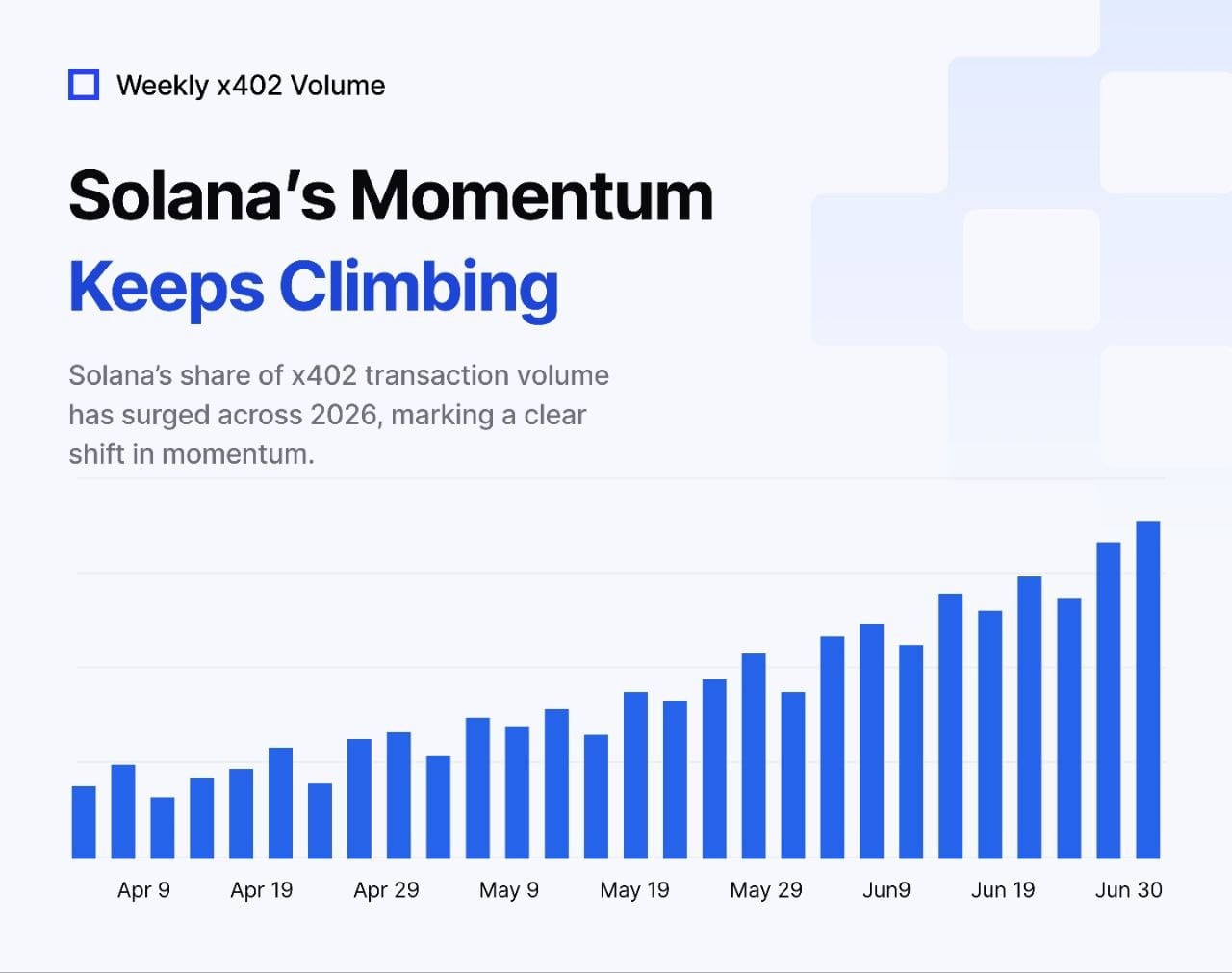
- Market share remains unverified here. The earlier claim of more than 80% lacked a reproducible dated export, common cross-chain denominator and disclosed filtering rules. We have removed it. A transaction count, dollar amount and number of distinct wallets answer different questions; none alone identifies autonomous agents or proves sustained demand.
The evidence supports continued ecosystem development, not a verified migration of agent-native spending toward Solana. To measure that claim, use comparable periods and chain coverage, disclose failed/test/incentivized-activity treatment, and distinguish repeat customers from repeated transactions.
This isn't a knockout — it's the standard getting bigger
x402 can support implementations on multiple networks. That extensibility does not mean every client, token, payment scheme or facilitator works everywhere. Builders still need to match the server’s payment requirements to supported software and funded wallets.
Our position is that Solana is worth building on. Whether it is the right settlement network for a service depends on measured fees, reliability and the actual confirmation policy. Solana’s confirmation guide explains why commitment and expiration matter; a slot-duration headline is not a service-level guarantee.
Where PayAI is putting its weight
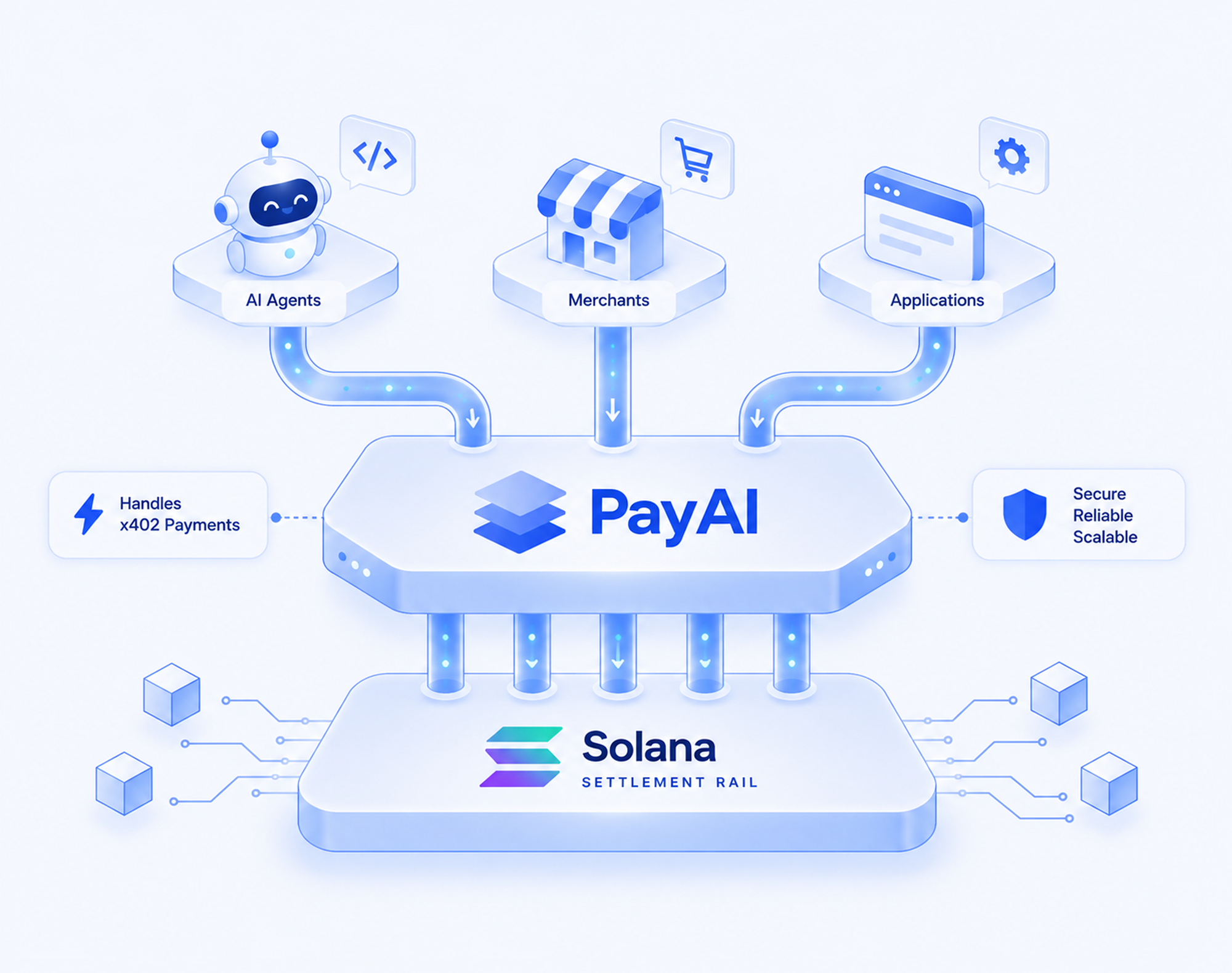
PayAI is a multi-network x402 facilitator that enables merchants to accept supported stablecoin payments via HTTP 402. That includes Solana and Base. Check the supported networks and chosen payment scheme; the facilitator does not bridge or convert an arbitrary incoming asset.
But PayAI is a Solana-native project, built by a Solana-native team, for a Solana-native reason: this is where we think the agent economy's transaction layer is actually heading. As that shift plays out, our focus is on our own ecosystem — the partners, merchants, and agent builders choosing Solana as their settlement layer — and making sure the facilitator infrastructure underneath them is the best it can possibly be. If you're building on Solana and haven't looked at what an x402 integration takes, our quickstart documentation is the fastest way in.
Base got this whole category started. We're not interested in taking anything away from that. We're just building for where it's going.