

The x402 payment protocol represents the most significant advancement in web payments in 30 years. After three decades of incremental advancements, developers finally have a standardized, blockchain-powered approach to native web payments, one that is designed specifically for the age of AI agents and machine-to-machine commerce. This guide covers everything you need to know about implementing x402 payments, from foundational concepts to production-ready code examples.
x402 payments in a nutshell:
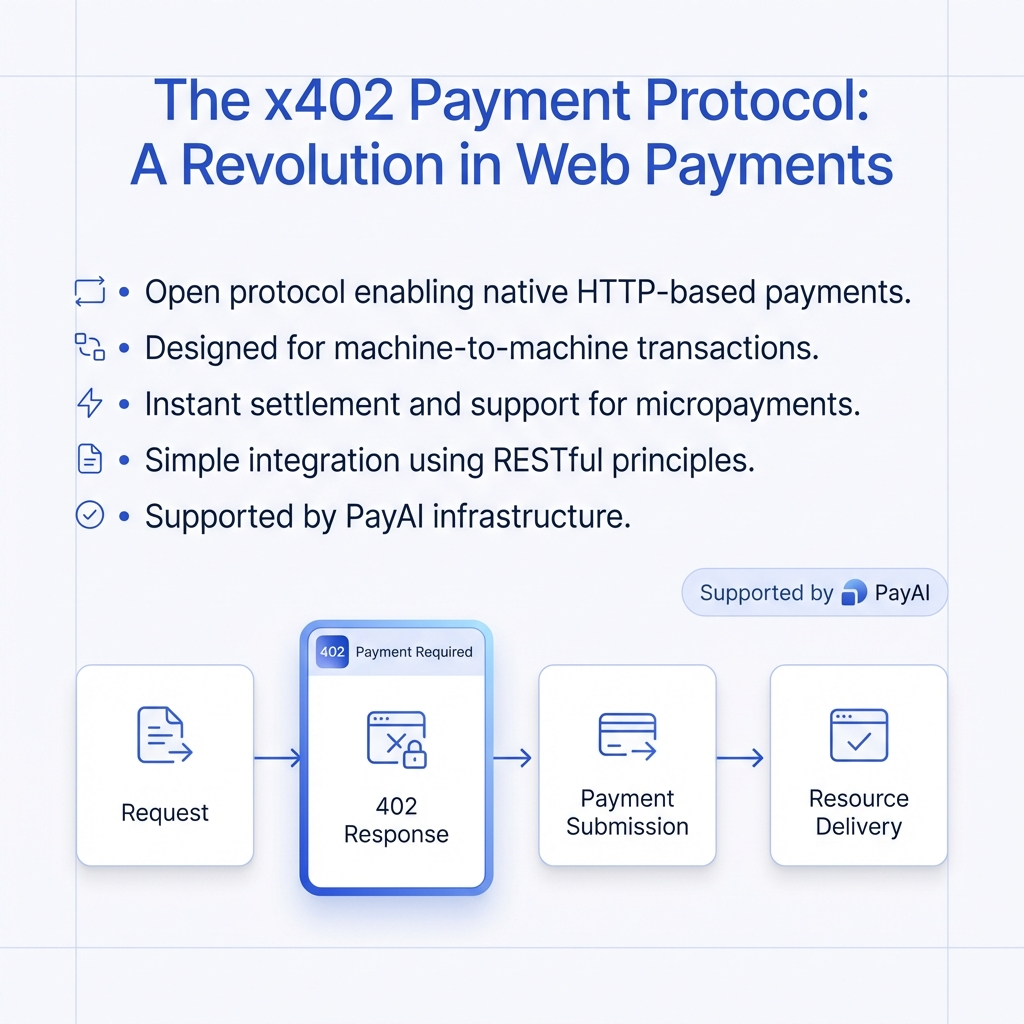
- x402 is an open protocol that enables native HTTP-based payments using blockchain rails, finally delivering on the 25-year promise of HTTP 402 Payment Required.
- Designed for machines, not just humans: x402 enables AI agents and autonomous systems to discover, negotiate, and complete payments without human intervention.
- Instant settlement and micropayments: Built on networks like Base and Solana, x402 supports sub-cent transaction fees and immediate finality with no merchant accounts required.
- Simple HTTP integration: The protocol follows RESTful principles, using standard HTTP headers and JSON payloads that any developer can implement.
- PayAI provides turnkey infrastructure: Skip months of blockchain development with pre-built SDKs, payment verification, and analytics dashboards.
Understanding the x402 context and the dawn of native web payments
The early architects of HTTP’s original codebase reserved status code 402 with a simple note: “Payment Required: reserved for future use.” They envisioned a web where payments were as native as authentication, where accessing premium content or services would be possible using standard protocol negotiation and not the clunky checkout flows that we see as standard today.
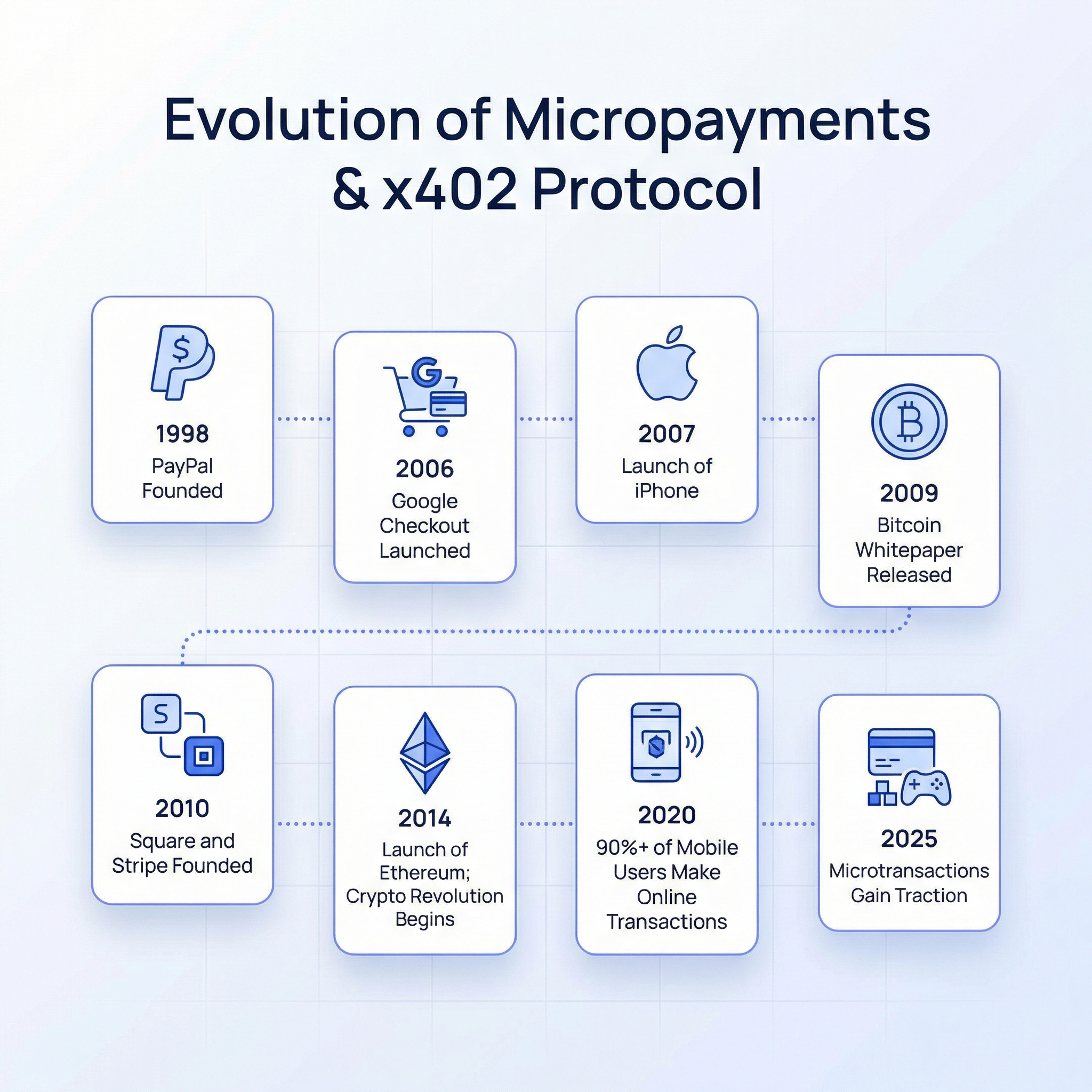
That future took longer than expected. Early attempts at web payments, such as DigiCash, CyberCash, and various micropayment schemes, all failed. They lacked the critical infrastructure needed to make web-native payments a reality: universally accepted digital currencies, low-cost transaction rails, and trustless verification mechanisms.
Today, that infrastructure exists. Stablecoins provide price-stable digital currencies. Networks such as Solana, and Layer 2 networks such as Base enable transactions for fractions of a cent. Smart contracts automate payment verification without intermediaries. And Coinbase's backing of the x402 payment protocol brings enterprise validation to what was once a theoretical possibility.
The timing couldn't be better. The AI agent market is exploding, with autonomous systems increasingly needing to purchase APIs, data, and compute resources on their own. These machine-to-machine payments demand programmatic solutions, which is exactly what x402 delivers.
This guide provides the most comprehensive resource available on the x402 payment protocol: what it is, how it works, why it matters, and how to implement it in your applications today.
Get Started with PayAI →
What is the x402 payment protocol?
The x402 payment protocol is an open standard that enables native HTTP-based payments using blockchain technology. Rather than redirecting users to external payment pages or requiring complex billing integrations, x402 embeds payment negotiation directly into the HTTP request-response cycle.
When a client requests a protected resource, the server responds with HTTP status 402 and structured payment requirements. The client then constructs a payment, submits cryptographic proof, and, upon verification, receives the requested resource. The entire flow happens programmatically, making it ideal for APIs, AI agents, and any machine-to-machine commerce scenario.
Built on blockchain rails (primarily stablecoins on Solana and EVM networks), x402 delivers instant settlement, global accessibility, and transaction costs low enough to support true micropayments.
The technical definition
At its core, the x402 payment protocol is a specification for payment negotiation over HTTP. It defines:
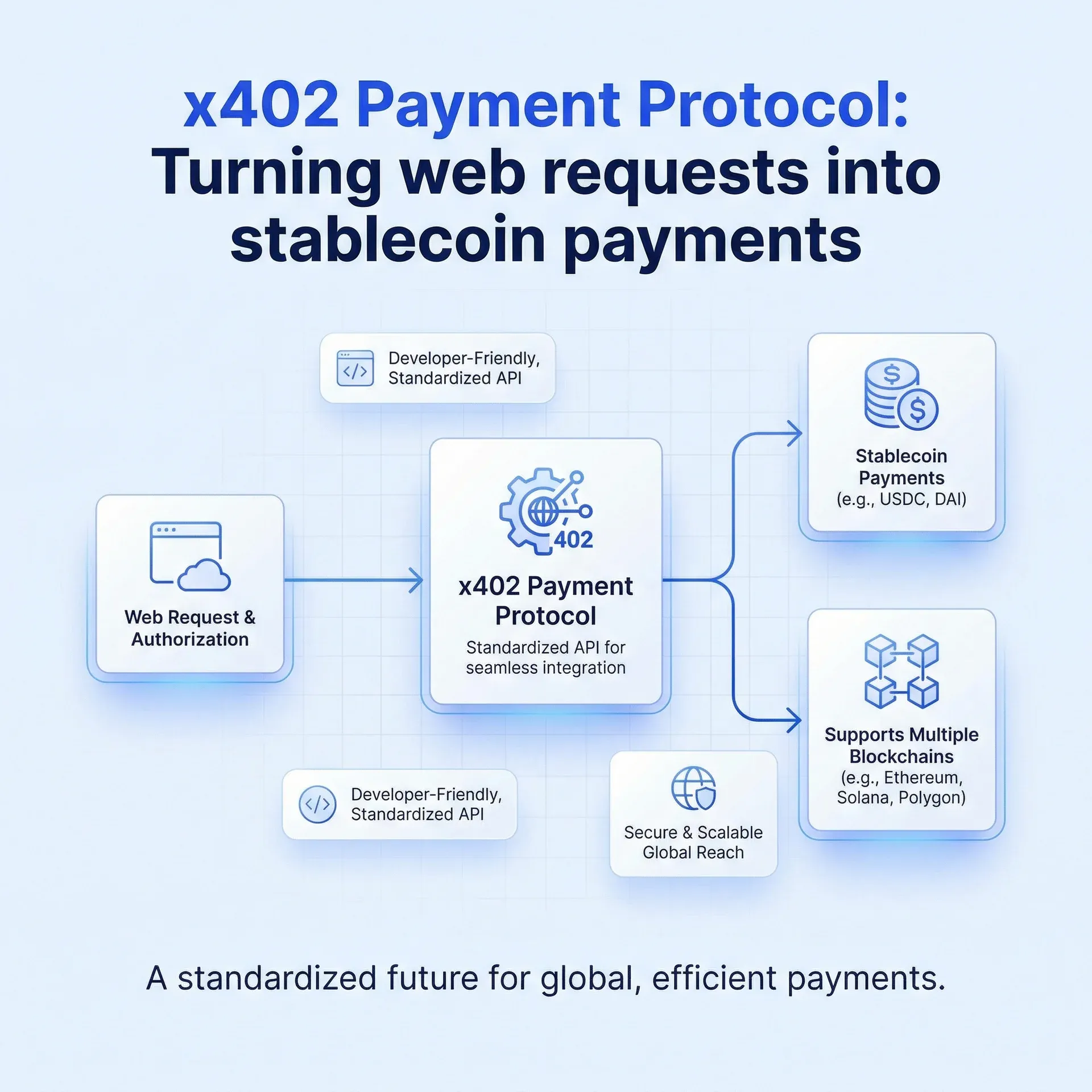
- Structured payment requirements: When a server returns a 402 status code, it includes headers and/or a JSON body specifying accepted currencies, amounts, recipient addresses, and supported payment networks.
- Payment proof format: Clients submit payment proof (typically a signed transaction or receipt) via the
PAYMENT-SIGNATUREheader, allowing servers to verify payment without direct blockchain interaction. - Stateless design: Following RESTful principles, each request contains all information needed for processing. Servers don't need to maintain payment session state.
- Multi-network support: While USDC on Base and Solana are the primary implementation, the protocol supports multiple EVM-compatible networks and currencies through standardized payment requirement structures.
javascript

// Example x402 payment requirement header structure

{
"x402Version": 2,
"error": "PAYMENT-SIGNATURE header is required",
"resource": {
"url": "<https://api.example.com/premium-data>",
"description": "Access to premium data",
"mimeType": "application/json"
},

"accepts": [
{
"scheme": "exact",
"network": "solana:5eykt4UsFv8P8NJdTREpY1vzqKqZKvdp",
"amount": "10000",
"asset": "EPjFWdd5AufqSSqeM2qN1xzybapC8G4wEGGkZwyTDt1v",
"payTo": "CKPKJWNdJEqa81x7CkZ14BVPiY6y16Sxs7owznqtWYp5",
"maxTimeoutSeconds": 60,
"extra": {
"feePayer": "2wKupLR9q6wXYppw8Gr2NvWxKBUqm4PPJKkQfoxHDBg4"
}
}
],
"extensions": {}
}
How x402 differs from traditional payment APIs
Understanding x402's advantages requires comparing it to traditional payment processors like Stripe or PayPal:
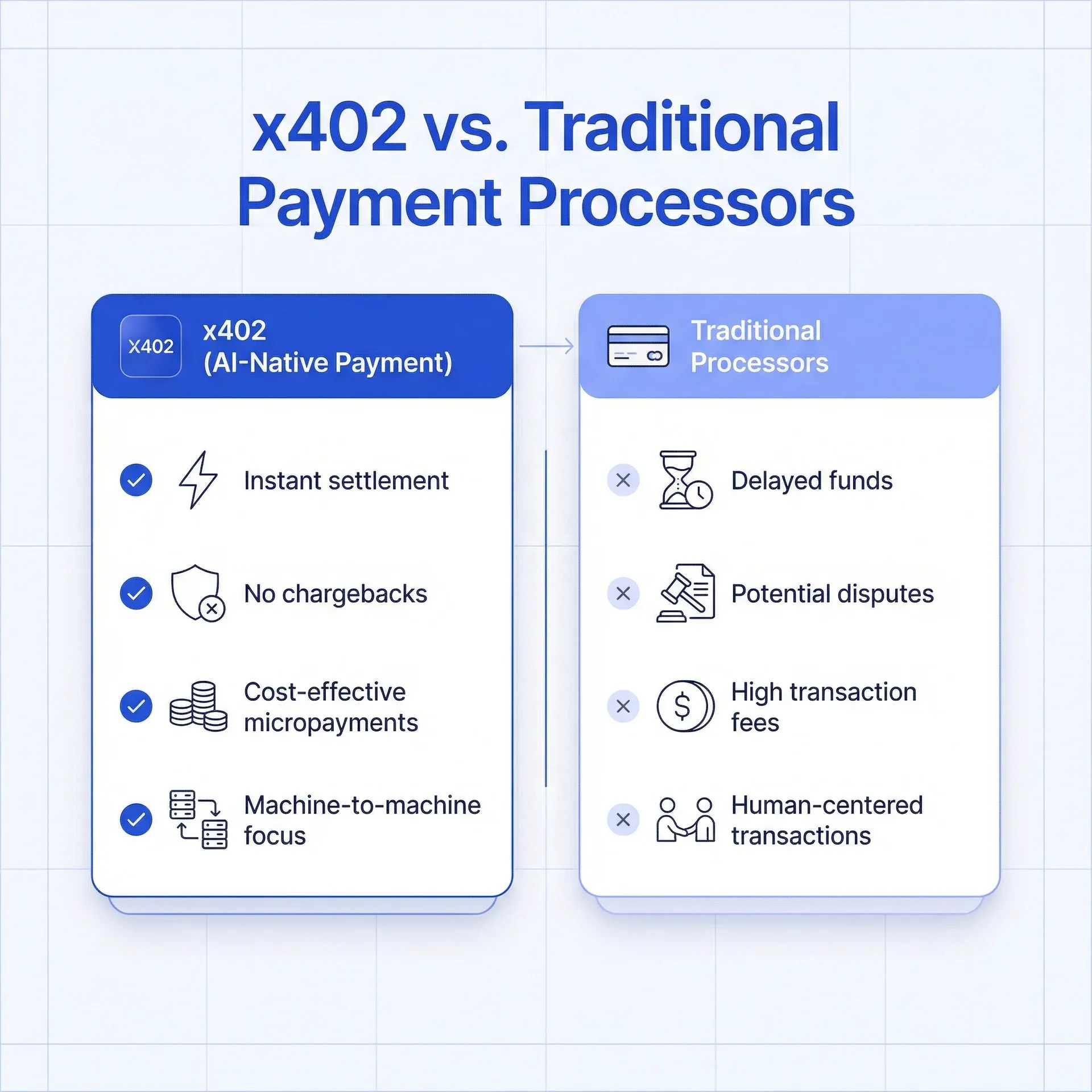
Good to know: The absence of chargebacks in x402 is a double-edged sword. While it eliminates payment disputes and fraud reversals, it also means you need robust service delivery guarantees. Design your systems to verify payments before delivering resources, and consider offering manual refund policies for legitimate customer service issues.
The history and evolution of HTTP 402
The story of HTTP 402 Payment Required spans nearly three decades of web history, from reserved but unused status code to revolutionary innovation waiting for technology to catch up to vision.
Why previous web payment standards failed
The original HTTP/1.1 specification (RFC 2616, published in 1997) included 402 alongside other status codes, with the intention that web payments would eventually become standardized. Tim Berners-Lee and early web pioneers envisioned a payment-aware web where accessing premium content required nothing more than a standard protocol exchange.
Several factors doomed early attempts:
No universal digital currency infrastructure. DigiCash, one of the first digital cash systems, required users to pre-fund accounts with specific banks. CyberCash and similar systems faced the same challenge: there was no globally accessible, stable-value digital currency that worked across jurisdictions.
Prohibitive transaction costs. Credit card processing fees of 2-3% plus $0.30 per transaction made micropayments mathematically impossible. Paying $0.05 for an article when the transaction fee alone exceeds that amount doesn't work.
No consensus on payment verification. Without blockchain technology, verifying payments required trusted intermediaries. Every proposed solution created centralized bottlenecks that undermined the web's distributed architecture.
Trust anchor problems. Who decides which payments are valid? Pre-blockchain systems required trusted third parties, introducing single points of failure and jurisdictional complexity.
Why x402 succeeds where others failed
The x402 payment protocol arrives at a unique moment when multiple enabling technologies have matured simultaneously:
Stablecoins provide price stability. USDC and other dollar-pegged stablecoins eliminate the volatility problem that plagued earlier cryptocurrency payment attempts. A $1 payment today is worth $1 tomorrow.
Modern networks enable sub-cent transactions. Solana supports thousands of transactions per second with transaction fees lower than 1 cent. Base, Coinbase's Ethereum L2 network, processes transactions for fractions of a cent as well, with block times of 2 seconds. This makes micropayments not just possible but practical, because you can charge as little as within the range of $0.001 for an API call without fees consuming the entire amount.
Smart contracts automate verification. Payment verification happens on-chain, trustlessly. Servers can verify payments without trusting the client or any third party.
Enterprise validation from Coinbase. The Coinbase 402 initiative brings institutional credibility, developer resources, and ecosystem support. This isn't a hobbyist project but infrastructure backed by a publicly traded company with billions in assets.
What are stablecoins?
Stablecoins are cryptocurrencies designed to maintain a stable value relative to a reference asset, typically the US dollar. USDC (USD Coin), the primary currency for x402 payments, is issued by Circle and backed 1:1 by dollar reserves. This means 1 USDC always equals approximately $1, eliminating the price volatility associated with Bitcoin or Ethereum while retaining the programmability and instant settlement of blockchain transactions.
How the x402 payment protocol works
Understanding the x402 payment flow is essential for implementation. The protocol follows a straightforward request-response pattern that will feel familiar to anyone who's worked with HTTP authentication.
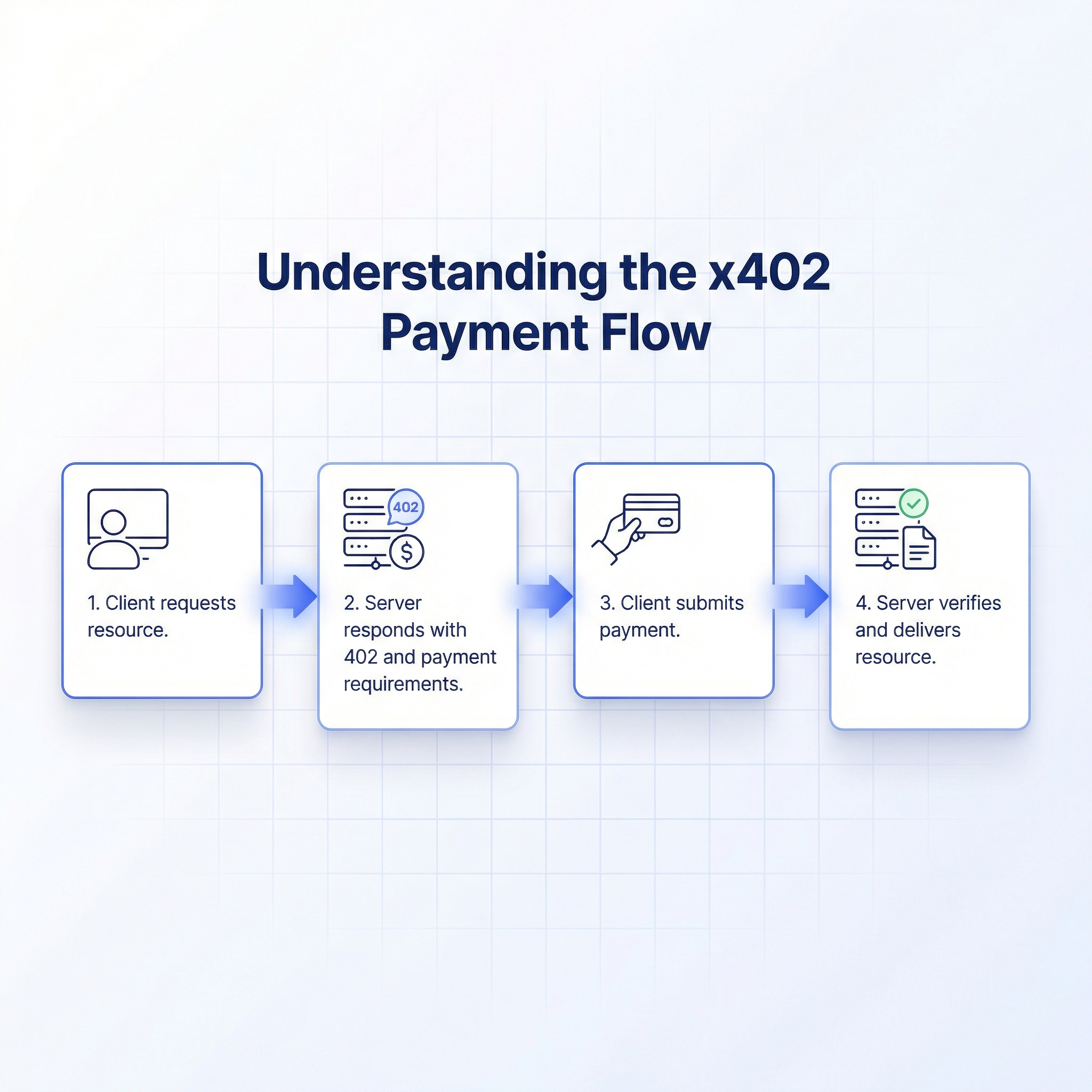
The x402 request-response cycle
The complete x402 flow involves four steps:
Step 1: Client requests protected resource
http

GET /api/v1/premium-data HTTP/1.1

Host: api.example.com
Step 2: Server responds with 402 and payment requirements
http

HTTP/1.1 402 Payment Required

Content-Type: application/json

Payment-Required: <base64-encoded requirements>
Decoding the Payment-Required header shows something like the following:
json

{

"x402Version": 2,
"error": "PAYMENT-SIGNATURE header is required",
"resource": {
	"url": "<https://api.example.com/premium-data>",
	"description": "Access to premium market data",
	"mimeType": "application/json"
},

"accepts": [
{
"scheme": "exact",
"network": "eip155:84532",
"amount": "10000",
"asset": "0x036CbD53842c5426634e7929541eC2318f3dCF7e",
"payTo": "0x209693Bc6afc0C5328bA36FaF03C514EF312287C",
"maxTimeoutSeconds": 60,
"extra": {
"name": "USDC",
"version": "2"
}
}
],
"extensions": {}
}
Step 3: Client constructs a payment and sends it
http

GET /api/v1/premium-data HTTP/1.1

Host: api.example.com

Payment-Signature: <base64-encoded payment>
Step 4: Server verifies payment and delivers resource
http
HTTP/1.1 200 OK
Content-Type: application/json
Payment-Response: <base64-encoded receipt>
{
"data": { ... }
}
The beauty of this flow is its simplicity. It mirrors HTTP authentication patterns that developers already understand, just with payment negotiation instead of credential exchange.
Supported networks and currencies
While x402 is fundamentally network-agnostic, its practical implementation relies on payment facilitators to handle network-specific verification and settlement. The choice of facilitator determines the range of supported blockchains and currencies.
The protocol specifies network identification using the CAIP-2 standard (Chain Agnostic Improvement Proposal), following the format namespace:reference for unambiguous cross-chain support.
Base and Solana serve as the primary rails for x402 payments due to their extremely low transaction costs and fast finality. Most x402 implementations default to USDC, though the protocol allows for a range of assets.
Payment facilitators and their role
Most implementations use production-ready payment facilitators to handle the blockchain complexity. Payment facilitators serve several critical functions:
- Payment verification: They verify that submitted payments are valid and likely to succeed..
- Settlement handling: They broadcast the payment to the network.
- Receipt generation: They produce cryptographic receipts that servers can use to grant access to resources.
- Abstraction: They shield developers from blockchain-specific implementation details like gas management, RPC endpoints, and transaction monitoring.
PayAI serves as a payment facilitator for x402, providing the infrastructure layer that makes implementation straightforward. Rather than building blockchain verification logic, developers integrate PayAI’s SDKs and let the platform handle the complexity.
Network Support by Facilitator
The following table demonstrates how network support varies based on the payment facilitator you choose:
| Facilitator | Supported Networks (Examples) | Key Supported Assets | Notes |
|---|---|---|---|
| *x402.org (Default) | Base Sepolia (eip155:84532), Solana Devnet | - | Recommended for basic testing and development. |
| PayAI | Solana, solana-devnet, Base, base-sepolia, Polygon, polygon-amoy, Avalanche, avalanche-fuji, Sei, sei-testnet, IoTex, XLayer, xlayer-testnet, Peaq, Skale-base, skale-base-sepolia, and more. | EIP-3009, SPL, Token-2022 | Supports a wide range of EVM and non-EVM chains; focuses on broad token support. |
| SolPay | Solana | SPL | Solana x402 facilitator powering crypto payments for storefronts and APIs. USDC settlements with sub-second finality, trustless escrow, and WooCommerce integration. |
| Kobaru | Solana, Solana Devnet, Base, Base Sepolia, Skale, Skale Sepolia | - | Institutional-grade payment engine for developers who need reliability and visibility into revenue operations. |
| Corbits | Solana, Solana Devnet, Base, Base Sepolia, Monad, Monad Testnet, Polygon, Polygon Amoy, CAIP-2 EVM, CAIP-2 SVM | EIP-3009, SPL, Token-2022 | A production grade facilitator which supports multi-network, multi-token, multi-payment schemes. |
Expert tip: For micropayment use cases (sub-$1 transactions), Base, Solana and other high throughput chains are effectively the only viable option. Ethereum mainnet gas fees would consume the entire payment for small amounts. Design your payment requirements to specify the most cost-efficient network for your use case.
Key benefits of the x402 payment protocol
The x402 payment protocol delivers concrete advantages that address longstanding pain points in digital payments, particularly for API providers and AI-powered applications.
For API and service providers
Monetize APIs without complex billing integration. Traditional API monetization requires building subscription management, usage tracking, invoice generation, and payment collection. With x402, monetization is as simple as returning a 402 status code with a price. The protocol handles the rest.
Pay-per-use models become trivially simple. Want to charge $0.001 per API call? With traditional processors, the fees alone make this impossible. x402 supports true micropayments where the transaction cost is a fraction of a cent.
No chargebacks or payment disputes. Blockchain payments are final. Once confirmed, a payment cannot be reversed by the payer. This eliminates the chargeback fraud that plagues digital goods and API services.
Instant access to revenue. Traditional payment processors hold funds for days or weeks before settlement. With x402, payments settle in seconds and you can access funds immediately.
For AI agents and autonomous systems
This is where x402 truly shines. The protocol was designed from the ground up for agentic payments, which are transactions initiated and completed by autonomous software agents without human intervention.
Agents can autonomously purchase resources they need. An AI coding assistant that encounters a paid documentation API can evaluate the cost, authorize payment from its wallet, and access the resource, all without prompting a human.
No human intervention required for payment approval. Traditional payment flows assume a human will review and approve each transaction. x402 supports pre-authorized agent wallets with spending limits, enabling true autonomy.
Cryptographic security suitable for machine authentication. Agents authenticate payments using private keys, not passwords or sessions. This model fits naturally with how autonomous systems operate.
Enables true agent-to-agent commerce. When agents can both provide and consume paid services, entirely new economic models emerge. An agent can earn revenue from one service and spend it on another, creating autonomous value chains.
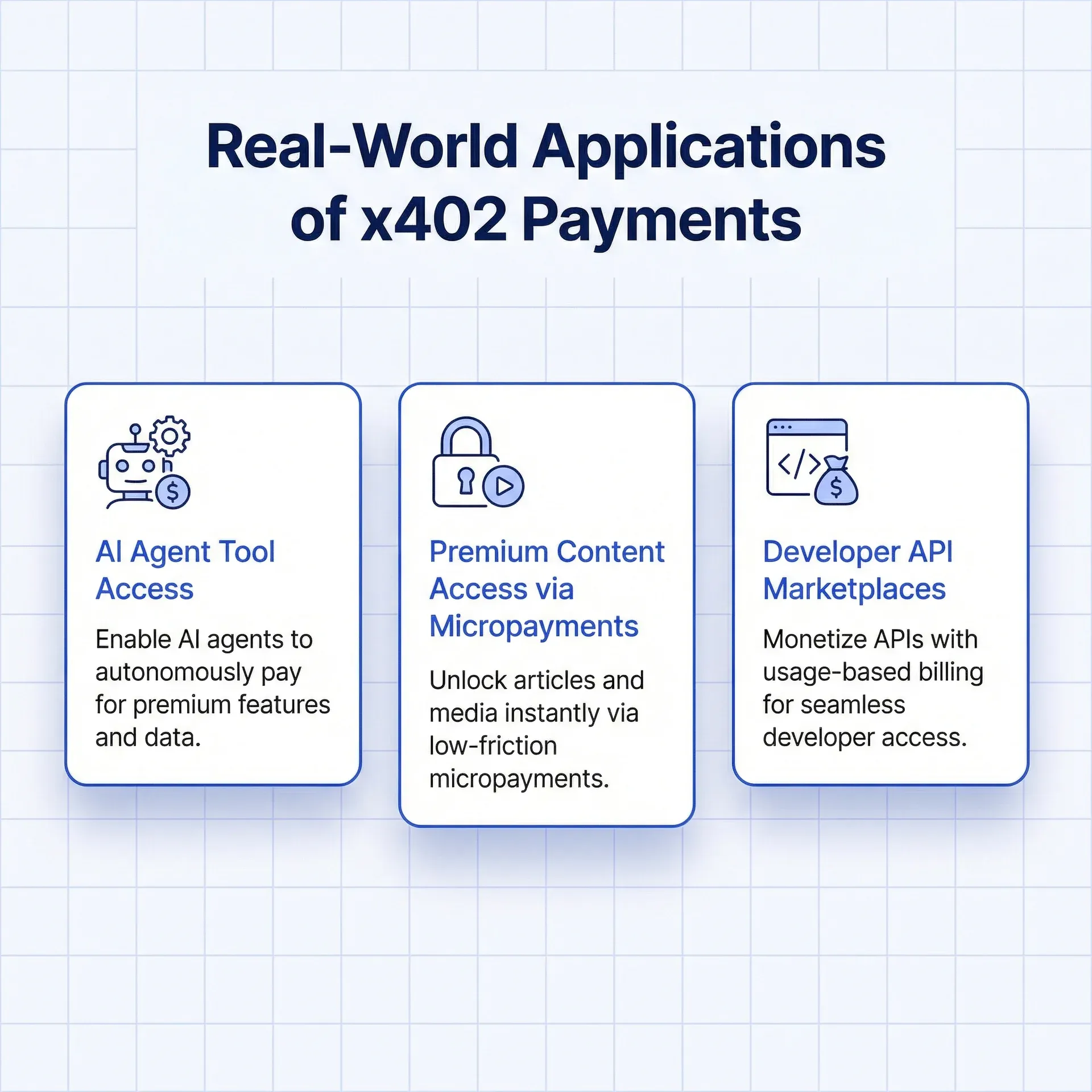
Real-world use cases for x402 payments
The x402 payment protocol enables use cases that were previously impractical or impossible. Here are the most compelling applications developers are building today.
AI agent tool access
The flagship use case for x402 is enabling AI agents to access paid tools and APIs autonomously.
Consider an AI research assistant tasked with analyzing market trends. It might need to:
- Query a premium financial data API ($0.05 per request)
- Access paywalled news articles ($0.10 per article)
- Run computations on a paid GPU cluster ($0.50 per job)
- Store results in a premium database service ($0.01 per write)
With x402, the agent can discover these services through standard HTTP, evaluate pricing from the 402 responses, and complete payments from its allocated wallet, all autonomously.
MCP (Model Context Protocol) servers represent a particularly interesting application. These servers provide context and tools to LLM applications, and x402 enables them to monetize premium capabilities directly through the protocol.
Premium content and data access
x402 transforms content monetization by making article-level purchases economically viable.
Micropayment paywalls: Instead of forcing users into monthly subscriptions, publishers can offer individual articles for $0.10-0.50. Readers pay only for what they consume, eliminating subscription fatigue.
Research data per-query pricing: Academic databases, market research firms, and data providers can sell individual queries rather than expensive annual licenses.
Premium feature unlocking: SaaS applications can offer advanced features on-demand. Need OCR processing for one document? Pay $0.05 for that specific request rather than upgrading your entire plan.
Developer API marketplaces
x402 enables a new model for API distribution that doesn't require platform intermediaries.
Traditional API marketplaces (like RapidAPI) take 20-30% of revenue and control the customer relationship. With x402:
- Developers can monetize APIs directly without middlemen
- Discovery happens through standard HTTP—no platform registration required
- Payment terms are embedded in API responses, making integration self-documenting
- The long-tail API economy becomes viable for niche, specialized services
extra field. This helps both human developers and AI agents understand what they're paying for, leading to higher conversion rates.Implementing x402 in your application
Moving from concept to implementation requires understanding both server-side and client-side patterns. One of the quickest ways to get started is by using the official PayAI resources.
Instead of providing exhaustive code examples here, we recommend diving directly into the dedicated documentation, which is kept up-to-date with the latest best practices and library versions:
- Quickstart Guide: For a guided, step-by-step process to set up your first x402-enabled application, refer to the PayAI x402 Quickstart Guide. This covers environment setup, essential library usage, and a minimal working example for both server and client.
- API Reference and Support: For detailed API documentation, advanced use cases, and support for your implementation questions, please consult the x402 facilitator resources for fast implementation of the x402 payments standard.
Security considerations for x402
Implementing payments requires rigorous security practices. The x402 protocol includes several built-in protections, but proper implementation is crucial.
Payment verification best practices
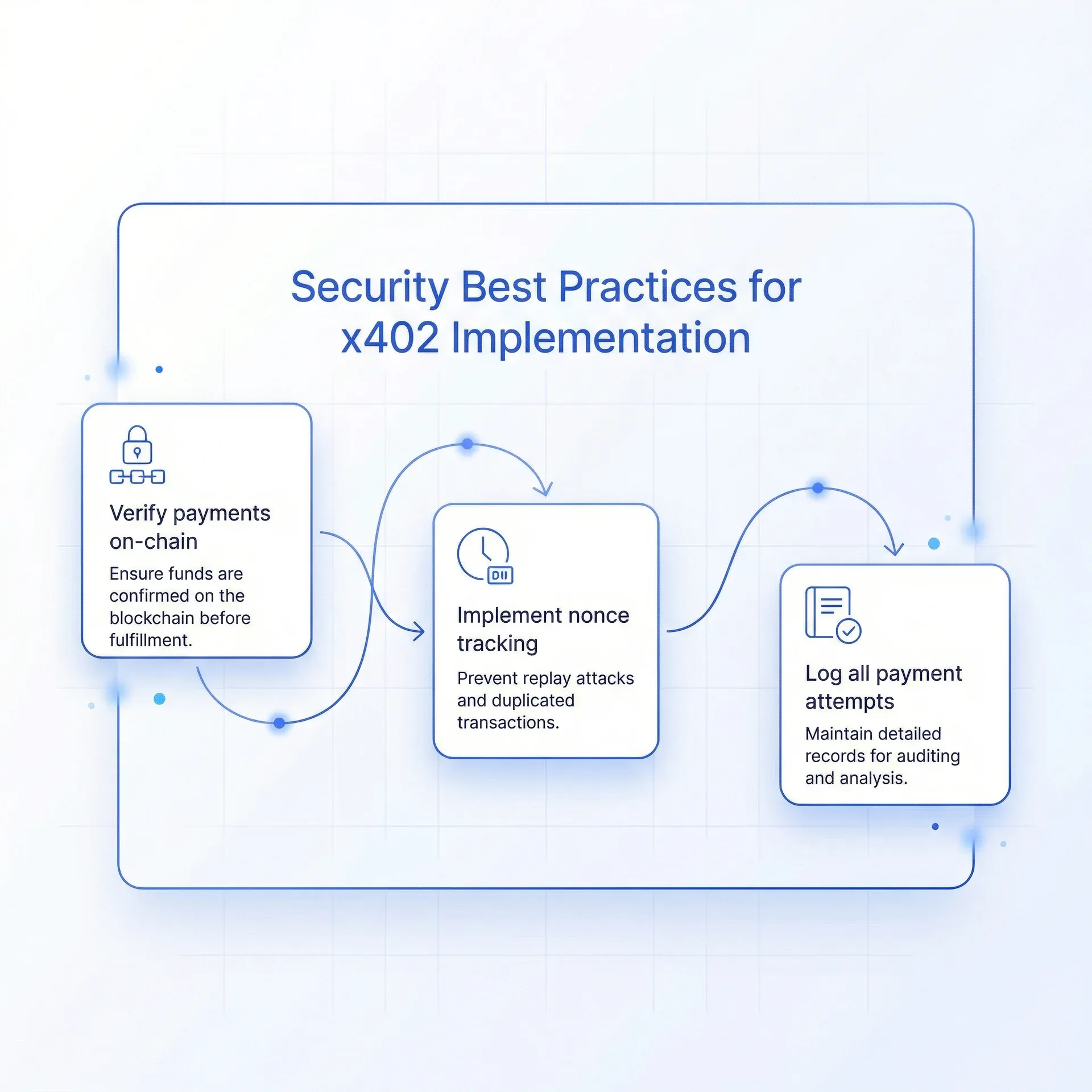
Always verify payments on-chain before delivering resources. Never trust that a payment settled successfully without verifying that it did first. Use a payment facilitator like PayAI or implement direct blockchain verification.
Consider side effects before releasing resources. When going through the x402 payment flow, getting a successful response from /verify does not equal getting a successful response from /settle. If your payment-gated resource has irreversible side effects, make sure you /settle first before running your payment-sensitive code.
Set appropriate payment expiration windows. Payment requirements should expire, usually within 1-24 hours. This limits the window for certain attack vectors and ensures pricing remains current.
Log all payment attempts for audit trails. Maintain comprehensive logs of both successful and failed payments. This data is essential for debugging, fraud detection, and financial reconciliation.
Handling edge cases and failures
Real-world systems encounter scenarios that the happy path doesn't cover:
Payment succeeds but delivery fails: Your server verified payment but then crashed before delivering the resource. Implement idempotent delivery with payment receipt lookup. For example, if a receipt exists for this payment, re-deliver the resource.
Network timeouts during payment: The client submitted payment but didn't receive acknowledgment. Implement retry logic with the same payment proof, and ensure server-side idempotency.
Partial payments and refunds: x402 doesn't natively support refunds (blockchain transactions are irreversible). Build manual refund processes for legitimate customer service issues, and consider holding payment addresses in reserve for this purpose.
Idempotency in payment processing: The same payment proof might be submitted multiple times due to client retries. Track processed payments and return cached responses for duplicates rather than processing again.
The future of x402 and agentic payments
The x402 payment protocol is still early, but momentum is building rapidly. Here's what the trajectory looks like:
Growing ecosystem of adopters. Major API providers, AI tool developers, and content platforms are beginning to implement x402. As the ecosystem grows, network effects accelerate adoption: more buyers attract more sellers and vice versa. x402 has rapidly grown, having exceeded 15 million transactions by the end of 2025. Key partners include Cloudflare, Google Cloud, Anthropic, and Visa, all integrating x402 into their respective agent, payment, and context protocols.
Coinbase's continued investment. As the primary backer of x402 through the Coinbase 402 initiative, Coinbase has significant resources invested in the protocol's success. Expect continued development, documentation, and ecosystem building.
Expansion to new networks and currencies. The protocol has significantly broadened its multi-chain support, thanks to integrations with various payment facilitators. While Base and USDC were dominant initially, the network now supports a wide range of additional L2 networks and stablecoin options.
The AI agent commerce wave. The agentic payments use case will explode as AI agents become more capable and autonomous. When millions of AI agents need to purchase tools, data, and compute, x402 will be the rails they run on.
Early adopters have a significant advantage. Building x402 infrastructure now positions you ahead of competitors who will scramble to catch up as agentic commerce accelerates.
Getting started with x402 today
You now have comprehensive knowledge of the x402 payment protocol. Here's how to move from understanding to implementation:
For API and service providers looking to monetize with x402:
- Install the server SDK for your framework
- Add paywall middleware to protected routes
- Configure your payment address and pricing
- Test with the PayAI sandbox environment
- Deploy to production
For developers building AI agents that need to make payments:
- Integrate the PayAI x402 client SDK
- Provision an agent wallet with spending limits
- Implement 402 response handling in your agent's HTTP client
- Add balance monitoring and alerting
- Test against x402-enabled sandbox APIs
For technical leaders evaluating x402:
- Review this guide with your engineering team
- Identify pilot use cases in your product
- Estimate ROI based on current payment pain points
- Schedule a technical consultation with PayAI
- Plan a proof-of-concept implementation
Time to first payment with PayAI: Most developers complete integration in only 2 minutes and process their first test payment almost immediately.
Join the agentic payments revolution.
Developers at leading AI companies are already using PayAI to power x402 payments. Create your free account today and start building.
Frequently Asked Questions
What is the x402 payment protocol?
The x402 payment protocol is an open standard that enables native HTTP-based payments using blockchain technology. When a client requests a protected resource, the server returns HTTP status code 402 (Payment Required) along with structured payment requirements. The client then completes payment using stablecoins on blockchain networks and resubmits the request with cryptographic proof. This enables seamless machine-to-machine commerce, particularly for AI agents and API monetization.
How does x402 differ from traditional payment processors like Stripe?
x402 offers several key advantages over traditional processors: instant settlement (seconds vs. days), no merchant account requirements, viable micropayments (sub-cent transactions on Layer 2 networks), and native support for autonomous agents. Traditional processors like Stripe are optimized for human checkout flows with cards, while x402 is designed for programmatic, machine-to-machine transactions. However, x402 payments are also irreversible: there are no chargebacks, which is advantageous for digital goods but requires different customer service approaches.
What is Coinbase's role in the x402 payment protocol?
Coinbase spearheaded the x402 initiative, driving the protocol specification and providing the primary infrastructure through the Base network. The "Coinbase 402" effort brings enterprise credibility, developer resources, and ecosystem support to the standard.
Can AI agents use x402 to make autonomous payments?
Yes. This is precisely what x402 was designed for. AI agents can detect 402 responses, parse payment requirements, evaluate costs against their budgets, sign transactions using their private keys, and complete payments without any human intervention. This enables agentic payments where autonomous systems acquire resources they need, such as APIs, data, and compute, on their own. The PayAI platform specifically supports agent wallets with spending controls and monitoring.
What currencies and networks does x402 support?
x402 is network-agnostic, optionally relying on Payment Facilitators for verification and settlement. While it works on any network identified by the CAIP-2 standard, Solana and Coinbase's L2 Base are the defaults, favoring USDC due to its low costs and fast finality. Facilitators like PayAI and Corbits handle blockchain complexity, supporting various EVM and non-EVM chains (e.g., Solana, Polygon, Avalanche). For cost-efficient micropayments (sub-$1), high-throughput chains like Base and Solana are recommended over Ethereum mainnet.
How do I implement x402 payments in my application?
Implementation involves two sides: servers return 402 responses with payment requirements for protected resources and verify payment proofs before granting access; clients detect 402 responses, execute payments, and retry requests with proof. While you can implement from scratch, PayAI provides turnkey SDKs that handle payment verification, settlement, and edge cases. Most developers complete basic integration in under an hour using PayAI’s middleware for Express.js, FastAPI, and other popular frameworks.
Is the x402 payment protocol secure?
Yes, when implemented correctly. x402 security relies on cryptographic signatures for payment authorization, blockchain verification for payment validity, and nonces to prevent replay attacks. Payments are verified against actual on-chain state, not just client claims. Key security practices include always verifying payments on-chain before delivering resources, implementing nonce tracking, setting appropriate expiration windows, and maintaining comprehensive audit logs. Payment facilitators like PayAI handle much of this complexity automatically.
What are micropayments and why does x402 enable them?
Micropayments are transactions typically under $1 and are often measured in cents or fractions of cents. Traditional payment processors make micropayments uneconomical because their minimum fees ($0.30+ per transaction) exceed the payment value itself. x402 enables micropayments through Layer 2 networks like Base, where transaction costs are under $0.01. This means you can charge $0.001 for an API call, $0.10 for an article, or $0.05 for a single database query, opening entirely new monetization models.