

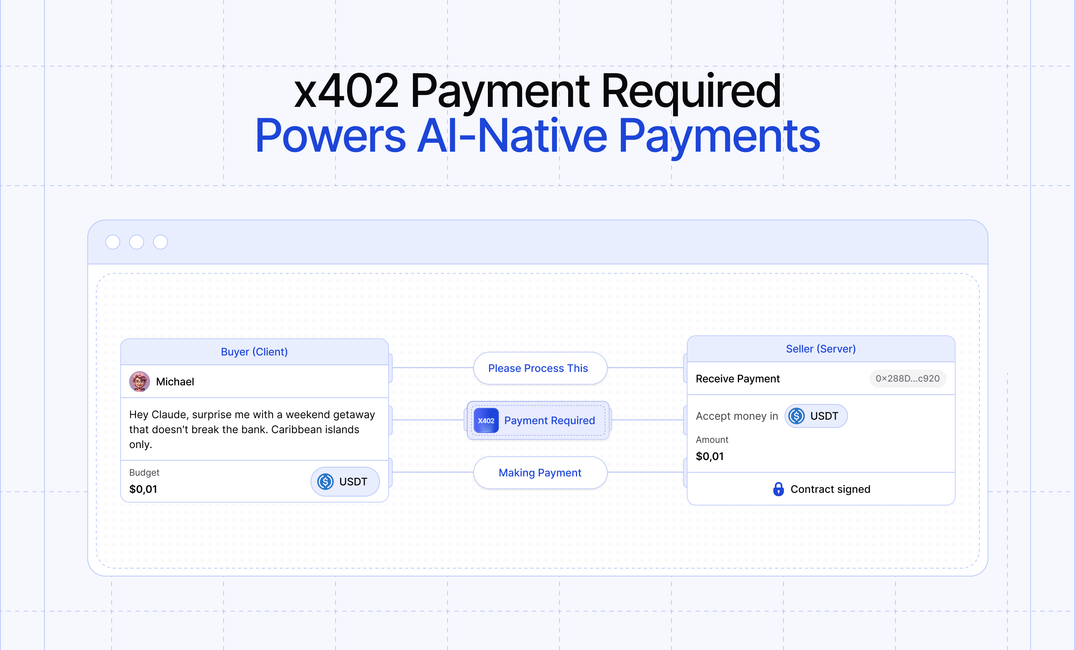
For over two decades, HTTP status code 402 sat dormant in the internet's architecture, a placeholder for a digital payments future that hadn't yet arrived. Now, with AI agents conducting autonomous transactions and machine-to-machine commerce becoming reality, the x402 payment protocol is finally cashing in on the internet's 25-year-old IOU. This article explains what the 402 status code means, how x402 activates it for real-time payments, and why this matters for anyone building in the agentic commerce space.
In a nutshell: x402 Payment Required
- HTTP 402 payment required is a client error status code indicating that payment is needed to access a resource.
- x402 is the protocol that brings 402 to life, enabling machine-readable payment requests embedded directly into HTTP headers.
- AI agents benefit most from x402 because it allows for fully autonomous payments without sign-ups or credit cards, which is essential for agentic commerce.
- PayAI Network offers a drop-in implementation of x402 across Solana and EVM networks, freeing merchants of API keys and complex blockchain integrations.
- The future is machine-driven: Early adopters implementing x402 today are positioning themselves for an economy where AI agents are primary economic actors.
PayAI offers a single endpoint for Solana and EVM networks without any blockchain complexity.
Find out more →
What is the 402 payment required status code?
The 402 status code is an HTTP response indicating that a client must provide payment before accessing the requested resource. As part of the HTTP/1.1 specification defined in RFC 7231, the 402 response code belongs to the 4xx family of client errors (think of the 404 – Not Found error code), but with a crucial difference from its siblings.
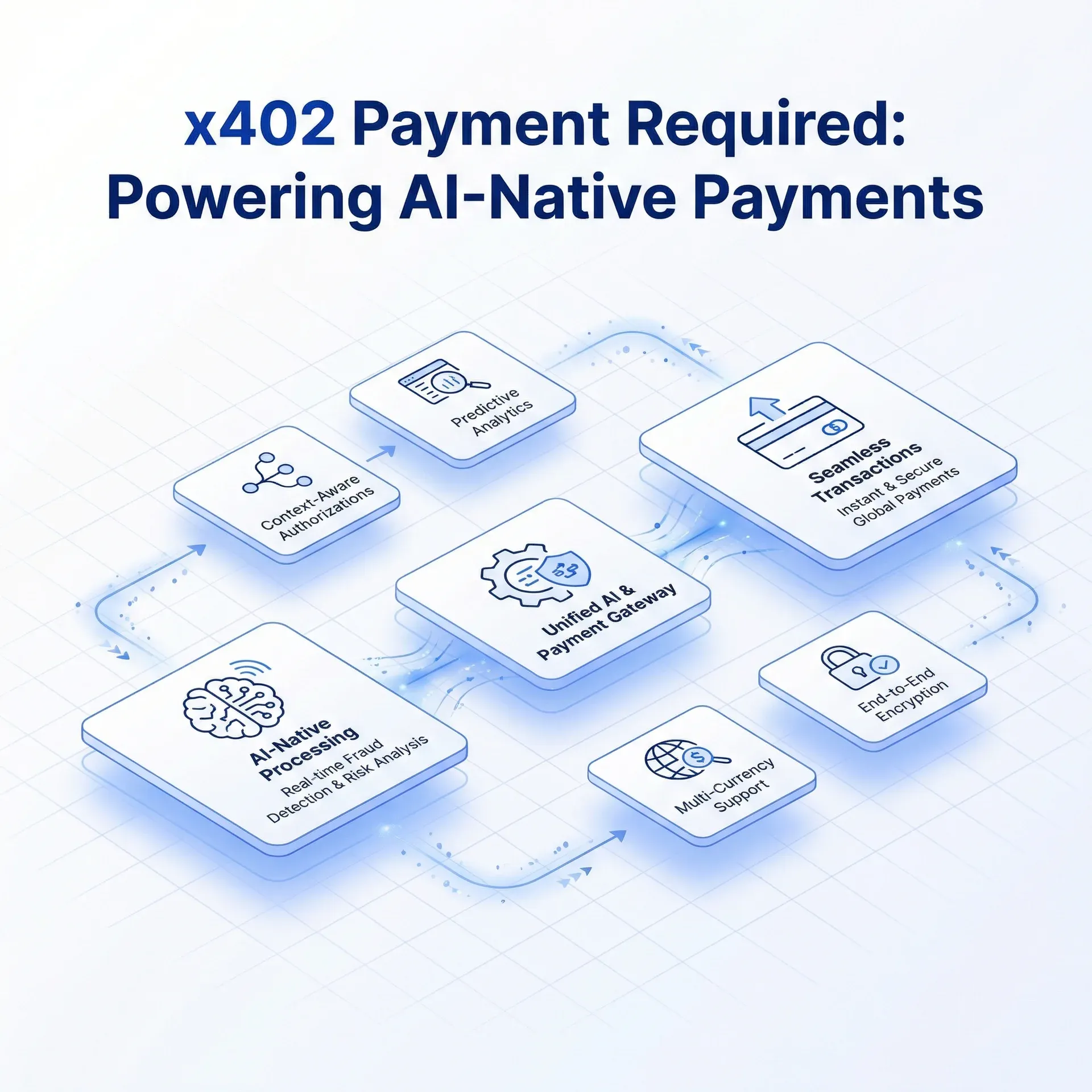
When a web server returns an HTTP code 402, it's telling the client: “I understand your request, you might even be authenticated, but you need to pay before I'll give you what you're asking for.”
Here's what a basic 402 response looks like:
Content-Type: application/json
Payment-Required: base64EncodedString
{"error": "Payment required to access this resource"}
Understanding where 402 fits among similar status codes is essential:
| Status Code | Name | Meaning |
|---|---|---|
| 401 | Unauthorized | Authentication required (who are you?) |
| 402 | Payment Required | Payment required (pay to proceed) |
| 403 | Forbidden | Access denied regardless of auth (you can't have this) |
The payment required response occupies a unique niche. Unlike 401, which challenges authentication, or 403, which denies based on authorization, the 402 status code creates a transactional opportunity: provide payment, receive access.
Why was 402 reserved for future use?
When the HTTP/1.1 specification was finalized in 1999, its authors anticipated a future of digital micropayments. They imagined users paying fractions of a cent to access articles, download files, or use online services. The 402 status code was their forward-thinking placeholder for this payments-enabled web.
The problem? Internet payment infrastructure simply wasn't ready. Credit card fees made micropayments economically unviable. Digital wallets barely existed. The cryptographic and financial rails needed for instant, low-cost payments were decades away.
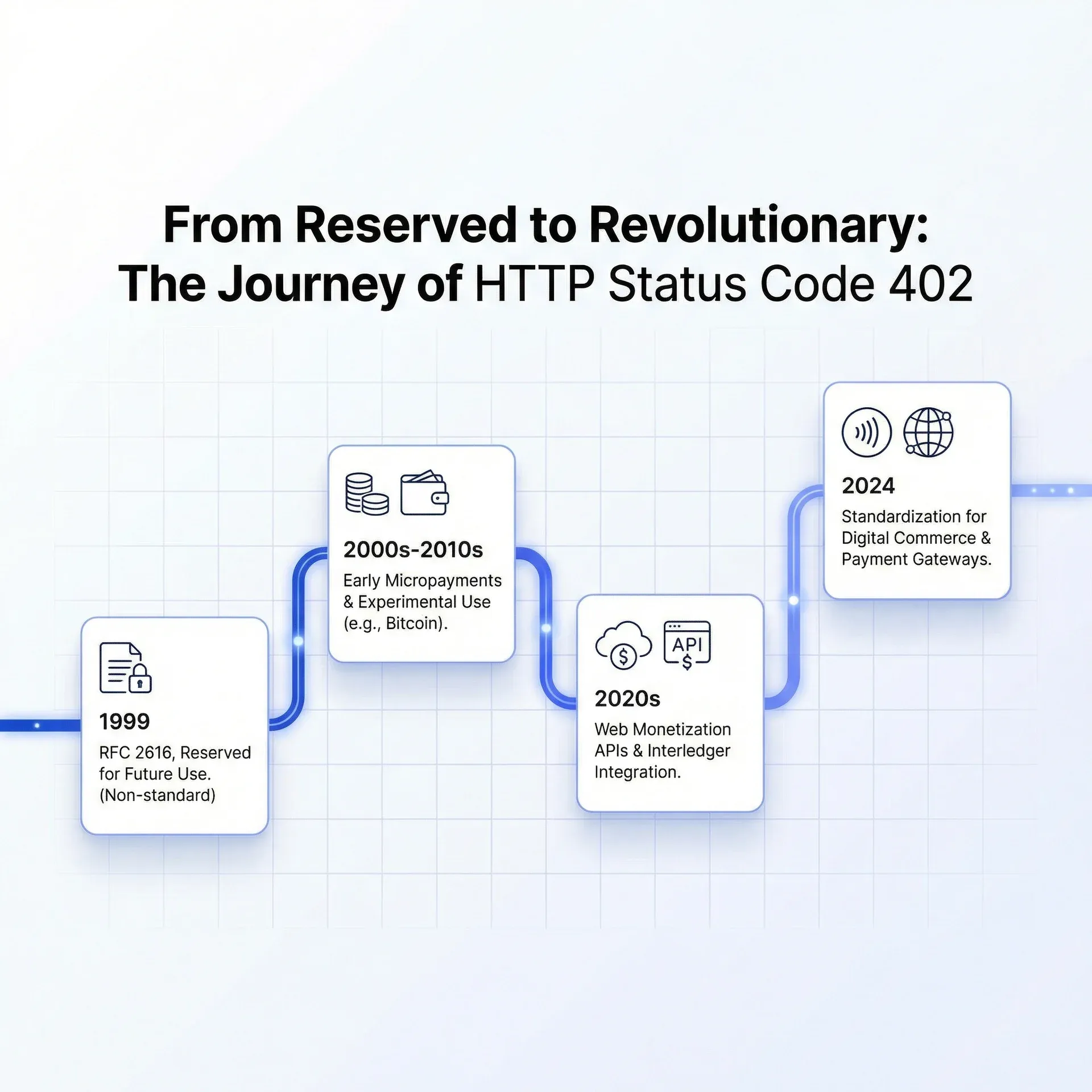
For over twenty years, 402 remained the HTTP specification's most underutilized status code. It was mentioned in documentation, but rarely implemented in production systems. Then came blockchain payments, stablecoins, and AI agents that need to transact autonomously. Suddenly, the infrastructure exists. The x402 payment protocol represents the fulfillment of a vision that HTTP's designers had in the late 1990s, just 25 years ahead of schedule.
Enter x402: the payment protocol that activates HTTP 402
The x402 payment protocol is an open standard that transforms the dormant 402 status code into a functional payment mechanism. Where HTTP 402 simply says “payment required,” x402 specifies exactly how that payment should happen, thereby embedding machine-readable payment instructions directly into HTTP headers.
This isn't a theoretical exercise. x402 enables programmatic, automated transactions across blockchain networks including Solana, Base, and other chains. For AI agents and autonomous systems, this represents a fundamental shift: services can now be paywalled at the protocol level, with payments processed in milliseconds without human involvement.
The protocol is designed for agentic commerce, which is an emerging paradigm where software agents discover services, negotiate access, and complete payments entirely on their own.
How x402 works: the payment handshake
The x402 payment flow follows a four-step handshake that mirrors familiar HTTP patterns while adding a payment layer:
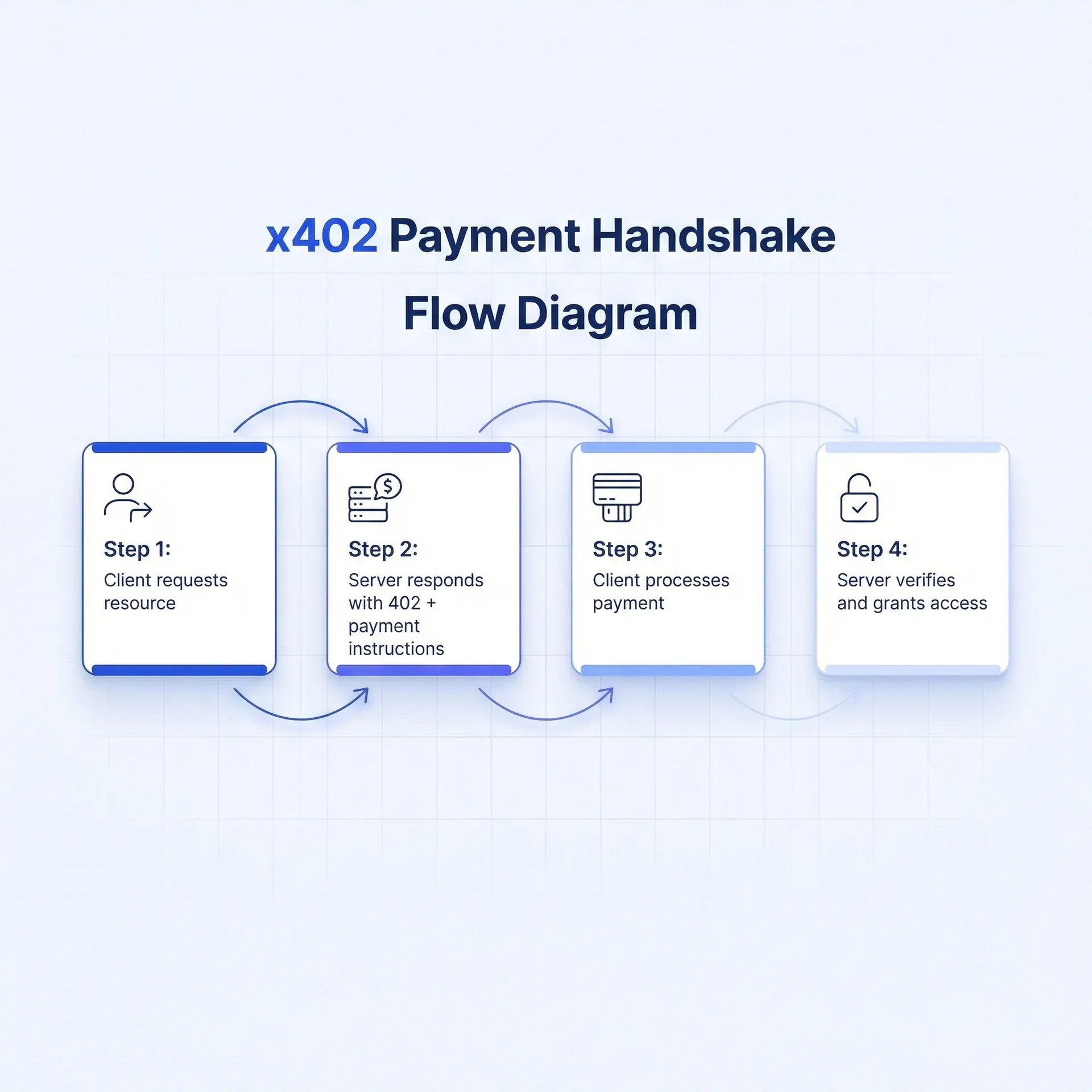
Step 1: Client requests resource
An AI agent or application sends a standard HTTP request to access a paid API endpoint or service.
Step 2: Server responds with 402 + payment instructions
Instead of a simple “payment required” message, the server returns detailed payment instructions in the response headers, encoded as a base64 string:
HTTP/1.1 402 Payment Required
PAYMENT-REQUIRED: eyJ4NVmV…iJ9fV19b
After decoding the PAYMENT-REQUIRED header, the client ends up with something like this:
{
  "x402Version": 2,
  "error": "PAYMENT-SIGNATURE header is required",
  "resource": {
    "url": "https://api.example.com/premium-data",
    "description": "Access to premium market data",
    "mimeType": "application/json"
  },
  "accepts": [
    {
      "scheme": "exact",
      "network": "eip155:84532",
      "amount": "10000",
      "asset": "0x036CbD53842c5426634e7929541eC2318f3dCF7e",
      "payTo": "0x209693Bc6afc0C5328bA36FaF03C514EF312287C",
      "maxTimeoutSeconds": 60,
      "extra": {
        "name": "USDC",
        "version": "2"
      }
    }
  ]
}
Step 3: Client processes payment
The client (or AI agent) reads these headers, constructs the payment transaction, and sends a new request to the server, including a PAYMENT-SIGNATURE in the request headers. The PAYMENT-SIGNATURE header is also a base64 string that contains the payment info.
Step 4: Server verifies and grants access
The server reads the PAYMENT-SIGNATURE, verifies and settles the payment, and then returns the requested resource. The entire process can be completed in a second.
Why x402 matters for AI agents
Traditional payment methods assume that a human is present. Credit cards require manual entry. PayPal needs login credentials. Even “automated” payment systems typically require pre-authorization or stored payment methods configured by a person.
AI agents don't operate this way. An AI research assistant querying premium data sources, an autonomous trading bot accessing market intelligence APIs, or an AI coding assistant paying for specialized tooling all need to make payment decisions dynamically, in real-time, without calling home for approval.
The x402 payment protocol enables this autonomy by:
- Embedding payment terms in standard HTTP headers: agents don't need special payment SDKs.
- Using blockchain for instant settlement: no waiting for bank processing windows.
- Supporting micropayments economically: pay $0.001 for an API call without fee overhead destroying the economics.
- Operating 24/7 without human intervention: agents can transact at 3 AM on a Sunday.
This unlocks entirely new business models. API providers can offer true pay-per-request pricing. AI tool marketplaces can enable instant access without subscription commitments. Agentic commerce becomes a reality where millions of machine-to-machine transactions happen continuously, settled instantly on-chain.
Common scenarios: when you might encounter a 402 response
Whether you're a developer debugging an API integration or a curious user who stumbled across a 402 payment required error, understanding where this status code appears helps contextualize its growing importance.
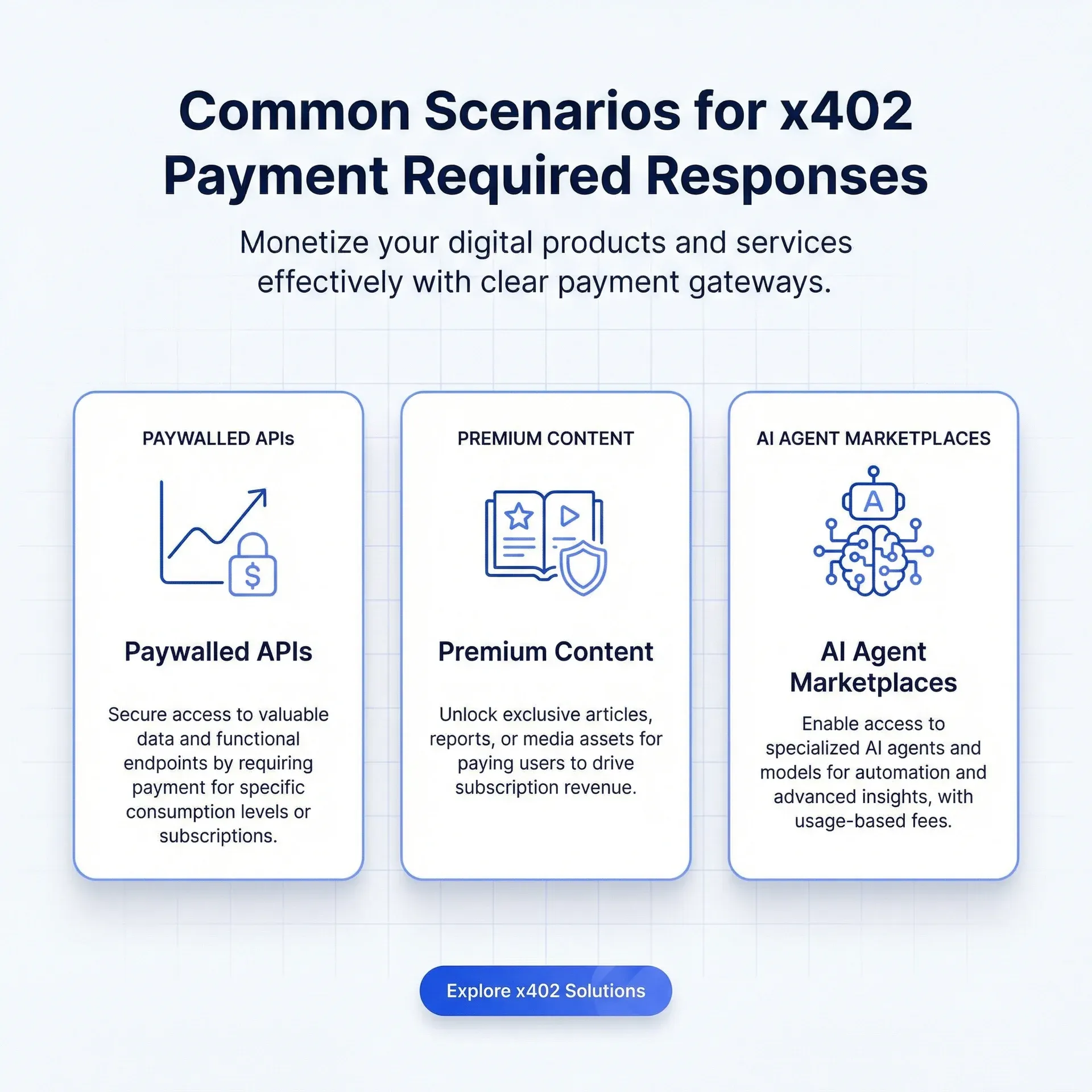
Paywalled API endpoints
Premium data providers increasingly use 402 responses for usage-based access. An AI agent querying a financial data API might receive a 402 notice after exhausting free-tier credits, with x402 headers specifying exactly how to pay for continued access.
Premium content and data services
Research databases, specialized datasets, and proprietary information sources can implement per-access pricing through x402. Instead of monthly subscriptions, users (or their agents) pay only for what they consume.
AI agent marketplaces and tool access
As AI agents become more capable, they need access to specialized tools such as image generation, code execution, and web scraping services. These marketplaces are natural fits for x402, enabling agents to discover, evaluate, and purchase tool access autonomously.
Usage-based SaaS billing
Traditional SaaS subscription models don't map well to AI agent usage patterns. An agent might need burst access during certain tasks and zero access otherwise. x402 enables true consumption-based pricing at the API level.
Example in practice: Consider an AI research assistant tasked with analyzing market trends. It discovers a premium industry report API returning a 402 status code. The x402 headers specify a $0.50 payment in USDC on Solana. The agent evaluates whether the data value exceeds the cost, processes payment, and retrieves the report, all within seconds, without human involvement.
How to implement x402 payments in practice
Once you understand the x402 flow conceptually, the main challenge is implementation: handling payment instructions, verification, settlement, and chain-specific logic without building custom blockchain infrastructure.
The x402 protocol itself is implementation-agnostic. Early work on agent-native payments has been pioneered by players like Coinbase, and today there are facilitators that provide a ready-to-use implementation layer on top of the standard.
In practice, most teams choose an x402-compatible facilitator that abstracts the operational complexity and lets you implement payments with minimal code. These solutions typically provide:
- A drop-in HTTP endpoint that handles 402 Payment Required responses and payment verification
- Chain abstraction, allowing clients to pay from different networks (e.g. Solana or EVM chains) through the same flow
- On-chain verification, removing the need for API keys, sessions, or stored credentials
- Automatic settlement, so servers receive funds immediately once a request is fulfilled
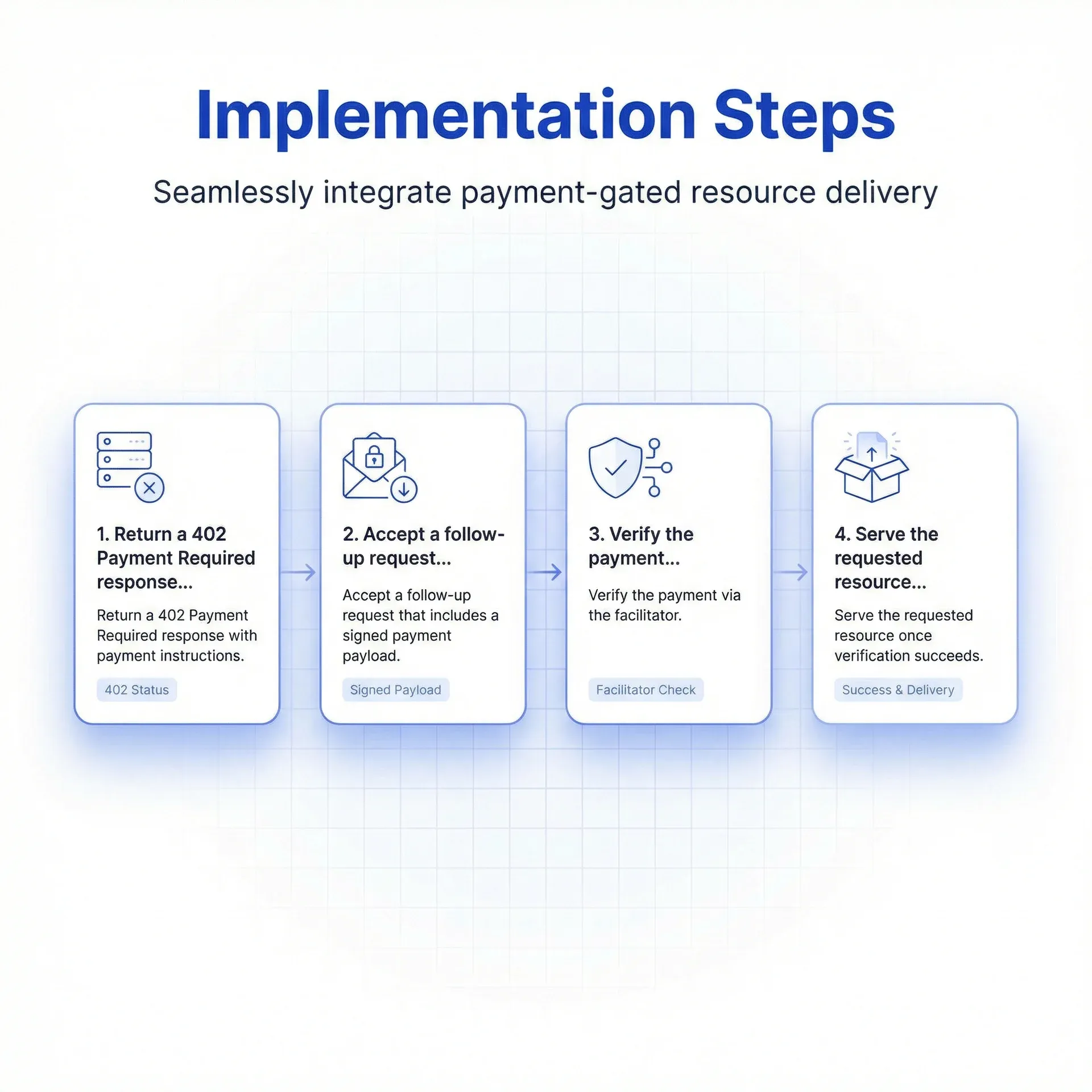
With this approach, implementing x402 usually means:
- Returning a 402 Payment Required response with payment instructions.
- Accepting a follow-up request that includes a signed payment payload.
- Verifying the payment via the facilitator.
- Serving the requested resource once verification succeeds.
Several implementations follow this model, including solutions like PayAI, but the architecture is not vendor-specific. The key idea is to avoid re-implementing wallet management, transaction verification, settlement logic, and multi-chain support yourself unless you explicitly want to operate at the protocol layer.
This keeps x402 adoption aligned with its original goal: simple, web-native, pay-per-request payments that fit naturally into the HTTP request–response flow.
Implementation shortcut:
If you want a production-ready x402 implementation without building blockchain infrastructure yourself, you can use a facilitator such as PayAI. PayAI provides a drop-in layer for handling 402 Payment Required flows, on-chain payment verification, and settlement across multiple networks, allowing teams to implement x402 with minimal code and no wallet or chain-specific logic.
The future of 402: from reserved to revolutionary
The trajectory is clear: internet commerce is shifting toward machine-driven transactions. As AI agents become more capable and autonomous, their need to transact independently grows proportionally.
Industry projections suggest AI agent transactions could represent a significant portion of API commerce by 2027. The agents won't be waiting for humans to approve each payment. All they will need is the x402 payment protocol implementation that enables instant, autonomous economic participation.
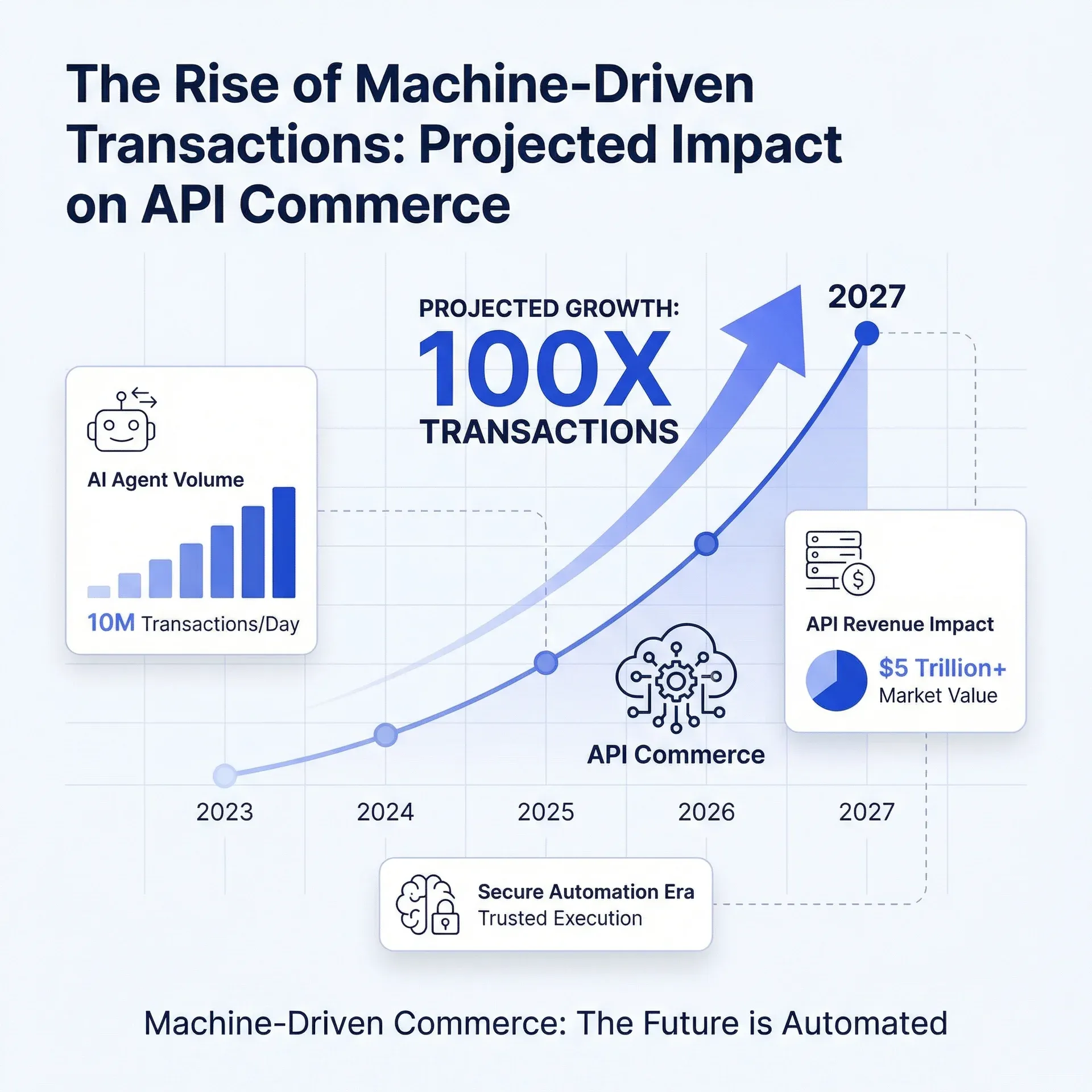
The x402 standard is gaining momentum. More API providers are implementing the protocol. More AI frameworks are adding native x402 support. More blockchain networks are optimizing for the high-frequency, low-value transaction patterns that agentic commerce demands.
The implications extend beyond convenience:
- AI agents become primary economic actors, not just tools operated by humans.
- New business models emerge around machine-to-machine service provision.
- The “autonomous economy” develops its own transaction patterns, pricing mechanisms, and market dynamics.
Early adopters (both API providers implementing x402 paywalls and agent developers integrating payment capabilities) are positioning themselves for this shift. The 402 payment required status code, dormant for 25 years, is becoming essential infrastructure for the AI-native internet.
Frequently Asked Questions
What does 402 payment required mean?
The 402 status code is an HTTP client error indicating that payment is required to access the requested resource. Unlike a 401 (which asks “who are you?”) or 403 (which says “you can't access this”), HTTP code 402 specifically signals a payment gateway opportunity: provide payment, receive access. Originally reserved for future use in the HTTP/1.1 specification, 402 is now being actively implemented through protocols like x402 for real-time machine payments.
Is HTTP 402 the same as x402?
No. They are related, but distinct. HTTP 402 is the status code defined in the HTTP specification, simply indicating that payment is required. It does not yet have an official standard. The x402 payment protocol is an emerging standard defining the specification as well as the reference implementation for how those payments actually work. x402 aims to one day become the official standard for 402. x402 specifies the header formats, payment verification methods, and transaction flows that transform a simple 402 response code into a functional payment mechanism. Think of 402 as the “what” and x402 as the “how.”
How do I fix a 402 payment required error?
For end users: A 402 payment required response typically means you've hit a paywall or exhausted free-tier access. Check if the service offers a payment option, subscription, or credit purchase. Contact the service provider if payment options aren't clear.
For developers: Examine the response headers for payment instructions. If the service implements x402, you'll find payment address, amount, network, and token information in the headers. Implement payment processing logic or integrate with a service like PayAI Network to handle x402 payments automatically.
Can AI agents make payments automatically with x402?
Yes. This is precisely what the x402 payment protocol enables. AI agents can read payment instructions from 402 response headers, evaluate whether the cost is justified for their task, construct and submit blockchain transactions, and receive access, all without human intervention. This autonomous transaction capability is fundamental to agentic commerce, where agents operate as independent economic actors. PayAI Network provides the infrastructure layer that makes implementing this autonomous payment flow straightforward.
Which networks do x402 payments settle on?
The x402 payment protocol is blockchain-agnostic by design, but practical implementations vary. PayAI Network currently supports Solana (optimized for speed and low fees), plus an ever-growing number of EVM-compatible networks, including Base, Polygon, Avalanche, and Skale and more. Solana is particularly well-suited for x402 payments due to sub-second finality and transaction costs measured in fractions of a cent, which is essential economics for micropayment use cases.