

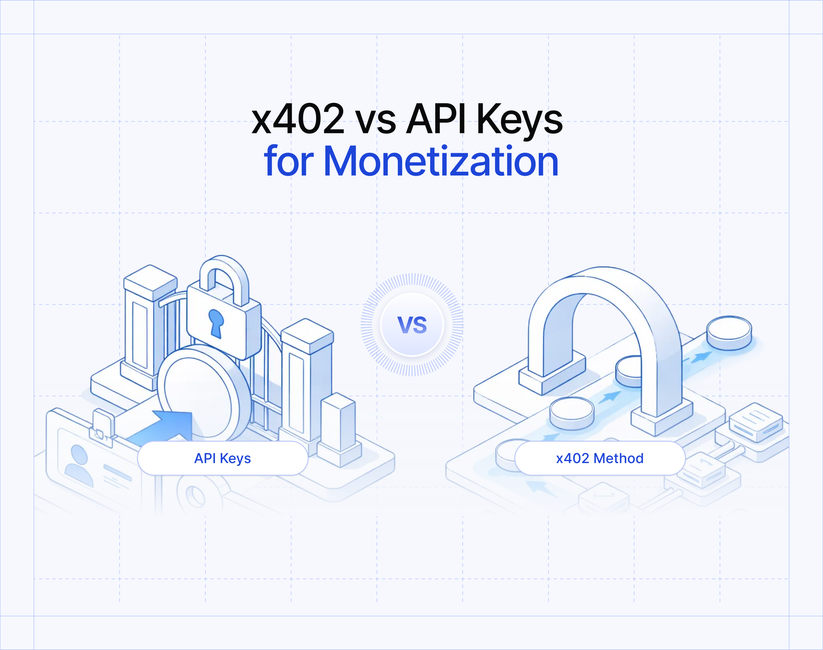
APIs are public interfaces that allow different software applications to communicate and exchange data. They define how requests are made and what data is exchanged. API keys let merchants track usage and bill for consumption, but they come with significant friction, customer dropoff, and operational complexity. The x402 protocol eliminates these issues. It enables seamless billing, open access to resources, and near-zero deployment overhead.
In a nutshell
- API keys were designed to identify callers, not to monetize usage.
- Over time, they became overloaded with responsibilities they were never meant to handle: billing, rate limiting, quota enforcement, and pricing. This creates friction, guesswork, and complexity.
- As APIs increasingly serve autonomous systems and global developers, monetizing through accounts no longer scales.
- x402 fixes this by separating access from payment and moving monetization to the request level.
- Instead of asking who is calling, systems ask whether the request has been paid for.
- This enables open access, per-request pricing, and clean economic signals, without accounts, subscriptions, or fragile tier logic.
The shortcomings of API keys
API keys were never meant to be billing systems.
They started as a simple way to identify callers and prevent accidental misuse. Over time, they accumulated responsibilities far beyond their original scope: access control, rate limiting, quota enforcement, pricing tiers, and monetization. Today, many platforms rely on API keys as the backbone of their revenue model. Not because keys are good at this job, but because there was no better alternative.
x402 offers that alternative. It separates access from payment and moves monetization to the protocol layer, where it belongs.
The hidden costs of API-key-based monetization
When API keys are used for monetization, platform teams inherit a set of structural problems.
Upfront friction drives users away. Users must create accounts, enter payment details, and choose a plan before they can test a single endpoint. This is a conversion killer. According to a Stripe analysis, every additional step in a checkout or onboarding flow can reduce conversion rates by up to 10–20%. For API platforms, the problem is even worse. A developer evaluating three competing APIs on a Tuesday afternoon will default to the one that lets them start immediately. If your platform requires signup, email verification, plan selection, and key generation, you've already lost that developer to a competitor with a simpler flow.
Pricing tiers are based on guesswork. Most API platforms launch with three or four pricing tiers: Free, Basic, Pro, Enterprise. These tiers are rarely based on real usage data. They are educated guesses about what customers might need. The result is a mismatch between what users actually consume and what they pay for. Some users on the Pro plan use only 5% of their quota. Others on the Free tier hit their limits within days. Neither group is well-served.
Free tiers encourage overuse, not efficiency. Free tiers are meant to drive adoption, but they also attract users who never intend to pay. A 2023 analysis by Moesif, an API analytics platform, found that the vast majority of free-tier API users, often exceeding 90%, never convert to paid plans. The platform still bears the infrastructure cost of serving those users. Free tiers subsidize extraction at the expense of paying customers.
Key management is operationally expensive. Keys must be provisioned, rotated, revoked, and audited. Every key is a potential security vulnerability. When a key leaks, the platform must detect it, invalidate it, and coordinate with the affected user. GitHub's secret scanning program detects millions of leaked API keys in public repositories every year. Each leaked key is a support ticket, a security incident, or both.
Usage doesn't reflect willingness to pay. A user making 10,000 requests per month might be running a hobby project. Another making 500 requests might be powering a high-value production workflow. API keys treat both the same. The system has no way to distinguish between high-value and low-value consumption. Revenue is tied to volume, not to the economic value of each request.
Put simply: API keys answer the question "Who is submitting this request?" instead of the more useful question: "Is this request worth fulfilling?"
The real cost of friction: how API platforms lose customers
The friction created by API-key-based monetization has measurable consequences.
Developer dropoff during onboarding
Developers are notoriously impatient with onboarding flows. Postman's 2023 State of APIs report found that ease of use and good documentation are the top factors developers consider when choosing an API. Complicated signup processes directly contradict this. When a developer hits a wall, whether it's a mandatory credit card field, a confusing tier comparison page, or a slow key provisioning process, many simply leave.
Twilio, widely considered a best-in-class API company, invested years in reducing onboarding friction. Their approach — instant access, pay-as-you-go pricing, and no mandatory contracts — became a template for the industry. But even Twilio's model still requires account creation and key management. The friction is reduced, not eliminated.
Subscription fatigue and cancellation
The subscription model that underpins most API key monetization creates a second problem: users who pay for more than they use eventually notice.
This pattern is well-documented in the broader SaaS world. A 2022 survey by C+R Research found that 42% of consumers had forgotten about a subscription they were still paying for, and many cancelled once they realized it. The same dynamic plays out with API subscriptions. A startup might sign up for a Pro plan during a sprint, use the API heavily for two months, and then see usage drop to near zero. The subscription keeps billing. Eventually, someone on the finance team flags it, and the subscription gets cancelled.
The tragedy here is that these users would still pay for occasional usage. They didn't stop needing the API. They stopped needing it at the volume the subscription assumed. A per-request model would have retained them as paying customers. The subscription model forced an all-or-nothing choice, and they chose nothing.
The long tail of low-volume users
Most API platforms follow a power-law distribution. A small number of heavy users generate the majority of traffic, while a long tail of low-volume users make occasional requests. Under a subscription model, this long tail is hard to monetize. The users don't consume enough to justify a paid plan, but collectively, they represent significant potential revenue.
Consider a mapping API. A large logistics company making millions of geocoding requests per month is easy to monetize through a subscription. But what about the thousands of small developers who need 50–200 requests per month for personal projects, small apps, or prototypes? A $29/month plan is too expensive for their needs. A free tier gives them access but generates no revenue. Per-request pricing, for example $0.001 per geocoding request, would capture value from every single one of these users without forcing them into a plan they don't need.
API keys optimize for control, not markets
From a systems perspective, API keys are coarse-grained. They treat all requests from a caller as equal, regardless of the marginal cost, marginal value, or real-time demand of each request.
Platforms that rely on API keys for monetization tend to use quotas instead of prices. They enforce hard limits — 1,000 requests per day, 10,000 per month — rather than letting price signal scarcity or value. This is like a highway that closes after a fixed number of cars instead of using congestion pricing to manage traffic flow.
The result is a system that can't adapt to real-time conditions. When demand spikes, quotas create bottlenecks. When demand is low, capacity sits idle. There is no mechanism for price discovery. No way for the market to signal what a request is actually worth at any given moment.
This also creates tension between platforms and users. Users resent arbitrary limits. Platforms struggle to set limits that are fair across diverse use cases. Customer support teams spend time handling quota exception requests, plan upgrade questions, and billing disputes.
x402 shifts monetization to the request level
x402 replaces identity-based access control with capability-based payment.
Instead of asking "Does this API key have access?", it asks "Has this request been paid for?"
This is a fundamental shift. Here's what it enables:
Per-request dynamic pricing. Each request can carry its own price. A simple lookup might cost $0.0001. A complex computation might cost $0.05. Prices can adjust based on demand, time of day, or resource availability. The platform doesn't need to predict usage patterns in advance. The price is the access control.
Usage-based economics without subscriptions. Users pay for exactly what they consume. No monthly minimums. No unused quota. No cancellation because the plan was too expensive for actual usage. A user who makes 10 requests pays for 10 requests. A user who makes 10 million pays for 10 million. The relationship scales linearly without plan boundaries. This is the core promise of micropayments applied to API infrastructure.
Open access without abuse. Because every request requires payment, there's no need for free tiers, rate limits, or abuse detection heuristics. Payment itself is the gatekeeper. If someone wants to make a million requests, they pay for a million requests. There's no "free tier abuse" because there's no free tier to abuse.
Native support for autonomous systems. AI agents and automated workflows don't have credit cards. They don't fill out signup forms. They don't pick pricing tiers. As more API traffic comes from machines rather than humans, the account-based model becomes increasingly impractical. x402 lets any system with a funded wallet make agentic payments programmatically — no human in the loop required.
Cleaner architecture, fewer edge cases
With x402, service providers no longer need to build or maintain:
- API key provisioning and rotation flows
- Plan upgrade and downgrade logic
- Free tier boundary management
- Quota reset scheduling
- Overage billing calculations
- Subscription lifecycle management
The underlying system becomes simpler. There are fewer failure modes and lower billing overhead. A request is either paid for or it isn't. That binary simplicity eliminates entire categories of edge cases that plague subscription-based systems.
Consider the engineering effort that goes into a typical API monetization stack: a user database, a subscription management system (often Stripe or Recurly), webhook handlers for plan changes, logic for prorating upgrades and downgrades, grace periods for failed payments, quota tracking infrastructure, and dashboards for usage monitoring. With x402, most of this disappears. The protocol handles payment verification. The server handles fulfillment. That's it. Getting started takes minutes: see our Quickstart Guide to try it yourself.
The big difference: x402 vs API keys
API keys are a workaround for a problem that has existed since the early days of web APIs. x402 is an internet-native solution to that same problem.
| API Keys | x402 | |
|---|---|---|
| Assumes | Known users, pre-negotiated access | Unknown callers, on-demand exchange |
| Pricing | Static tiers | Dynamic, per-request |
| Access control | Identity-based | Payment-based |
| Onboarding | Account required | No account needed |
| Granularity | Plan-level | Request-level |
| Agent-friendly | No | Yes |
| Free tier needed | Yes | No |
As platforms increasingly serve AI agents, autonomous systems, and global developers, the assumptions behind API keys break down. Users are no longer always human. Access patterns are no longer predictable. Static pricing tiers can't capture the true value of diverse requests.
This is where x402 shines. It gives platforms a native way to monetize requests instead of identities. It replaces guesswork with market signals. And it removes the friction that silently drives away the customers that platforms never even knew they lost.
To learn more about how x402 works under the hood, read our introduction to the x402 protocol. To see it in action with a real integration, explore the Holoworld case study.