
In 63 days, ClawRouter settled 26,860 transactions from 160 unique paying agents on Solana — every one of them facilitated by PayAI.
That sentence contains the whole story. But how it happened is worth reading.
The product behind the numbers
Blockrun builds AI-native API infrastructure. Their flagship product, ClawRouter, is a drop-in gateway that lets AI agents call external APIs — search, chat completions, image generation — and pay per request, in real time, without a wallet or subscription.
The use case became real fast. In one documented instance, a single user ran up $4,660 in API charges through ClawRouter in a single session. As Blockrun's founder put it: most people use a Ferrari to buy groceries. ClawRouter is the Ferrari. And the grocery bill was real.
When Blockrun launched sol.blockrun.ai on February 22, 2026, they needed Solana-native settlement from day one. The x402 protocol was the payment layer. PayAI was their facilitator. Blockrun published a full account of how the integration came together — including why they didn't build their own settlement stack, what they evaluated, and what landed them on PayAI.
Why x402 needs a facilitator on Solana — and why it's different from Base
The x402 protocol lets any HTTP endpoint charge for access. A server returns a 402 Payment Required response with a payment details header; the client pays; the server confirms and fulfills. It's elegant, chain-agnostic on paper, and increasingly chain-specific in practice.
On Base, the ERC-20 token model and Ethereum's account abstraction tooling make facilitator implementations relatively straightforward. Solana is architecturally different: a transaction model built around accounts and instructions rather than calls and state mutations, Address Lookup Tables (ALTs) to compress transaction size, SPL Token semantics that diverge from ERC-20 in meaningful ways, and a throughput profile that changes what "fast enough" means.
A facilitator on Solana isn't a port of a Base facilitator. It's a different implementation built around Solana's constraints and strengths.
PayAI is built Solana-first. → How PayAI's Solana facilitator works
The integration
ClawRouter plugs into PayAI at the settlement layer. When an agent hits a monetized endpoint, ClawRouter's gateway fires a payment request; PayAI validates the on-chain USDC transfer on Solana mainnet, confirms settlement, and returns an auth signal that lets the request through. The agent never sees the machinery.
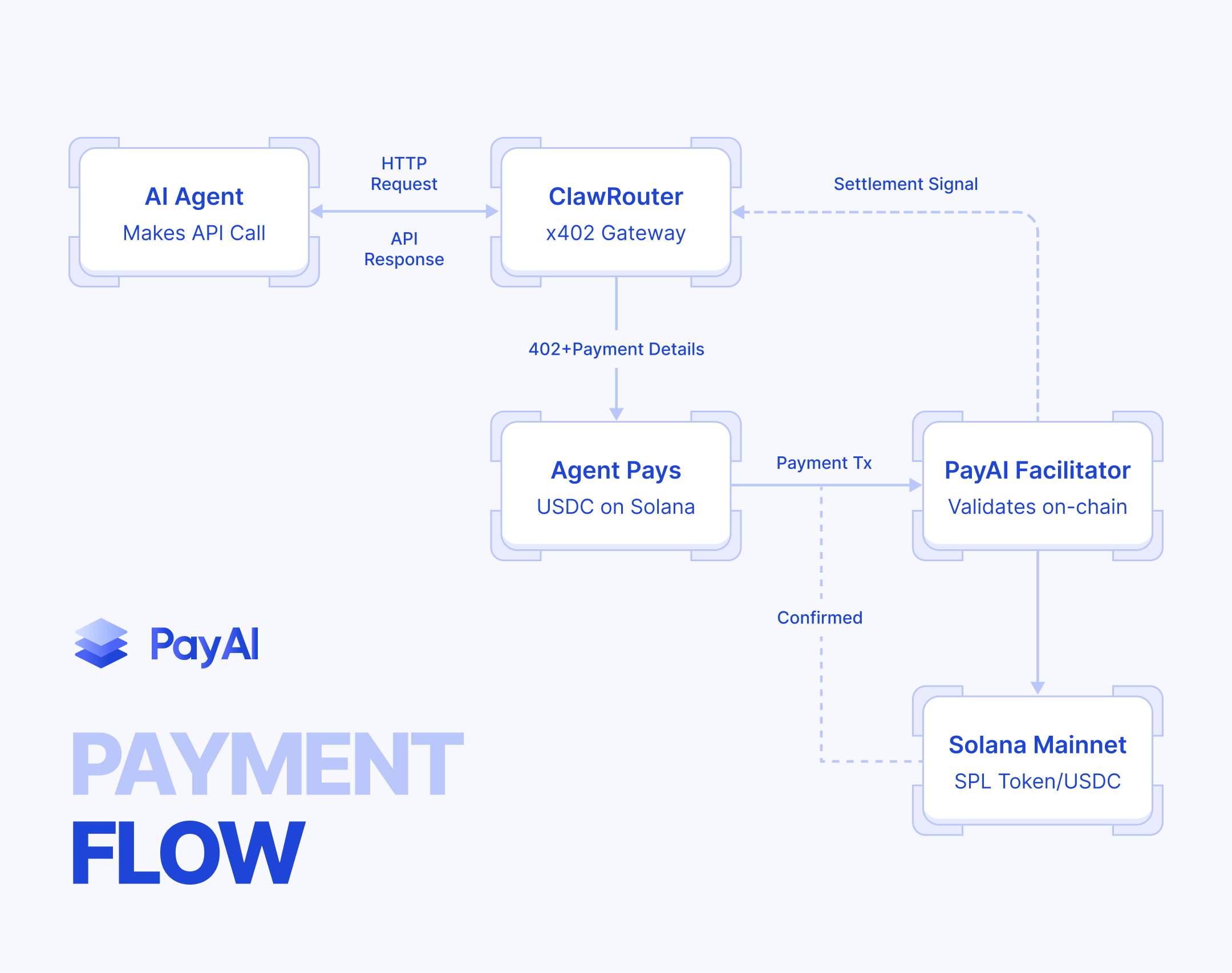
The integration required no changes to ClawRouter's product surface. Agents using the /api/v1/chat/completions endpoint — which accounts for 97% of all calls — interact identically whether or not they're on Solana. The chain is PayAI's concern, not the agent's.
For the technical breakdown of the integration, see Blockrun's engineering decision to use PayAI on Solana.
The results
sol.blockrun.ai went live on February 22, 2026. Here's what 63 days looked like:
Volume & transactions
| Metric | Value |
|---|---|
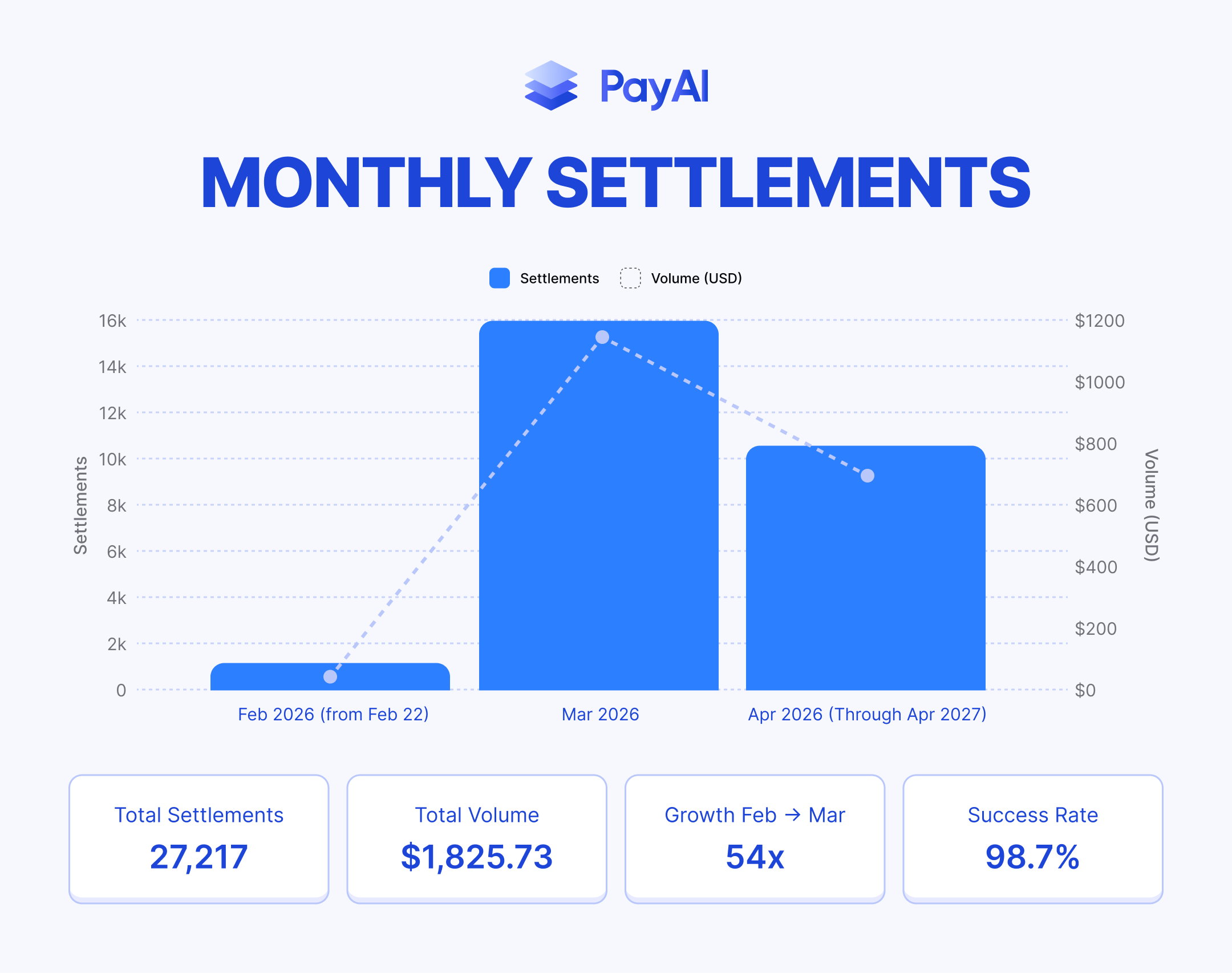
| Total settlement events | 27,217 |
| Successful settlements | 26,860 |
| Success rate | 98.7% |
| Total volume | $1,825.73 |
| Avg. transaction value | $0.067 |
| Unique paying agents | 160 |
Monthly growth
| Month | Settlements | Volume |
|---|---|---|
| Feb 2026 (from Feb 22) | 294 | $19.78 |
| Mar 2026 | 15,943 | $1,154.16 |
| Apr 2026 (through Apr 27) | 10,980 | $651.79 |
March was the inflection point — 54x more transactions than their first partial week of operation. April 3 became their single biggest day, with 1,130 successful settlements. Three days in March (the 7th, 8th, and 9th) each crossed 1,000 transactions.
Settlement performance on Solana
| Metric | Time |
|---|---|
| Average | 1,396 ms |
| Median | 1,296 ms |
| P95 | 2,263 ms |
Sub-1.4 seconds average on Solana mainnet. At $0.067 per transaction, this is micropayments infrastructure that actually moves. The x402 protocol's promise — pay per request, in real time — is only meaningful if settlement keeps pace with the API. These numbers say it does.
Endpoints being monetized
| Endpoint | Calls |
|---|---|
| /api/v1/chat/completions | 26,404 (97%) |
| /api/v1/messages | 622 |
| /api/v1/x/search | 71 |
| /api/v1/images/generations | 34 |
| /api/v1/x/trending, /x/users/* | ~60 |
What Blockrun's founder says
"We knew we needed Solana from day one. PayAI gave us clean Solana integration without having to build the facilitator layer ourselves. The numbers speak for themselves."
— [Vicky, Founder, Blockrun.ai]
What this means for the x402 ecosystem
ClawRouter is one product. The pattern it proves — agents paying per API call, on Solana, with sub-1.4s settlement and 98.7% success rates — is replicable for any team building monetized AI infrastructure.
PayAI's role in that pattern is the Solana-side facilitator: the piece that sits between the x402 protocol and the chain, handling the complexity that the protocol specification leaves to implementers. Solana is where we're built. It won't be the only chain.
Build on Solana with PayAI
If you're building x402-monetized endpoints and need a Solana facilitator, start with our documentation or reach out directly.
For teams evaluating facilitator options across chains, read how Blockrun approached the decision: Blockrun's engineering decision to use PayAI on Solana.
Or read what Blockrun published in their own words: BlockRun × PayAI: Solana x402 Payments Go Live.