

Gaming has always been the proving ground for new ways to pay. Arcades ran on quarters. MMOs sold subscriptions. Free-to-play rewired the entire industry around microtransactions and battle passes. Each shift didn't just change a price tag — it redefined what a "player" was and what they were allowed to buy.
The next shift is already underway, and it comes with a twist: the player making the payment might not be human.
AI agents are moving out of chat windows and into game worlds — as autonomous companions, dynamic NPCs, tireless grinders, matchmakers, and tournament organizers. To do anything useful, these agents need to pay for things on their own: compute, items, entries, data, services. Not with a saved card and a checkout page, but programmatically, per action, in real time.
That's the problem agentic payments solve. So can they be used in online gaming? Yes — and gaming might be one of the most natural fits there is.
What "agentic payments" actually means
Agentic payments are machine-to-machine (M2M) transactions: software paying software, with no human clicking "buy." The emerging standard that makes this work over the open web is the x402 protocol, which revives the long-dormant HTTP 402 Payment Required status code and turns it into a real payment handshake.
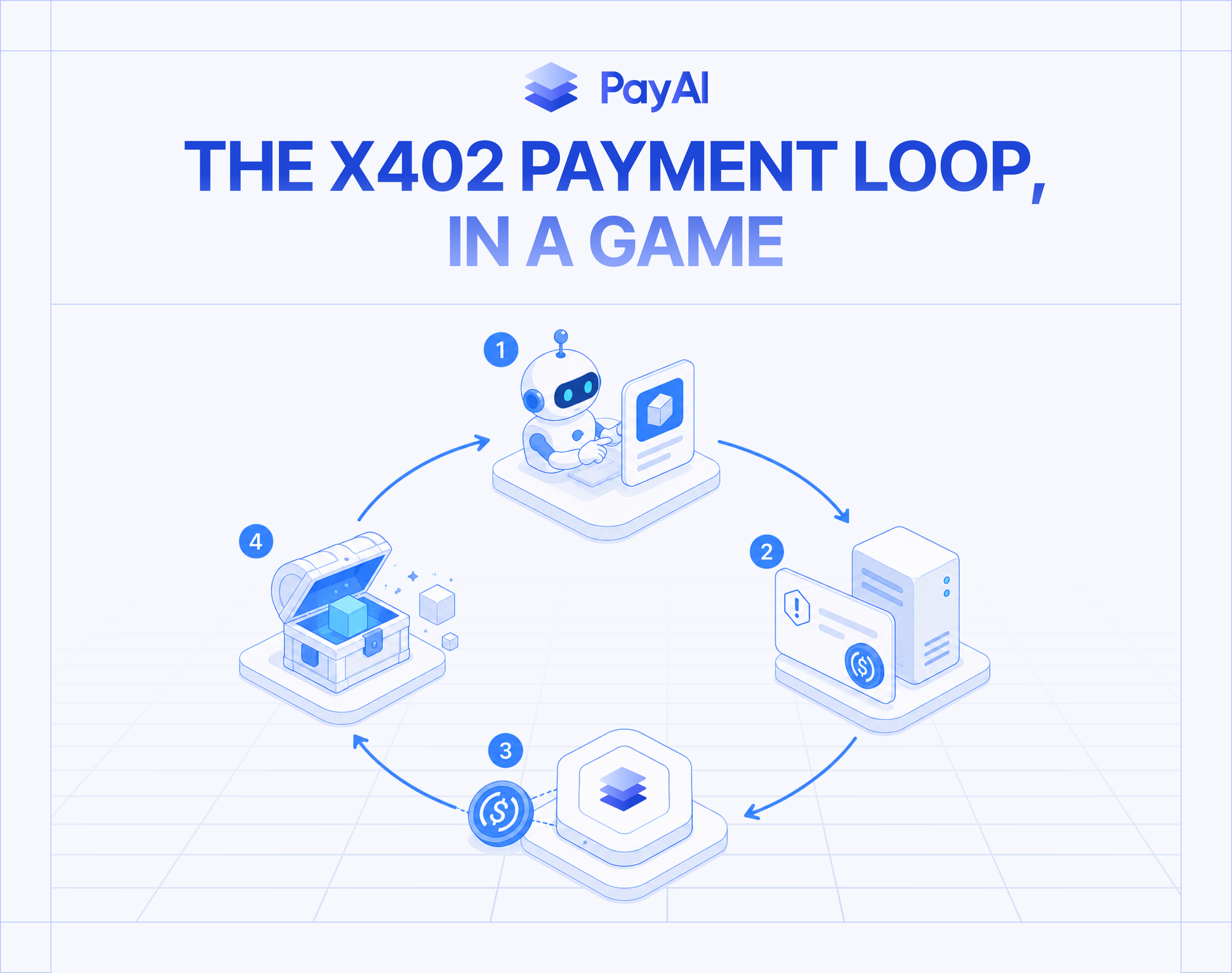
The flow is simple. A client — say, an in-game AI agent — requests a resource. The server responds with 402 Payment Required and a price. The agent pays instantly, in stablecoins like USDC, and the server delivers. No accounts, no card forms, no 30-day settlement. Just pay-per-request, baked directly into the request itself.
This is the model PayAI is built around. PayAI is a multi-network x402 facilitator that enables merchants to accept stablecoin payments via HTTP 402 — handling verification and settlement so developers don't have to wire up the payment plumbing themselves. If you want the protocol-level detail, the x402 payment protocol docs are the place to start.
Keep that flow in mind, because it maps onto gaming almost one-to-one.
Why gaming is a natural fit
Most industries would need to be dragged into agent-native payments. Gaming is already standing at the door:
- Games are already live, API-driven services. Matchmaking, inventory, telemetry, anti-cheat, AI inference — modern games are constant streams of server calls. Every call is a place a price could live.
- Games are already micro-priced and high-frequency. The industry normalized $0.99 and sub-dollar purchases years ago. Agentic payments push that further: fractions of a cent, thousands of times a session.
- Games already have non-human actors. Bots, NPCs, and AI companions already act inside game economies. Giving them wallets is a smaller leap than it sounds.
- Games need instant, final settlement. Nobody wants a chargeback dispute over a loot drop. Stablecoin settlement is instant and irreversible by design.
Five ways it actually plays out
1. AI agents and NPCs that pay for their own services.
An LLM-powered companion that needs fresh dialogue, a strategy, or a generated quest can call an external service and pay per request. A smarter NPC becomes a customer, not just code.
2. True microtransactions — finally.
Card rails make $0.02 purchases impossible; fees eat the transaction. x402 plus stablecoins make per-action pricing viable: pay per revive, per hint, per generated map, per AI-rendered skin.
3. Cloud gaming and pay-per-compute.
Streaming and AI-heavy games burn real compute. Agentic payments let sessions settle by the minute — or by the inference — instead of forcing flat subscriptions onto wildly different usage.
4. Autonomous tournaments and instant payouts.
Entry fees collected programmatically, prize pools escrowed, winners paid the moment a match resolves — no manual payout queue, no waiting on a processor.
5. Cross-game, interoperable economies.
Stablecoins are a neutral settlement layer. An agent can spend the same USDC across titles and storefronts, making cross-game marketplaces and asset trades far simpler to settle.
Why x402 and stablecoins fit the medium
The mechanics line up with what games need:
- Sub-cent fees make genuine micro-pricing possible.
- Instant USDC settlement matches the real-time pace of play.
- No chargebacks removes a whole class of fraud and dispute overhead.
- Programmable by default — payments live inside the request, so logic and money move together.
- Multi-chain reach across Solana, Base, Polygon, and Arbitrum means studios aren't locked to one ecosystem's users or fees.
Where PayAI fits
Plumbing all of this yourself — verifying payments, settling across chains, supporting both EVM and SVM signers — is a project on its own. The PayAI Facilitator handles that layer: a single multi-network endpoint that verifies and settles x402 payments so a studio can focus on the game, not the rails. For a team already shipping live-service infrastructure, it's the difference between "interesting idea" and "in production this sprint."
What's still hard
Agentic payments in gaming aren't a solved problem, and pretending otherwise helps no one:
- Wallet UX and key management for agents is still maturing — autonomy and security are in tension.
- Abuse and rate-limiting matter more when a bot can pay thousands of times a minute.
- Regulation around in-game value, wagering, and stablecoins varies by region and is still moving.
- Player trust has to be earned; "AI agents with wallets" needs to feel safe, not predatory.
None of these are reasons to wait. They're the design problems the first movers get to solve.
The bottom line
Gaming has reinvented payments at every stage of its history, and it tends to adopt new models before the rest of the economy catches up. Agentic payments are the next one — and with autonomous agents already inside game worlds, the demand is arriving ahead of the tooling.
The studios that wire up pay-per-request economies early won't just add a payment method. They'll unlock game designs that weren't economically possible before.
Want to see how it works end to end? Start with the x402 quickstart documentation, or watch a live payment flow in the x402 Echo Merchant demo.