

Gaming has always been the proving ground for new ways to pay. Arcades ran on quarters. MMOs sold subscriptions. Free-to-play rewired the entire industry around microtransactions and battle passes. Each shift didn't just change a price tag — it redefined what a "player" was and what they were allowed to buy.
The next shift is already underway, and it comes with a twist: the player making the payment might not be human.
AI agents can act inside game worlds as companions, NPCs or service clients. Some designs could let them buy compute, generated content or other resources under a developer-defined budget. That is a possible use case, not a requirement for every game agent.
That's the problem agentic payments solve. So can they be used in online gaming? Yes — and gaming might be one of the most natural fits there is.
What "agentic payments" actually means
Agentic payments let software initiate transactions within delegated spending authority, without a person clicking “buy” each time. One protocol for this over HTTP is the x402 protocol, which revives the long-dormant HTTP 402 Payment Required status code and turns it into a real payment handshake.
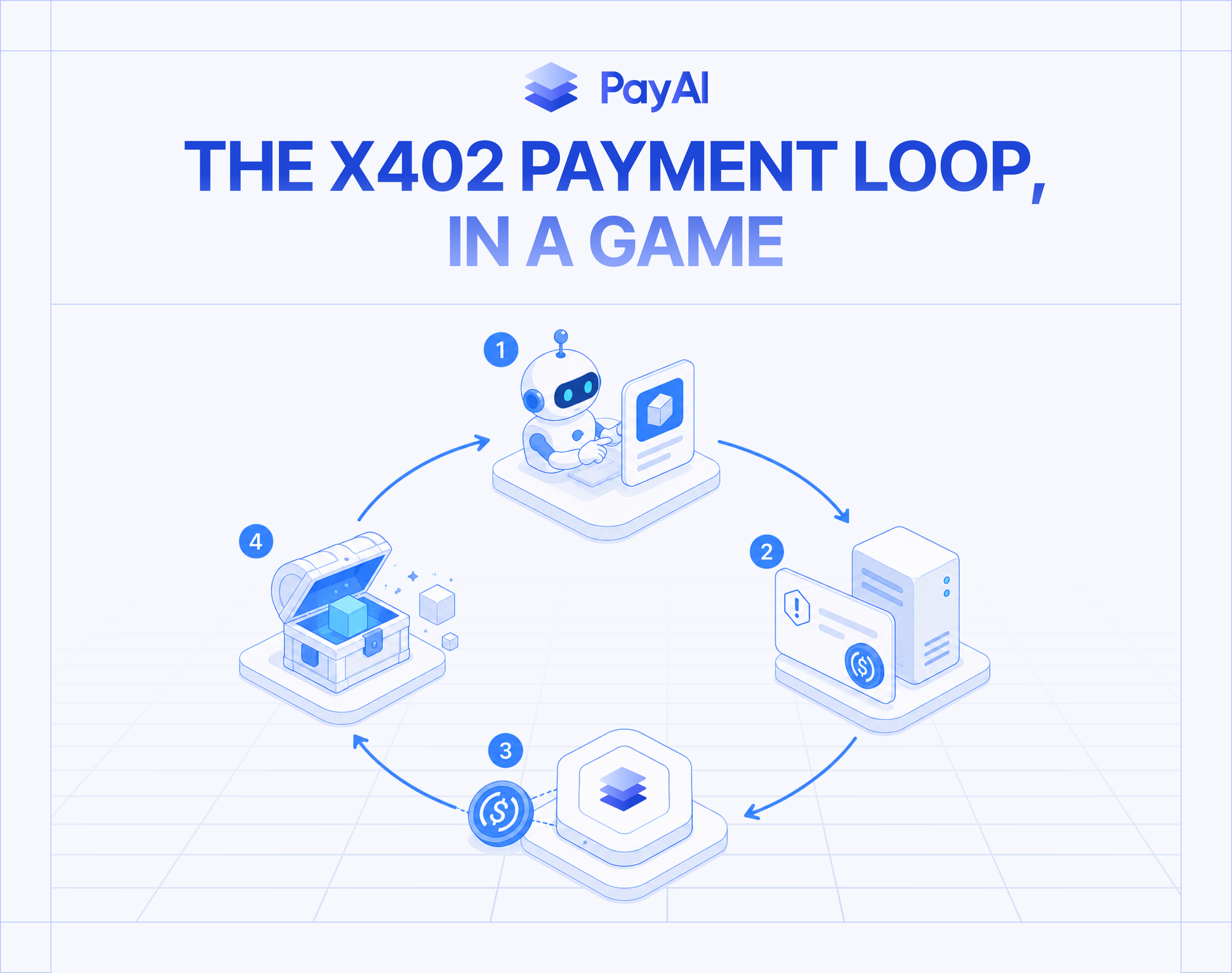
The flow is simple. A client — say, an in-game AI agent — requests a resource. The server responds with 402 Payment Required and payment requirements. In an exact-payment flow, the agent signs a supported payload and retries; the server verifies and settles before releasing the paid response. Verification alone does not move funds. Merchant credentials, game accounts and service authorization are separate requirements.
This is the model PayAI is built around. PayAI is a multi-network x402 facilitator that enables merchants to accept stablecoin payments via HTTP 402 — handling verification and settlement so developers don't have to wire up the payment plumbing themselves. If you want the protocol-level detail, the x402 payment protocol docs are the place to start.
That request flow can support paid game services, but it does not define game rules, inventory ownership or payout logic.
Why gaming is a natural fit
Most industries would need to be dragged into agent-native payments. Gaming is already standing at the door:
- Games are already live, API-driven services. Matchmaking, inventory, telemetry, anti-cheat, AI inference — modern games are constant streams of server calls. Every call is a place a price could live.
- Games are already micro-priced and high-frequency. Per-action pricing can be finer-grained still, provided total payment and resource costs leave a workable margin.
- Games already have non-human actors. Bots, NPCs and companions can call paid services, but wallet access needs explicit permissions and spending limits.
- Games need reliable delivery and payment handling. Confirmation is not instant finality. A settled on-chain transfer has no card-style chargeback, but refunds, service disputes and recovery still require application logic.
Five possible gaming applications
1. AI agents and NPCs that pay for their own services.
An LLM-powered companion that needs fresh dialogue, a strategy, or a generated quest can call an external service and pay per request. A smarter NPC becomes a customer, not just code.
2. Per-action purchases with tested economics.
A separate card charge for every $0.02 action can be uneconomic. Compare aggregated card billing and prepaid balances with stablecoin payment schemes. Include facilitator fees and resource costs before pricing a revive, hint, generated map or skin.
3. Cloud gaming and pay-per-compute.
Streaming and AI-heavy games consume compute. A service could meter usage by time or inference; how often funds settle depends on the payment scheme, not just the billing unit.
4. Programmatic tournament payments.
A tournament could automate entry collection and payouts. Prize escrow, trusted match results, eligibility, refunds and payout execution would need separate implementation and applicable legal review. The x402 facilitator does not provide a tournament or escrow system.
5. Cross-game, interoperable economies.
Services that accept the same supported USDC asset and network could share a payment rail. That does not make game items portable, bridge funds between chains or establish a cross-game marketplace.
Why x402 and stablecoins fit the medium
The useful properties come with implementation choices:
- Total payment costs determine whether small purchases are viable; a low network fee is not the full cost.
- Programmatic settlement can fit the request flow, but latency and finality depend on the network and scheme.
- Different dispute handling means designing refunds and recovery; removing card chargebacks does not eliminate fraud or delivery disputes.
- Programmable by default — payment requirements travel with the HTTP request flow, while the application still enforces game rules and spending authority.
- Multi-chain reach gives studios choices, but clients and servers must agree on supported versions, schemes, networks and assets.
Where PayAI fits
Plumbing all of this yourself — verifying payments, settling across chains, supporting both EVM and SVM signers — is a project on its own. The PayAI Facilitator handles verification and settlement for supported combinations. The studio still owns account permissions, delivery, abuse controls and failure recovery. Test the integration before production; there is no universal one-sprint deployment guarantee.
What's still hard
Agentic payments in gaming aren't a solved problem, and pretending otherwise helps no one:
- Wallet UX and key management for agents is still maturing — autonomy and security are in tension.
- Abuse and rate-limiting matter more when a bot can pay thousands of times a minute.
- Regulation around in-game value, wagering, and stablecoins varies by region and is still moving.
- Player trust has to be earned; "AI agents with wallets" needs to feel safe, not predatory.
Treat these as requirements to resolve in a test environment before exposing real players or funds.
The bottom line
Gaming has reinvented payments at every stage of its history, and it tends to adopt new models before the rest of the economy catches up. Agentic payments are the next one — and with autonomous agents already inside game worlds, the demand is arriving ahead of the tooling.
Pay-per-request payments are worth testing where they improve a specific game or service. Measure payment overhead, player experience and operating costs before expanding the design.
Want to see how it works end to end? Start with the x402 quickstart documentation, or watch a live payment flow in the x402 Echo Merchant demo.
Integration references: Merchant authentication requirements · Exact-payment verification and settlement flow