

The giants of traditional finance are no longer debating whether stablecoins are the future of money movement — they're fighting over who issues them. Here's why that battle is a tailwind for agentic payments.
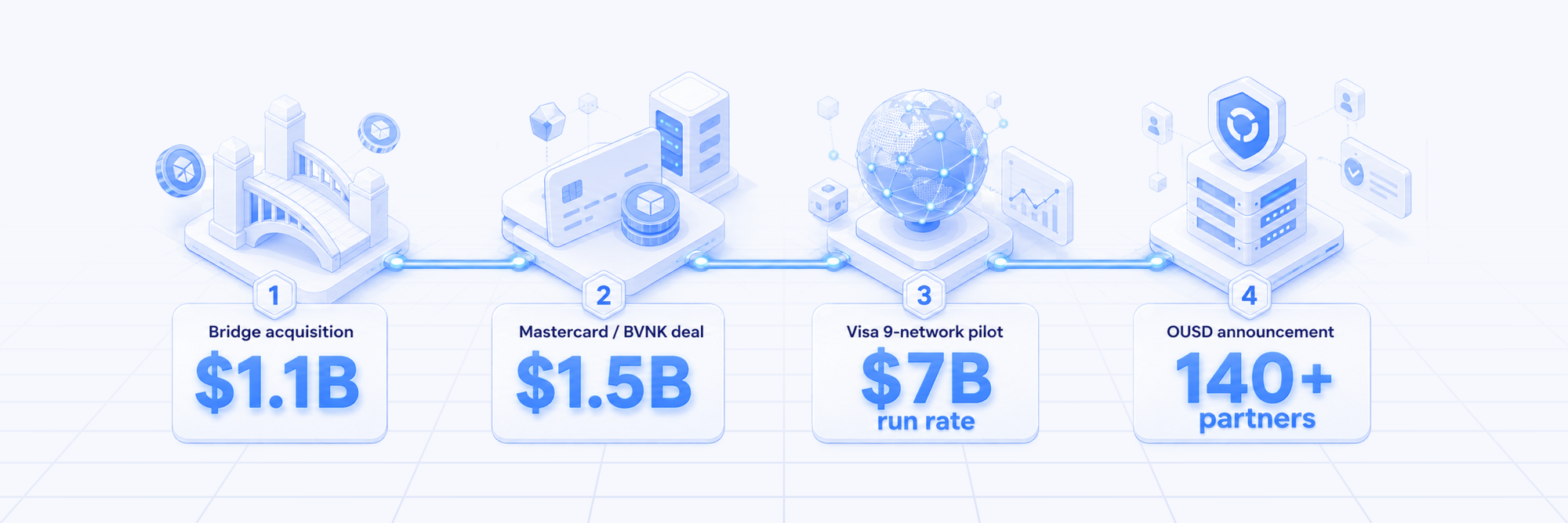
On June 30, 2026, something happened that would have sounded like satire three years ago: Visa, Mastercard, Stripe, American Express, BlackRock, Google, Coinbase, and more than 140 other companies announced they're backing a brand-new stablecoin — Open USD (OUSD) — through an independent consortium called Open Standard.
Read that partner list again. The two largest card networks on Earth. The world's largest asset manager. The internet's default payment processor. All aligned behind a shared, dollar-pegged token with zero mint and redeem fees, designed to hand reserve yield back to the businesses that use it.
For those of us building agentic payments infrastructure on the x402 protocol, this isn't a competitive threat. It's the loudest validation signal the space has ever received. Let's unpack what actually happened — and what it means for the machine economy.
What actually happened
Open USD isn't just another stablecoin launch. It's an attack on the business model of stablecoins as we've known them.
Today, when you hold USDC or USDT, the issuer keeps the interest earned on the reserves backing your tokens. That yield is the entire reason Circle and Tether are two of the most profitable companies per employee in finance. OUSD flips that: zero fees to mint and redeem, no volume caps, and nearly all reserve earnings shared back with consortium partners.
The market understood immediately. Circle's stock dropped roughly 15% the day of the announcement.
And OUSD isn't happening in a vacuum. Look at the moves stacking up in 2026 alone:
- Mastercard agreed to acquire stablecoin infrastructure provider BVNK for $1.5 billion in March, per its own SEC filings.
- Stripe already owns Bridge, the $1.1B stablecoin acquisition whose co-founder, Zach Abrams, now leads Open Standard.
- Visa has expanded its stablecoin settlement pilot to nine blockchain networks, moving stablecoins across VisaNet at an annualized run rate of roughly $7 billion as of March 2026.
- BlackRock — the world's largest asset manager — put its name on a stablecoin consortium next to Western Union, BNY, and Standard Chartered.
This is not experimentation anymore. This is incumbents racing to own the settlement layer of the internet.
Why now? Because the buyers are changing.
Here's the part most coverage buries: the incumbents aren't doing this for human shoppers. Humans are fine with cards. Cards were built for humans.
Visa's own Chief Product & Strategy Officer framed it plainly at this year's Visa Payments Forum: AI is transforming the front end of commerce, while stablecoins are reshaping the back end. That's the card network — the company with the most to lose from a new payment paradigm — describing the exact thesis behind x402 and pay-per-request payments.
AI agents don't have credit scores. They don't fill out checkout forms. They don't want a monthly subscription to an API they'll call four times. What they need is programmable, instant, sub-cent-fee settlement that speaks the native language of the web: HTTP. Stablecoins are the asset. x402 is the handshake. The TradFi giants just told the world they agree on the asset half of that equation.
What OUSD means for x402 — the protocol layer
Here's the elegant thing about x402: it doesn't care which stablecoin wins.
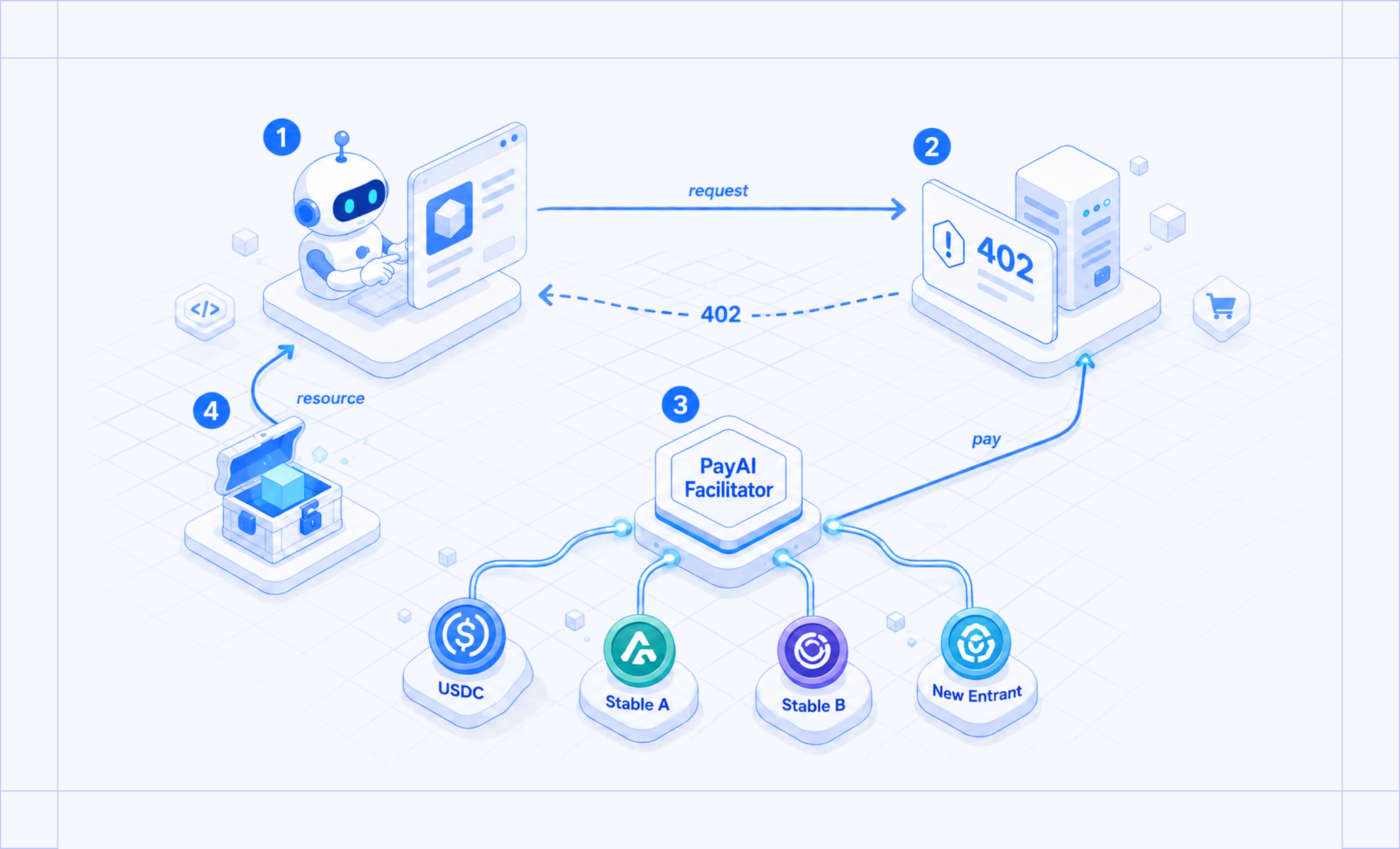
When a server responds with HTTP 402, it names its price, its accepted assets, and its settlement details. USDC today. OUSD tomorrow. Whatever comes next. The protocol is asset-agnostic and chain-agnostic by design — which means every new credible stablecoin entering the market expands what x402 can settle, rather than fragmenting it.
More issuers competing on fees is also structurally great for machine-to-machine payments. OUSD's zero mint/redeem fee model exists because 140 companies concluded that money movement itself shouldn't be a toll booth. That's the micropayment thesis — the same economics that make a $0.001 API call viable — arriving from the top down instead of the bottom up.
You can watch that handshake work right now on our live x402 Echo Merchant demo: request, 402, pay, response. No account. No card. No human.
The catch: more stablecoins = more fragmentation for merchants
Now the honest part. A world with USDC, USDT, OUSD, USDG, and bank deposit tokens — spread across Base, Solana, Polygon, Arbitrum, Plasma, Tempo, Stellar, and whatever launches next quarter — is a better world for agents and a messier one for merchants.
If you're a developer monetizing an API, you don't want to think about which stablecoin an agent holds or which chain it lives on. You want to get paid.
That's exactly the problem a multi-network facilitator exists to solve. The PayAI Facilitator sits between your endpoint and the settlement layer: it verifies payments, settles on-chain across networks, and hands you a clean confirmation — regardless of where the money came from. As the stablecoin race adds more assets and more chains, the value of not caring about assets and chains compounds.
The incumbents are competing to issue the money. Facilitators make sure sellers never have to pick a side.
What builders should do this week
- Stop waiting for a winner. The stablecoin race won't produce one — it'll produce several regulated, liquid, near-zero-fee dollar tokens. Build asset-agnostic from day one.
- Put a price on your endpoints. If Visa believes agents are the next buyers, your API should be sellable to them. Adding x402 to an existing endpoint takes minutes with the quickstart.
- Settle multi-network. Don't hardcode one chain in 2026. The OUSD launch list alone spans multiple networks at genesis.
The open-source tooling to do all three is on our GitHub — SDKs, examples, and the facilitator integrations, free to fork.
The suits just bought into the machine economy. The rails were already here.