

Updated September 14, 2026 UTC. Large payment companies are backing shared stablecoin infrastructure. That could benefit agentic payments, but an issuer announcement is not an x402 integration. This update distinguishes announced economics, product access and what a PayAI merchant can actually accept.
On June 30, 2026, Open Standard announced Open USD with more than 140 participating businesses overall, including Visa, Mastercard, Stripe, American Express, BlackRock, Google and Coinbase. Open Standard is described as an independent company with partner governance.
The announcement proposed no minting or redemption fees and reserve earnings for partners after an operating-management fee. Those are issuer economics, not a promise of zero network, facilitator or application costs.
For builders using the x402 protocol, the opportunity is more infrastructure and potentially more payment options. The work is still to establish compatibility, costs and real demand.
What actually happened
The June announcement said Open USD would go live later in 2026. Visa’s July 16 Stablecoin Platform release subsequently described Open USD minting, redemption and wallet functions in a beta for select clients. These releases do not establish general access for every merchant, or OUSD support in PayAI.
The proposed revenue-sharing model directs reserve economics to participating businesses, less management costs; it is not a blanket yield entitlement for every token holder. Open Standard’s site describes its governance and participation model. Verify the applicable terms, issuer, token contract and access route before integrating.
The partner list is evidence of institutional interest. It does not measure active merchants, agent purchases or x402 payment volume. This review no longer uses an unverified stock-price move as evidence for the argument.
The wider timeline includes both completed acquisitions and payment pilots:
- Mastercard announced its BVNK agreement on March 17, 2026 for up to $1.8 billion, including $300 million in contingent payments. It announced completion on August 3. The earlier $1.5 billion figure did not describe the full potential consideration.
- Stripe completed its Bridge acquisition on February 4, 2025, not in 2026. The June Open USD announcement identifies Bridge co-founder Zach Abrams as Open Standard’s interim CEO.
- Visa’s April 29, 2026 release reported nine blockchains in its stablecoin settlement pilot and a $7 billion annualized run rate. That is Visa’s reported stablecoin-settlement measure, not $7 billion of x402 revenue or agent purchases.
- BlackRock, BNY, Standard Chartered and Western Union appear in the Open USD announcement’s participant list. Participation is separate from evidence of a deployed integration or current customer usage.
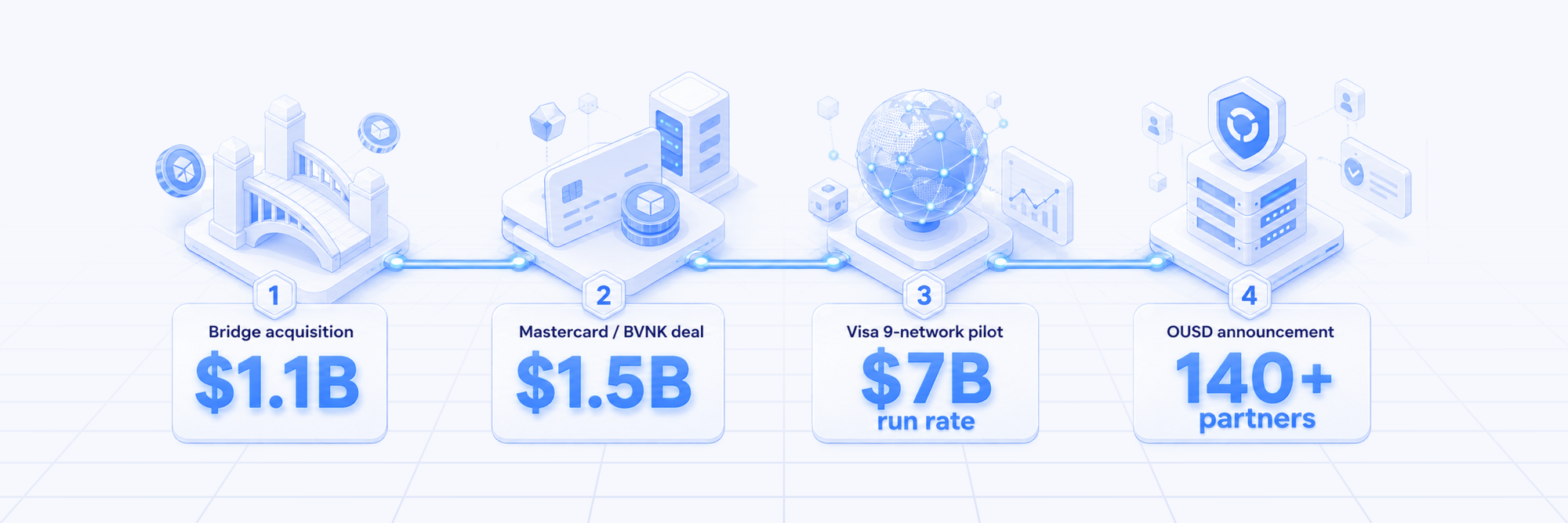
These are meaningful commitments to stablecoin infrastructure. The stage still matters: an acquisition, a signed-up partner, a beta and a production payment service establish different things.
Why it matters for agentic payments
These initiatives serve human and business payment needs as well as potential agent workflows. Stablecoins can be used for treasury, remittances and payouts; their adoption does not require every payment to come from an AI agent.
Visa’s Payments Forum announcement discusses AI, stablecoins and tokenization across commerce. It is not a declaration that x402 is the exclusive payment method for agents or that card-based automation is impossible.
For a paid API, compare x402 with subscriptions, prepaid credit and other automated billing. Evaluate the full cost and response latency, with explicit spending authority and recovery behavior. Programmability does not imply instant finality or a universal sub-cent total fee.
What OUSD means for x402 — the protocol layer
x402 can express payment requirements for different supported networks and assets. That extensibility does not make every stablecoin automatically compatible.
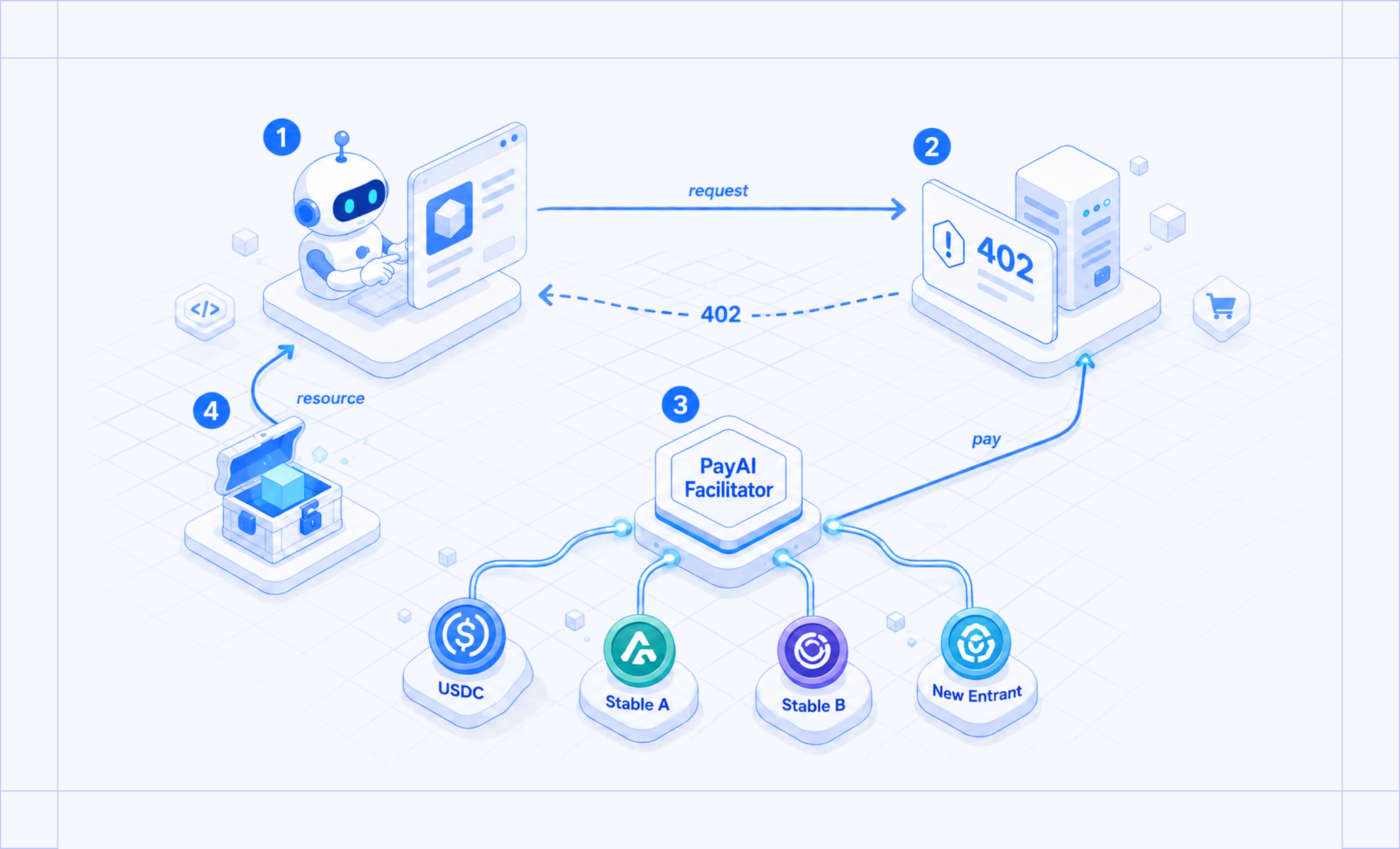
A resource server advertises accepted payment terms. A client must support the chosen version, scheme, network and asset, and have the appropriate funds and authority. A newly announced token still needs compatible implementations and server configuration; this article does not announce OUSD acceptance through PayAI.
Lower issuer costs could improve some payment economics, but minting/redemption fees are only one layer. Compare network costs, facilitator pricing, funding and conversion costs, and the service’s own price. A zero issuance fee is not a zero-cost API call.
The x402 Echo Merchant demo illustrates an HTTP payment flow. Use its documented environment and a compatible funded wallet. This source review did not execute a new payment; it does not imply every demo, client or merchant is exempt from accounts or credentials.
The catch: more stablecoins = more fragmentation for merchants
More tokens and networks mean more combinations to evaluate. A list of organizations backing a stablecoin is not a list of supported token contracts or production networks at a facilitator.
Merchants want reliable payment and delivery. They still need to choose accepted assets and networks, account for fees and decide how to handle failed or ambiguous responses.
The PayAI Facilitator verifies and settles supported payment flows. Verification alone does not transfer funds. Multi-network support does not bridge balances or convert an arbitrary incoming token into the merchant’s preferred asset. Check supported networks and merchant authentication for the actual integration.
Facilitation can simplify the supported payment path. It does not remove asset-selection, issuer, liquidity or operational decisions from the merchant.
What builders should do this week
- Choose an integration you can verify. Confirm the exact network, token and payment scheme; do not infer support from an issuer’s partner list.
- Test a useful paid endpoint. Start with the PayAI quickstart, then validate payment, delivery, retries and recovery before production. Integration time depends on the application.
- Add networks when customers need them. Measure demand and costs first; multi-network support is not a substitute for compatibility testing or a reason to promise every stablecoin.
The PayAI GitHub organization contains implementation work and examples. Check each repository’s documentation, license and supported release instead of assuming every asset or payment route is already implemented.
The institutional interest is real. Turning it into useful agent payments still takes a working integration and a service worth buying.