
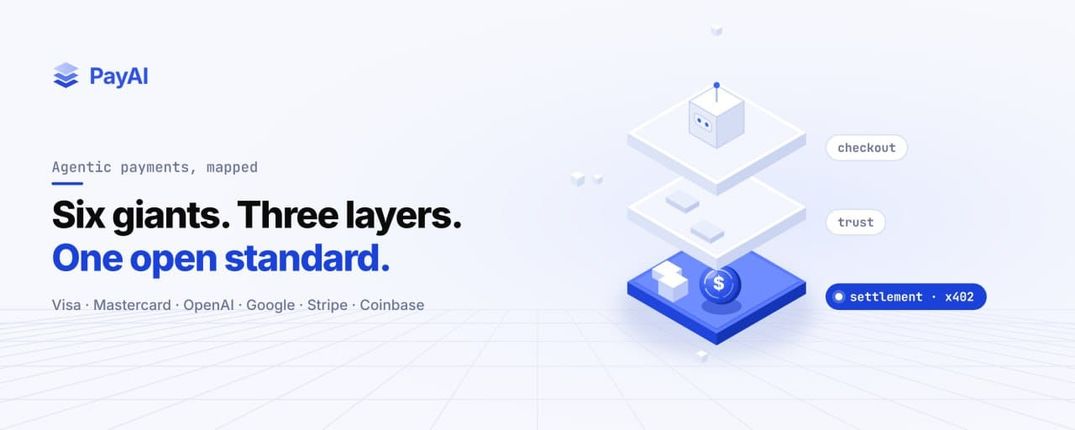
Since spring 2025, every major name in payments and AI has shipped an answer to the same question: how does software pay?
Visa has Intelligent Commerce. Mastercard has Agent Pay. OpenAI and Stripe wrote the Agentic Commerce Protocol. Google wrote AP2, then co-wrote the Universal Commerce Protocol with Shopify. Stripe and Tempo launched the Machine Payments Protocol. Coinbase built x402, which now lives at the Linux Foundation.
Read the headlines and it looks like a six-way war. It isn't. These companies are building different layers of the same stack. And on the layer where machines actually pay each other, most of them have landed on the same open standard.
This post maps who builds what, where they really compete, and where PayAI sits.
Quick answer
- Agentic payments split into three layers: trust, checkout and machine settlement.
- Trust: Visa, Mastercard and Google's AP2 prove an agent is legitimate and authorized to spend.
- Checkout: OpenAI and Stripe's ACP and Google and Shopify's UCP handle purchases a person delegates to an agent.
- Machine settlement: x402 and MPP handle per-request payments between agents, APIs and services.
- PayAI is an x402 facilitator in the settlement layer. It verifies and settles stablecoin payments onchain across Solana, Base and more networks, and it’s one of the most active contributors to the open x402 protocol.
The map: three layers, not one race
Agentic payments split into three layers, and each giant is strongest in one or two of them.
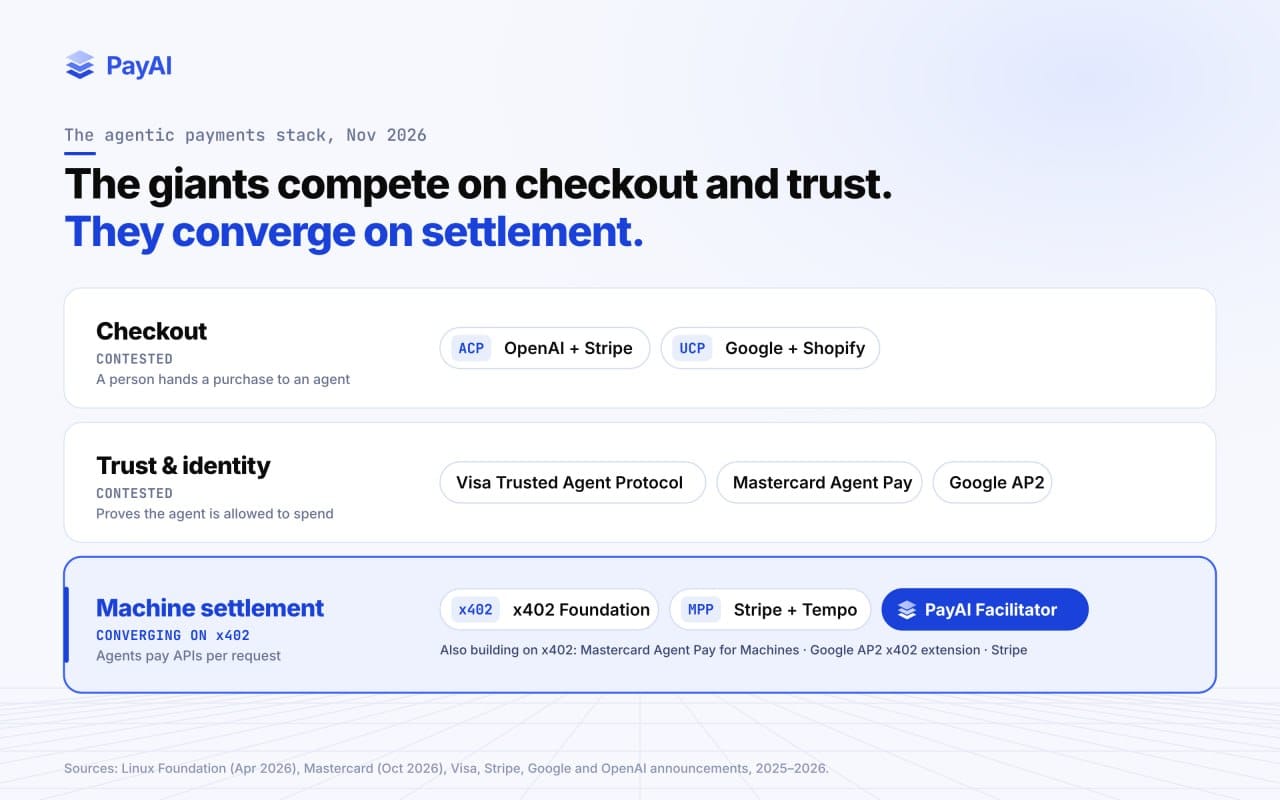
Checkout and trust are where the giants compete. Machine settlement is where they converge, and it's the layer PayAI works in.
The six players, one row each
Five of the six either sit on the x402 Foundation or ship something that works with x402. OpenAI is the exception, and it has spent 2026 retreating from payments toward discovery.
Player | What they shipped | Layer | Rails | Status, Nov 2026 |
|---|---|---|---|---|
Intelligent Commerce, Trusted Agent Protocol, Intelligent Commerce Connect, a card spec for MPP | Trust and card acceptance | Cards, Visa and non-Visa | Connect in pilot since Apr 2026; card spec and SDK for MPP since Mar 2026 | |
Agent Pay; Agent Pay for Machines, built on x402 | Trust, plus a control layer for machine payments | Cards, bank accounts, stablecoins | Agent Pay for Machines in Early Access since Oct 20, 2026 | |
Agentic Commerce Protocol (with Stripe), Instant Checkout in ChatGPT | Checkout, now mostly discovery | Cards through the merchant's processor | Instant Checkout moved to merchant apps in Mar 2026; ACP continues | |
AP2 (with an x402 extension), UCP (with Shopify) | Trust (signed mandates) and checkout | Rail-agnostic: cards, bank transfers, stablecoins via x402 | Open protocols with a 60+ partner coalition | |
ACP (with OpenAI), MPP (with Tempo), x402 support | Checkout and machine settlement | Stablecoins on Tempo; cards and BNPL via Shared Payment Tokens | MPP live since Mar 18, 2026 | |
x402, now governed by the Linux Foundation | Machine settlement | Stablecoins, mainly USDC, across many chains | Foundation launched Apr 2, 2026; protocol live since 2025 |
Visa is building the trust layer for card payments. Its Trusted Agent Protocol lets merchants tell a registered agent from a malicious bot, using agent-specific cryptographic signatures. Intelligent Commerce Connect is one integration that accepts agent payments arriving through TAP, MPP, ACP or UCP. Visa's MPP card spec says it was designed to complement standards like x402.
Mastercard made the loudest x402 move of the year. Agent Pay for Machines builds directly on x402. In the October pilot, a merchant returned HTTP 402, the agent answered with a signed voucher, and vouchers were batched and redeemed later instead of settling one by one. Coinbase supplied the wallets and Base handled onchain settlement.
OpenAI launched Instant Checkout in September 2025, then pulled back. In March 2026 it said Instant Checkout was moving to Apps, with ACP continuing as infrastructure for discovery and handoff to merchants. The lesson: owning the chat window is not the same as owning the payment.
Google plays both sides. AP2 carries signed mandates that prove what a user authorized, whatever rail settles it. Its A2A x402 extension, built with Coinbase, the Ethereum Foundation and MetaMask, is the stablecoin path inside AP2. UCP, co-developed with Shopify, covers the shopping journey.
Stripe has a seat at every table. It co-wrote ACP, co-wrote MPP with Tempo, and supports x402. MPP is the closest thing to a direct rival for x402, and Stripe runs both.
Coinbase started x402 and then gave it away. Since April 2, 2026 the protocol has been governed by the x402 Foundation under the Linux Foundation. Its premier members include AWS, American Express, Cloudflare, Coinbase, Google, Mastercard, Shopify, Solana Foundation, Stripe and Visa.
Where they actually compete
The real fights are over checkout and agent identity. At the settlement layer, the giants are mostly converging.
Fight one: who owns checkout. ACP and UCP both want to be the standard way an agent buys from a merchant on a person's behalf. OpenAI's retreat from Instant Checkout shows what's at stake. Merchants want to keep checkout, inventory and customer data, and they pushed back. Whoever wins this layer wins the customer relationship. That's a fight between AI platforms and commerce platforms, not between payment rails.
Fight two: whose credential the agent carries. Visa's Trusted Agent Protocol and Mastercard's Agent Pay both register agents and tie them to tokenized cards. Each network wants its token to be the one that says "this agent is allowed to spend." Even here they cooperate: both back Google's AP2, and both sit on the x402 Foundation.
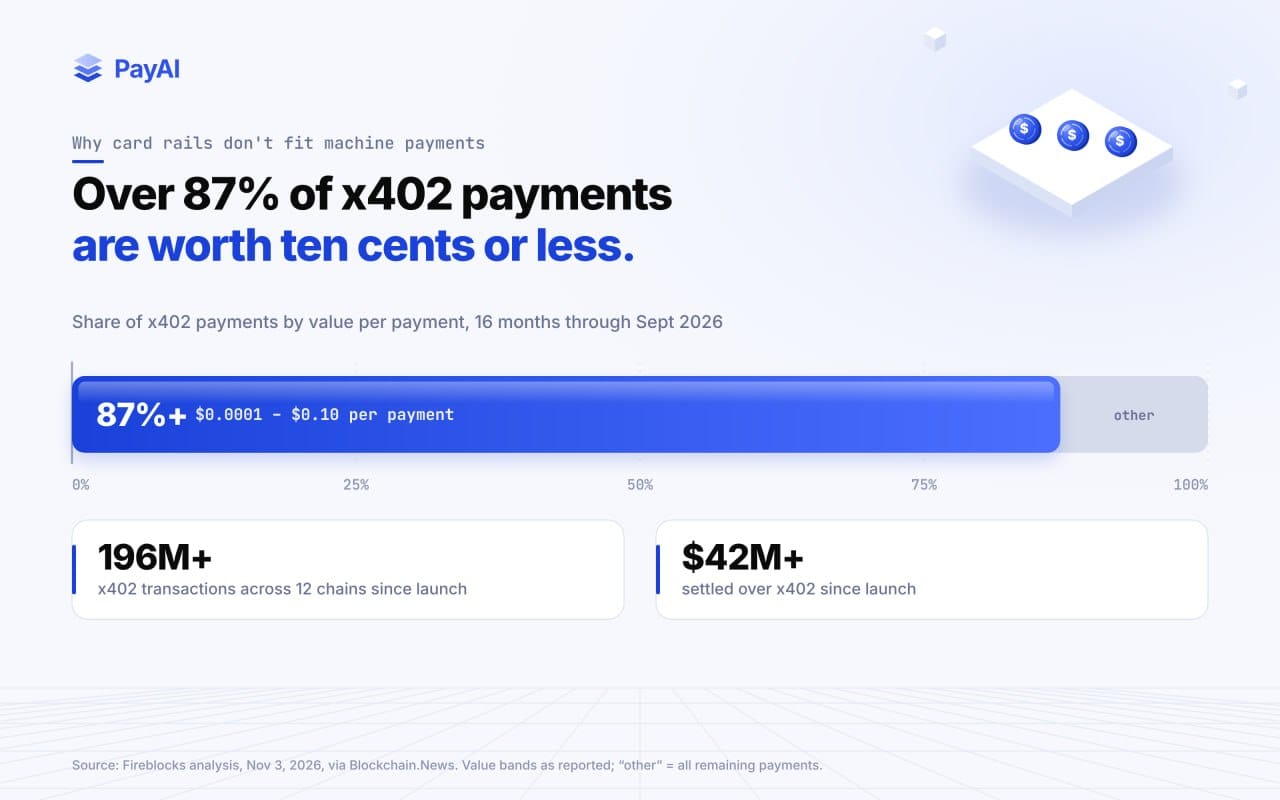
Not a fight: how machines settle. A huge share of agent payments are tiny. Fireblocks reported that more than 87% of x402 payments in the 16 months through September 2026 were between a hundredth of a cent and ten cents. A card transaction with a fixed fee can't price a one-cent API call. That's why the card networks are not trying to replace x402. They're building on top of it.
Mastercard's design proves the point. Agent Pay for Machines adds budgets, permissions and a network guarantee, then lets x402 carry the request and the payment signal. Vouchers get batched and redeemed later, because settling every call one by one doesn't work at these sizes.
The one live protocol contest is x402 vs MPP. MPP is Stripe and Tempo's take on the same problem, with cards via Shared Payment Tokens alongside stablecoins. We compared the two in x402 vs MPP: Agentic Payments Compared. Even that contest is soft: Stripe supports both, and Visa built its MPP card spec to sit alongside x402.
What isn't settled yet: volume. Fireblocks counts more than 196 million x402 transactions across 12 chains since launch, but October 2026 was 5.1 million transactions worth about $274,000. The rails are ahead of the traffic. That's normal for infrastructure, and it's why the standards being chosen now matter.
Where PayAI sits
PayAI works in the settlement layer. It's the neutral x402 facilitator between an agent that pays and a merchant that gets paid.
PayAI helps build x402, not just run it. x402 is an open protocol, governed by the x402 Foundation under the Linux Foundation and developed in public on GitHub. PayAI is one of its most active contributors, alongside engineers from Coinbase and the Solana Foundation. PayAI developer Notorious D.E.V. wrote x402’s original Solana support in 2025 and still ships protocol fixes, from Solana batch settlement to the paywall.
In an x402 payment, a service answers a request with HTTP 402 Payment Required. The agent signs a stablecoin payment and retries. A facilitator verifies that payment and settles it onchain, and the service releases the resource. The PayAI Facilitator does that verify-and-settle step, on Solana, Base, Polygon, Arbitrum, BNB Smart Chain and more.
That role matters more as the giants converge on x402, for three reasons.
- The standard is neutral, so settlement should be too. The x402 Foundation exists so that no single company controls the protocol. Merchants shouldn't have to pick a network giant's stack just to accept a pay-per-request payment. A multi-network facilitator lets them accept x402 on the chains their customers already use.
- Micropayments need smarter settlement. Mastercard batches vouchers. We shipped x402 Batch Settlement for the same reason: pay per call, settle once. When most payments are under ten cents, how you settle decides whether the business model works.
- More front doors means more traffic for the same back end. AP2's x402 extension, Mastercard's machine payments and Stripe's x402 support all route agents toward services that answer with 402. Each new entry point is more demand for the layer that verifies and settles.
What PayAI is not. PayAI is not a card network, a checkout protocol or a wallet. It doesn't compete with Visa for card acceptance or with ACP and UCP for retail checkout. When a person asks an agent to buy shoes with a card, PayAI isn't in that flow. When an agent pays an API a fraction of a cent for data, compute or content, that's our job.
What builders should do now
Pick the layer that matches what you sell, not the logo you trust most.
- Selling physical goods to consumers? Your fight is checkout. Keep your product data clean for ACP and UCP, and let your card processor handle Visa and Mastercard agent credentials.
- Selling APIs, data, compute or content per request? You're in the settlement layer. Return HTTP 402, price per call, and accept stablecoins. That's x402, and it works with the agents that Google, Mastercard and Stripe are routing your way.
- Don't bet on one chain. Agent traffic already spans Solana, Base and more networks. Use a facilitator that settles across them, so you don't have to rebuild when your buyers move.
The bottom line
The six biggest names in payments and AI aren't fighting one war. They're fighting over checkout and identity, and agreeing on settlement. When Visa, Mastercard, Google, Stripe and Coinbase all sit on the same foundation for the same open protocol, the question is no longer whether x402 wins the machine layer. It's who settles it, neutrally, across every chain agents use.
That’s the job PayAI was built for**, on a protocol we help build.**
Start accepting x402 payments: facilitator.payai.network · Read the quickstart