
In late 2025, a four-legged robot named Bits did something quietly historic: it paid to recharge itself. 🤖
No human tapped a card. No invoice changed hands. The robot noticed it was running low on power, found a charging service, and settled the bill in USDC — over x402, the payment standard built to let machines transact. It's the same rails PayAI facilitates. A real machine-to-machine transaction, start to finish, with nobody in the loop.
Humans have spent a decade teaching robots to walk, see, grip, and reason. Somewhere along the way, we forgot to give them a wallet.
That's the gap. And it's about to become the most important piece of infrastructure in robotics.
The robots aren't coming. They're already here.
Forget the sci-fi framing for a second and look at the numbers, because they're staggering.
There were roughly 4.66 million industrial robots in operation worldwide in 2024 — up 9% in a single year. Factories installed 542,000 new robots that year alone, the second-highest annual total ever recorded. Robot installations have more than doubled over the past decade, and they're not slowing down: the industry expects to blow past 700,000 annual installations by 2028.
And that's just the industrial arm of the story. Across the wider robotics world, machines are showing up everywhere:
- Logistics and transport robots were the single largest category of professional service robots in 2024 — about 102,900 units sold, up 14% — the autonomous movers shuttling goods through warehouses and fulfillment centers.
- Medical robots exploded 91% year-over-year, with rehabilitation robots up 106% and diagnostic/lab robots up an eye-watering 610%.
- For the first time ever, the electronics industry overtook automotive as the world's biggest buyer of industrial robots.
These aren't lab demos. They're line items on balance sheets, doing real work in real economies — and every one of them consumes resources to do it.
Which countries are actually winning the robot race?
If you want to know where the machine economy lands first, follow the density.
South Korea is the most automated country on Earth, with a jaw-dropping 1,220 robots per 10,000 manufacturing employees — roughly one robot for every eight human workers on the factory floor. Singapore comes second (818), Germany third (449), and Japan fourth (446). The United States sits eighth globally at 307.
On raw scale, China is in a league of its own: it installed 295,000 robots in 2024 — 54% of the entire global market — and its operational fleet has surged past 2 million units, the largest of any nation. A decade ago China ranked outside the top tier on density. It has since doubled its robot density in roughly four years.
The pattern is clear. Asia accounts for about 74% of new robot deployments, with Europe and the Americas filling in the rest. Wherever labor is scarce and manufacturing is dense, robots arrive first — and economic agency follows.
And then there are the humanoids 🦾
Industrial arms are one thing. The bigger shift is embodiment — general-purpose robots with legs, hands, and AI brains, designed to operate in human spaces.
The forecasts here are almost hard to believe:
- Goldman Sachs projects the humanoid market hitting $38 billion by 2035, with 1.4 million units shipped — a figure it revised upward sixfold in a single year as AI progress accelerated.
- Morgan Stanley goes further: more than 1 billion humanoids in use by 2050, a ~$5 trillion ecosystem, with 90% deployed in industrial and commercial roles.
Prices are already collapsing. Unitree's G1 humanoid launched at $16,000; its R1 dropped to under $6,000. Tesla is targeting $20,000–$30,000 for Optimus — half the price of a new car, for a machine that can theoretically work 20+ hours a day.
A billion autonomous machines. None of them able to open a bank account.
The problem nobody built for
Here's the thing the entire robotics industry is quietly bumping into: our financial system was built for humans, not machines.
Robots can't open bank accounts. They can't sign contracts, pass a KYC check, hold a credit card, or click through a checkout flow with a CAPTCHA at the end. Every payment rail we have — cards, ACH, online banking — assumes a person sitting on at least one end of the transaction.
But a delivery bot doesn't have a person on board. A warehouse robot that needs to buy compute, or an autonomous vehicle that needs to pay a charging station, can't wait for a human to approve a $0.04 micropayment thousands of times a day. The latency and overhead of human-in-the-loop billing make it a non-starter at machine speed.
For robots to become true economic participants — to pay for the energy, data, compute, and services they consume — they need three things humans take for granted: an identity, a wallet, and a settlement layer that moves at the speed they operate.
That's not a robotics problem. That's a payments problem. And it has a solution.
Enter x402: payments built for machines
x402 takes a status code that's been dormant in the web's plumbing since the 1990s — HTTP 402, "Payment Required" — and finally puts it to work.
The mechanics are elegantly simple. A machine requests a resource. The server responds with a 402 and a price. The machine pays — in stablecoins, programmatically, in milliseconds — and the resource is released. No accounts, no subscriptions, no human approval screen. Just pay-per-request payments that any machine capable of making an HTTP call can use.
This is exactly the shape a robot needs:
- Micropayments at scale — fractions of a cent, settled thousands of times per second, for granular services like a single API call or a few minutes of charging.
- Stablecoin settlement — a robot needs to know the $5 in its wallet today buys the same kilowatt-hour tomorrow. Stable value isn't a nice-to-have for machines; it's a requirement.
- No human in the loop — the whole point of autonomy is that the machine acts within set spending policies on its own.
x402 doesn't decide when a machine should pay — that's the job of higher-level logic like the Machine Payments Protocol (MPP), which governs how machines actually execute payments. x402 defines the moment payment is required and makes settling it trivial. For an embodied agent making continuous economic decisions in the physical world, that's the missing primitive.
This isn't theoretical — it's already running
Remember Bits, the robot from the top of this post? 🐕
That demo came out of OpenMind's work with Circle, integrating USDC with an x402 payment module so robots can autonomously buy energy, services, and data in the physical world. OpenMind's founder, a Stanford professor, describes it as building the connective tissue robotics has been missing — letting machines coordinate economically across different manufacturers and platforms.
The use cases practically write themselves once the rail exists:
- An autonomous vehicle pays its own charging station, tolls, and maintenance.
- A warehouse robot detects low stock, sources a vendor, and completes the purchase in stablecoins — logging an immutable record as it goes.
- A drone settles airspace-priority fees with a municipal traffic system.
- A fleet of delivery bots each holds its own wallet, earning revenue from completed jobs and spending it on the resources to do the next one.
Major players see it too. Mastercard has launched "Agent Pay for Machines." Circle is wiring USDC directly into x402. McKinsey projects up to $1 trillion in agentic commerce in the US alone by 2030, with global estimates running to several trillion. The machine economy isn't a forecast anymore — it's an infrastructure build-out happening right now.
Want to watch the mechanic settle for yourself? You can hit a live x402 merchant demo and see a 402 resolve the same way Bits did.
Where PayAI fits
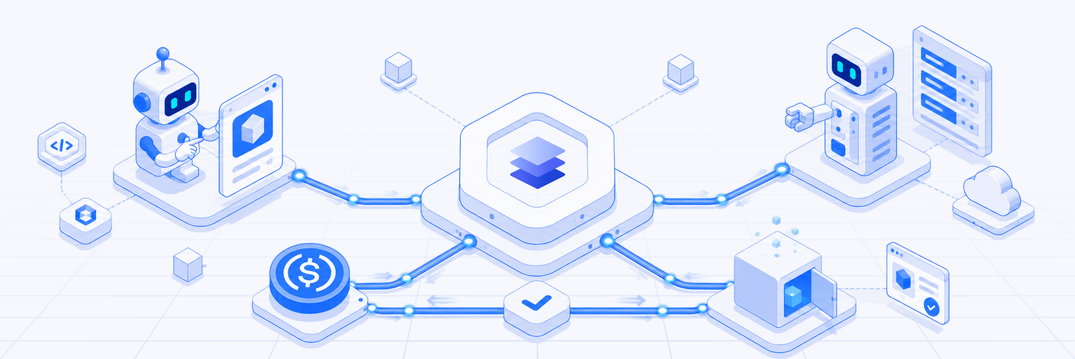
Every one of those robot payments has to settle somewhere. That's the facilitator layer — and it's exactly what PayAI does.
PayAI is a multi-network x402 facilitator that enables merchants to accept stablecoin payments via HTTP 402. Spanning Solana, Base, Arbitrum, and Polygon, the PayAI Facilitator handles the verification and settlement that turns a 402 response into a finalized payment — whether the buyer is a deep-research AI agent, a SaaS backend, or a robot dog topping up its battery.
As robots transition from tools into economic actors, they need a neutral, multi-chain rail that doesn't care whether the wallet belongs to a human, a software agent, or a humanoid. PayAI is building that rail for the x402 ecosystem — the settlement layer the machine economy runs on.
So, are the robots taking over?
Not in the way the headlines want you to fear.
A robot that can pay isn't a step toward some runaway singularity — it's a customer. It's a machine that consumes electricity, compute, and services, and finally has a way to settle the bill for what it uses. Giving robots a wallet doesn't mean handing them the keys; it means giving them spending policies, verifiable identities, reputation, and hard limits. That's not chaos. That's control — the exact opposite of an economy where nobody knows who paid for what.
The robots are already here. They're already working. The only question left is how they pay — and that answer is being written in x402, one machine-to-machine transaction at a time.
The future of the machine economy isn't a robot uprising. It's a robot picking up the tab. 🤖💸
Want to build on it? The open-source repos are on GitHub.