

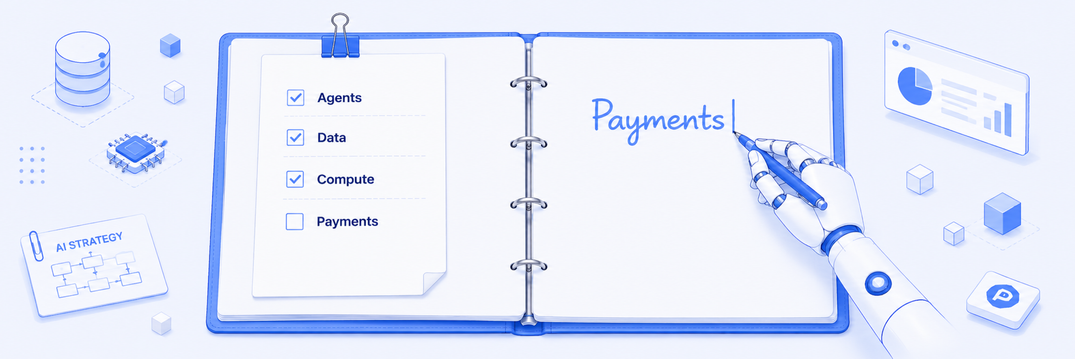
Enterprises spent 2025 deploying AI agents. In 2026, those agents are hitting a wall nobody budgeted for: they can't transact. Here's the gap — and why closing it is easier than you think.
Somewhere in your organization right now, an AI agent is doing real work. Pulling data. Drafting reports. Triaging tickets. Monitoring systems. According to Gartner, 80% of enterprise applications shipped or updated in Q1 2026 now embed at least one AI agent — up from 33% just two years ago. IBM's survey of 2,000 CEOs found 61% are actively adopting agents and preparing to scale.
The AI strategy conversation is over. Every company has one.
But ask a simpler question in your next leadership meeting and watch the room go quiet: when one of our agents needs to buy something — data, compute, an API call, a service — how does it pay? And when someone else's agent wants to buy from us — how do we charge it?
That's the AI payments strategy question. Almost nobody has an answer. The companies that get one first are going to open a revenue line their competitors don't know exists yet.
The blind spot: agents can think, but they can't transact
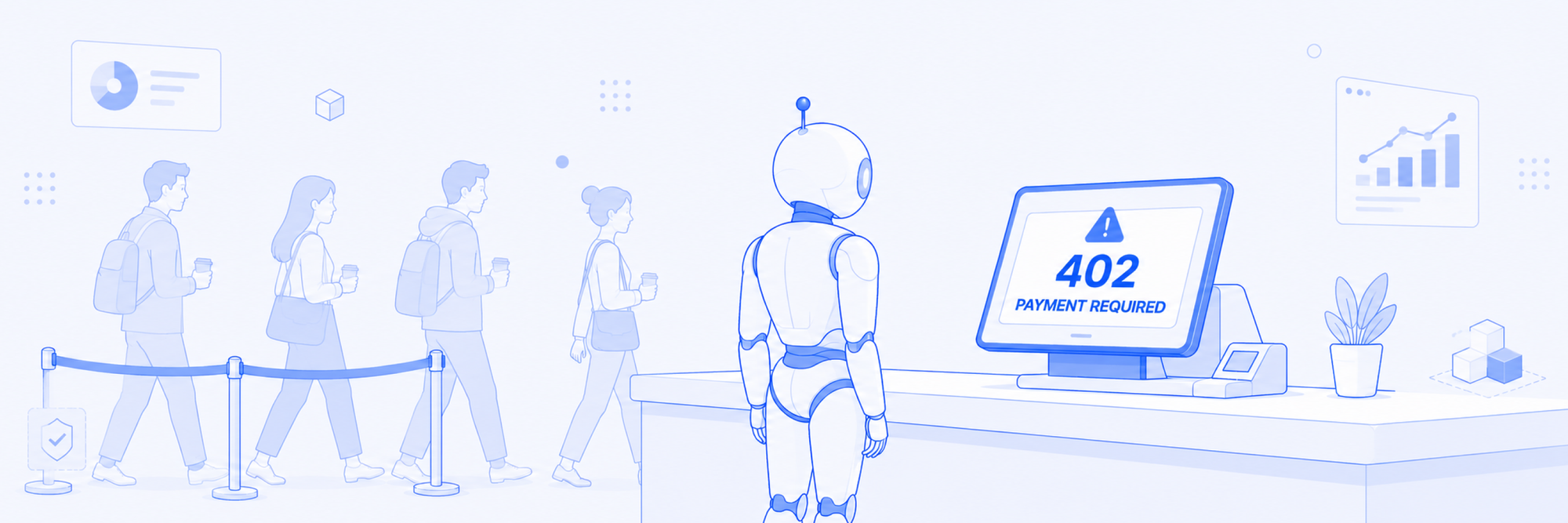
Here's the structural problem. The internet's entire money layer — checkout pages, credit card forms, subscription portals, invoicing, procurement approvals — was designed for one payer: a human, with a card, clicking "buy."
AI agents can't do any of that. They can't fill out a signup form, verify an email, pass a card check, or wait three days for a vendor to be onboarded through procurement. So today, every agent transaction gets bottlenecked through a human: an engineer pre-purchasing API credits, a manager approving a vendor, a corporate card sitting in a config file (please don't do this).
The result is a strange asymmetry. Enterprises report that agents are already automating 31% of workflows on average, and two-thirds of adopters report measurable productivity gains — yet the moment a workflow touches money, automation stops and a human steps back in. Your most scalable workers are locked out of the economy they're supposed to operate in.
That's not just a cost problem. It's a revenue problem — because the same wall that stops your agents from buying stops everyone else's agents from buying from you.
The fix already exists — and it's an open standard, not a startup's product
The answer is a protocol called x402, built on something that's been sitting in the fabric of the web since the 1990s: the HTTP status code 402 Payment Required.
The flow, in plain terms:
- An agent requests a resource — an API endpoint, a dataset, a document, a service.
- Instead of a login wall, the server responds: 402 — this costs $0.005.
- The agent pays instantly in stablecoins (digital dollars), the payment settles on-chain in seconds, and the resource is delivered in the same request cycle.
No account. No signup. No card. No invoice. No net-30. Payment becomes a native part of the web request itself — which means any machine that can make an HTTP request can now make (or accept) a payment.
This isn't theoretical. The x402 ecosystem already counts over 400,000 buyers transacting with more than 80,000 sellers — real economic activity between machines, happening today. PayAI operates as a multi-network x402 facilitator: the settlement layer that verifies and processes these payments across chains, so businesses on either side of the transaction never have to touch blockchain infrastructure themselves.
What this means for your business: two sides of a new market
The sell side: revenue from traffic you're currently serving for free
Every company with an API, a dataset, proprietary content, or a digital service has the same monetization playbook today: build a signup funnel, issue API keys, run a billing system, chase invoices. That playbook filters out an entire class of customer — the autonomous agent that wants one answer, right now, and would happily pay for it.
With an x402-enabled endpoint, that agent becomes a paying customer in milliseconds:
- Pay-per-request pricing — charge per call, per record, per document. No subscription commitment required from buyers who'd never subscribe anyway.
- Zero billing infrastructure — no invoicing, no dunning, no accounts receivable. Settlement is instant and final.
- A customer base that scales like software — you're not limited by how many humans discover your product. Any agent, anywhere, can find your endpoint and pay.
Wrapping an existing API with the PayAI Facilitator doesn't require re-architecting anything — it's a payment layer in front of what you've already built.
The buy side: procurement at machine speed
Flip it around. Your agents need inputs — market data, compute, enrichment services, third-party tools. Today each of those means a vendor relationship, a contract, a subscription your team half-uses.
Agent-native payments turn procurement into a runtime decision: your agent needs a data point, pays $0.01 for it, and moves on. With spend policies and budgets attached to the agent's wallet, finance keeps control while operations gain speed. You pay for exactly what's consumed — nothing pre-purchased, nothing wasted, everything on an auditable on-chain trail.
"Sounds like crypto." It's more boring than that — and that's the point.
If your compliance team just raised an eyebrow, here's what changed in the last twelve months:
- x402 is now governed by the Linux Foundation — the same neutral body behind Linux and Kubernetes — with Coinbase, Cloudflare, and Stripe as co-developers of the standard and founding participation spanning AWS, American Express, and Adyen. This is standards-body territory, not token speculation.
- The payment instrument is the stablecoin — a digital dollar — and the institutions entering that market are Visa, Mastercard, and BlackRock. We covered that shift in depth in our analysis of TradFi's stablecoin push; the short version is that the rails your CFO trusts are converging on the same settlement layer x402 runs on.
- The protocol keeps getting more enterprise-shaped — recent upgrades added session-based access (so agents don't re-pay for repeated use) and broader token support, closing the gap between crypto-native payments and familiar billing patterns.
The pattern here is one every technology leader has seen before: an open protocol, neutral governance, big-vendor backing, and a fast-growing ecosystem. That's what TCP/IP looked like. It's what Kubernetes looked like. Standards win quietly — and then all at once.
What an AI payments strategy actually looks like
You don't need a task force. You need three decisions:
- Inventory your machine-sellable assets. Which APIs, datasets, or services could earn per-request revenue from agent traffic? (Hint: start with the ones you already expose publicly for free.)
- Pick one endpoint and price it. A single x402-enabled endpoint is an afternoon of work, not a quarter of roadmap. The x402 quickstart documentation walks a developer through it end to end, and you can see a live x402 endpoint in action before writing a line of code.
- Give one internal agent a budget. Start small — a capped wallet, a narrow use case — and learn how machine-speed procurement changes your unit economics.
That's it. That's the whole pilot. Everything PayAI ships is open source — you can inspect the code on GitHub before your security review even asks.
The takeaway
Two years ago, "we're deploying AI agents" was a differentiator. Today it's table stakes — 80% of enterprise applications already have them. The next differentiator won't be having agents. It'll be having agents that participate in the economy: earning revenue from machine customers on one side, procuring at machine speed on the other.
Your competitors are all writing AI strategies. The blank page is the payments chapter.
Write it first. Start with the PayAI Facilitator — and turn your agents from a cost center into counterparties.